Low key

I just saw the last episode of the Marvel mini-series Loki tonight.

It was pretty cool. During the main confrontation in the show, there were continued accusations that a character was lying which left some details in doubt. It certainly gives plenty of grist for a discussion by Marvel fans. I don’t think he was completely dishonest, but that’ll become more obvious as Marvel continues develop its Phase 4.

Some of the mysteries from earlier episodes weren’t really solved. They were just left in the dustbin and replaced by newer mysteries in episode 6. However, you don’t need to spell out everything in block letters to carry a story. More discussions…?

It was fun to watch it with my sister. We knew the story well enough that we didn’t have to keep asking each other questions about the plot. We’d been spending the last couple of weeks saying “Where are you?” “Have you seen episode 5?” etc. We did well at not revealing spoilers to each other. Once we were done, I paired my phone with the TV so that we could watch a few YouTube commentaries.

Mobius (Owen Wilson) is my favorite characters in the series. Mobius’s low-key humor and self-satisfaction were entertaining. He was always smug and one step ahead.

My favorite YouTube commentator is Emergency Awesome. It was nice that his videos make it easy to avoid spoilers. He also had videos about the trailers for the upcoming episodes, but I avoided those also.

It wouldn’t be a Marvel movie without an obligatory fight scene. The “green” flashes that were used later in the fight seemed to be “Oh yeah! I have a gun” during a sword fight. Why did the characters wait so long to pull out their magic?

Emergency Awesome said that he would be making commentaries of the upcoming What If…? Marvel animated series. imdb.com said that it’s 11 episodes would start August 11.

Proms and Honeymoons

A movie reel

Nemo (Jared Leto) and Elise (Sarah Polley) have just been married. They are on the way to their honeymoon. Traffic backs up and they are stopped in front of a gasoline tank car. The have a wonderful life planned until the tanker detonates.

The explosion kills Elise and leaves Nemo with burn scars on his face. Later, he stands in front of some photos of Elise. As he pulls away, you see a silver urn as a shrine for her in his study. It was a very powerful moment that ties together different parts of the story.

This variant of Nemo is an example of one of the worst honeymoons one could imagine.

Years ago, I was driving home from Lafayette, Indiana to Fort Wayne on Indiana 25. I passed a boy on a moped also driving northeast. For some reason, I was watching him in my rear window.

Before I got too far, the boy turned left into the path of the car following me. The 13 year old boy, William, flew through the air and landed in the berm. I stopped and ran back to where the accident was. The boy was surrounded by a huge pool of blood. I didn’t want to believe he was dead. When the neighbors came out, one covered him with a sheet.

The police warned me to be careful because after seeing an accident like that, I would be more at risk of having my own accident. I could see their point: I could be distracted by the horror of it. I told the police was looking back because I thought it was a dangerous situation.

I didn’t realize it at first, but the driver and passenger of the car were to teenagers on their way to their prom. Such an awful prelude for what should have been a happy occasion.

The local newspaper published a photo taken after the accident. It had the two teenagers in the foreground and the father of the boy at the side of the frame. The photograph won an award.

Nemo and Elise’s honeymoon is one the versions of Nemo Nobody’s potential life. Mr. Nobody (2011) has different lives and most are full of pain. The lives that he reports are torn by crisis or disaster. A journalist (Daniel Mays) is puzzled by so many contradictory lives. His interview ends with the tape runs out.

Some of the events of life are horrible. Nemo’s honeymoon was cut short. The couple on their way to the prom were just planning to have a pleasant day. They all were faced with events turning in an unexpected direction.

Sometimes the tape is torn. When there’s no way to splice it back together, somehow the recording continues on. Sometimes it’s stronger and sometimes it’s weaker. Sometimes I have tears in my eyes and sometimes the tears in my tape are difficult. Even when I weep, I can realize there is still a ways to go.

Evil Mad Scientist Laboratories

Making the world a better place, one mad scientist at a time”

Evil Mad Scientist Laboratories develops many gizmos to let microcontrollers help or be artists, to magnify integrated circuits into a giant-sized DIP. They are really fun and worth looking over. They celebrate the maker community and its artistic talents.

One regular series on the blog is a monthly link dump. I’ve collected links to them on a page here.

The link dumps are always interesting and I hope you enjoy them as much as me.

External drive not found in Windows 10

I had a USB hub fail yesterday. The 3 external drives connected through the hub all disappeared from my system. I almost went into panic mode when I moved the external drives’ cables to a new USB hub and they were still were not working. However, I knew some keys to the process.

tl;dr: Restart has benefits that shut down/power up do not. Make one change at a time.

In Windows, the process of moving a drive from one USB port to another can be fraught. I have seen this problem in the past. I don’t know the exact reason Windows has this behavior.

When the hardware configuration changes, the naïve way of just unplugging the drive from one port and installing the cable in another doesn’t always work. When there is a problem, Device Manager might show the drive, but it could have a error flag. [See below for an easy way to launch Device Manager.]

Before pulling out the heavy guns on the problem, it might be that some simple steps are enough. Some actions unlikely to succeed:

  • Device manager’s driver uninstall.
  • External hardware manager software.
  • Registry changes
  • Disk management changes
  • For emphasis, making changes in Device Manager, even if you see errors there
  • Modifying BIOS settings

Some of these are suggested as the first line of defense, but I’ve found them unhelpful when USB drives are not recognized.

Device Manager can show your progress but you do not need to make any manual changes there. Especially true: Online help that says you should download and install special tools shouldn’t be trusted.

The two keys are

  • “Shut down/power up” is not always equivalent to “Restart” when it comes to USB devices.
  • Only make one change at a time.

Shut down/power up is safe but sometimes a restart is still needed.

The steps I took to successfully transfer the drive is as follows. It’s wiser to disconnect/reconnect while the power is off, but Restart is still needed after the power is turned on.

  1. Power down and unplug the drive from their old ports.
  2. Power up and Restart the system
  3. power down and put the drive’s cable into its new USB port
  4. power up and restart the system again.

At this point the device manager showed the external drives under the “Disk drive” category.

I was disappointed that, at first, Windows didn’t show the drives in Explorer and Device Manager didn’t show any errors. To fix this didn’t require any extra magic steps. I did an extra restart and shut down the system and turned off the power strip. I did not change anything in administrative tools nor device manager.

My point in this description is to explain that the error when I moved a drive from one USB port to another required some extra steps but no wizards hat.

A similar problem can happen when you move a USB hub from one USB port to another. That also requires multiple reboots. You just make each change one at time.

Fortunately, changing usually works without any trouble. Unfortunately, when you do have trouble, many online help sites give identical suggestions that don’t work. The pedestrian steps of change, restart, change, restart can be enough.


To launch Device manager in windows 10, just go to search in the taskbar and type Device Manager. You can also search in the configuration tool (the gear in the start menu). You don’t need to remember the name of the tool’s file any more.

The New Yorker Fiction July 2020

Two of the fiction in the July 2020 issues of The New Yorker are Jack and Della by Marilynne Robinson was published July 20, 2020 and The Lottery by Shirley Jackson, originally published June 26, 1948 was republished July 27, 2020.

The story Jack and Della is a melancholy story about a young man who had recently been released from prison. He meets the teacher Della, and has a positive relationship with her. The story ends very sadly and the desperation and loss really touched me.

In the article, Marilynne Robinson on Expanding the World of ‘Gilead‘ also published July 20 discusses Jack’s position in the “Gilead” series of novels. In the first novel in the series, “Gilead,” Jack is a respectful and mysterious man who comes home to his family and then disappoints his family by leaving abruptly. He isn’t able to explain himself to anyone other than the minister John Ames. The fiction Jack and Della is adapted from the fourth book in the series, “Jack.”

The Lottery is disturbing and has the distinction of generating the most mail for a fiction piece. (“The Lottery” Letters) To me it ends very unsatisfying. The events that conclude the story are taken so matter-of-fact by the community and the anticipation of a horror as if it were a natural fact of life.

[Many of these links may require a subscription to The New Yorker.]

Sirens of Titan

I wanted to explore my speaker’s directionality by making a jig that could hold the microphone in fixed relative positions to the headphone. My overarching goal was to be able to isolate the behavior of the microphone from the behavior of the headphone speaker.

This is what I came up with. The use of hard, rigid, flat surfaces is significant, but not in the way I anticipated.

Jig for holding desktop microphone inside frame and speaker in position.

The slotted food boxes make a rigid frame with holes to allow the microphone to be placed in different positions. The shipping box is marked with a pencil outline so that the headphones can be placed consistently. The edge of the box fits against the slotted structure. I only used the speaker on the side that faces the microphone. I didn’t use the perpendicular speaker nor the microphone on the headphones.

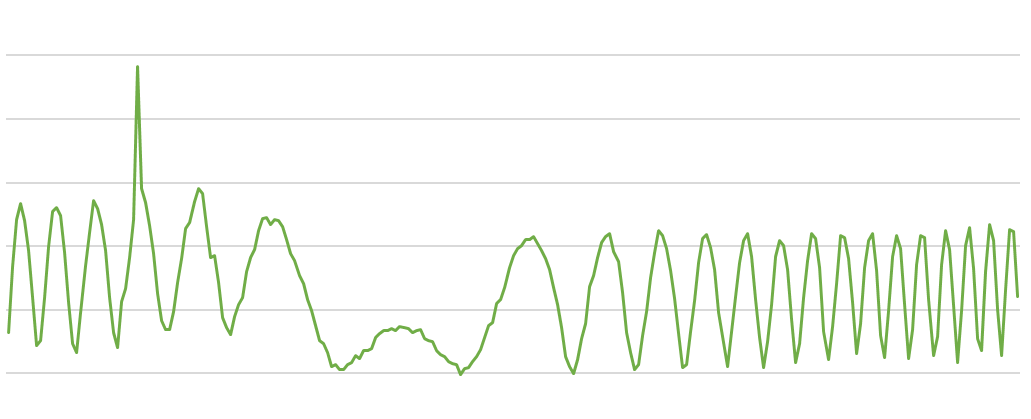
Again, I did a sweeping sine wave. When I analyzed the results, I found an interesting waveform around 120Hz. In the first graph, the frequency was sweeping from about 118.8 Hz to 121.2 Hz. At first I thought that what I saw was some kind of audio interference pattern. But that didn’t make sense because the graph shows large changes between slight frequency changes (and thus slight audio wavelength changes.)

This graph covers about 33.5 seconds of recording. By slowing down the rate of change of the frequency, there are more samples over the course of the transition and noise interferes less. (The spike to the left was due to noise from a car passing or me moving on my chair.)

Magnitude of the sound recorded as the audio frequency swept from 118.8 to 121.2 Hz.

I was trying different adjustments to the configuration to identify the parts that are responsible for the resonance. My first try was apply force to the front wall of the food containers. This had only a small effect on the behavior. My second adjustment was to place crayons on the box out of the line of sight between the speaker and microphone. The resonance was completely gone in that case.

The third adjust I tried making was to put some weight on the box, also out of the line-of-sight. I placed several CD discs on the box. The lower one had some CDs laying on the box and there is an obvious change. The graphs aren’t synchronized.

Top sweep with unmodified setup, bottom with CDs on the shipping box

What I understand now is that these effects are due to resonances within the box that the headphones are on or between the headphone’s strap and the box. Changing the forces on the box caused substantial changes.

Another way that I visualize the data is to break the signal into equal sized blocks of time and perform a Fourier transform of the block and plot them as an image. Pixels closer to the bottom edge of the graph represent lower frequency components of the signal.

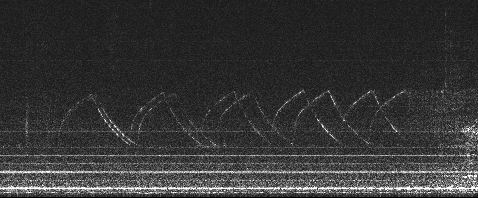
I found this strange shape in the first graph I created. I created graphs from other runs and none of them had anything like this.

Part of a chart showing Fourier transform of recording a siren passing

Then I remembered a fire truck siren that I heard a few blocks away when I was recording one of the results. It’s interesting to see the shape. It’s a repeating pattern of the tone rising rapidly, followed by the tone falling more slowly. I notice that that the same shape is repeated twice with difference delays which indicates there were two sound sources cycling at different speeds.

I had other things happen that I wasn’t looking for as well.

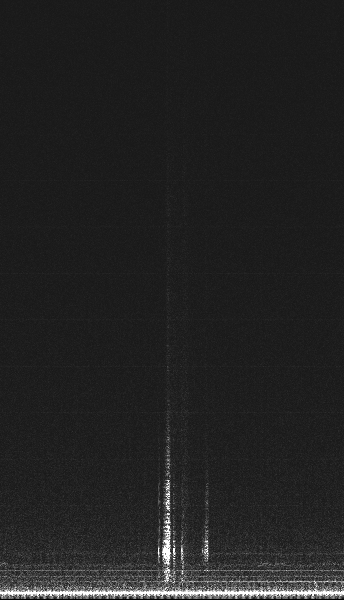
A “thump” from me moving the chair or coughing

I received a text while I was recording.

The tone for a text on my phone “Glass”

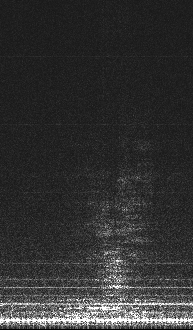
There were several smudges like this next one in the plots. They are due to cars passing. I was recording in the daytime so there was more traffic than at night.

Car passing

There is an unlimited list of sounds that I could analyze to see more interesting patterns.

I ended up finding another rabbit hole just by looking at one position of the microphone and haven’t explored how other positions differ. However, I may have seen enough to know that I haven’t found the key to need to isolate the speaker from the microphone. Without a more sophisticated setup, the environment is going to be a confounding effect. In addition, my jig only works with one microphone and different speakers can’t be positioned with an equivalent geometry.

Noise?

I’ve been doing new experiments analyzing the results of using the microphones without a pipe for resonance. I was expecting flatter results with less noise because of the removal of the resonator. What I found was a lot different.

There were two directions that my search took. One was to run the same geometric configuration with identical input signals or two that are only different in volume. The other direction was to use different speakers to help tease out what effects are by the frequency response of the microphone, the frequency response of the speakers and variation caused by echoes in my work area.

My audio source was a pure tone swept linearly between 40 Hz and 8000 Hz over a timespan of 4, 8 or 12 minutes. Because the sweep is linear, the right half of each graph covers about one octave while the left half shows about ten. That would indicate that I’m emphasizing only a small part of the sound spectrum. I started working with a linear sweep to show as many resonance peaks as I could. That led to that emphasis.

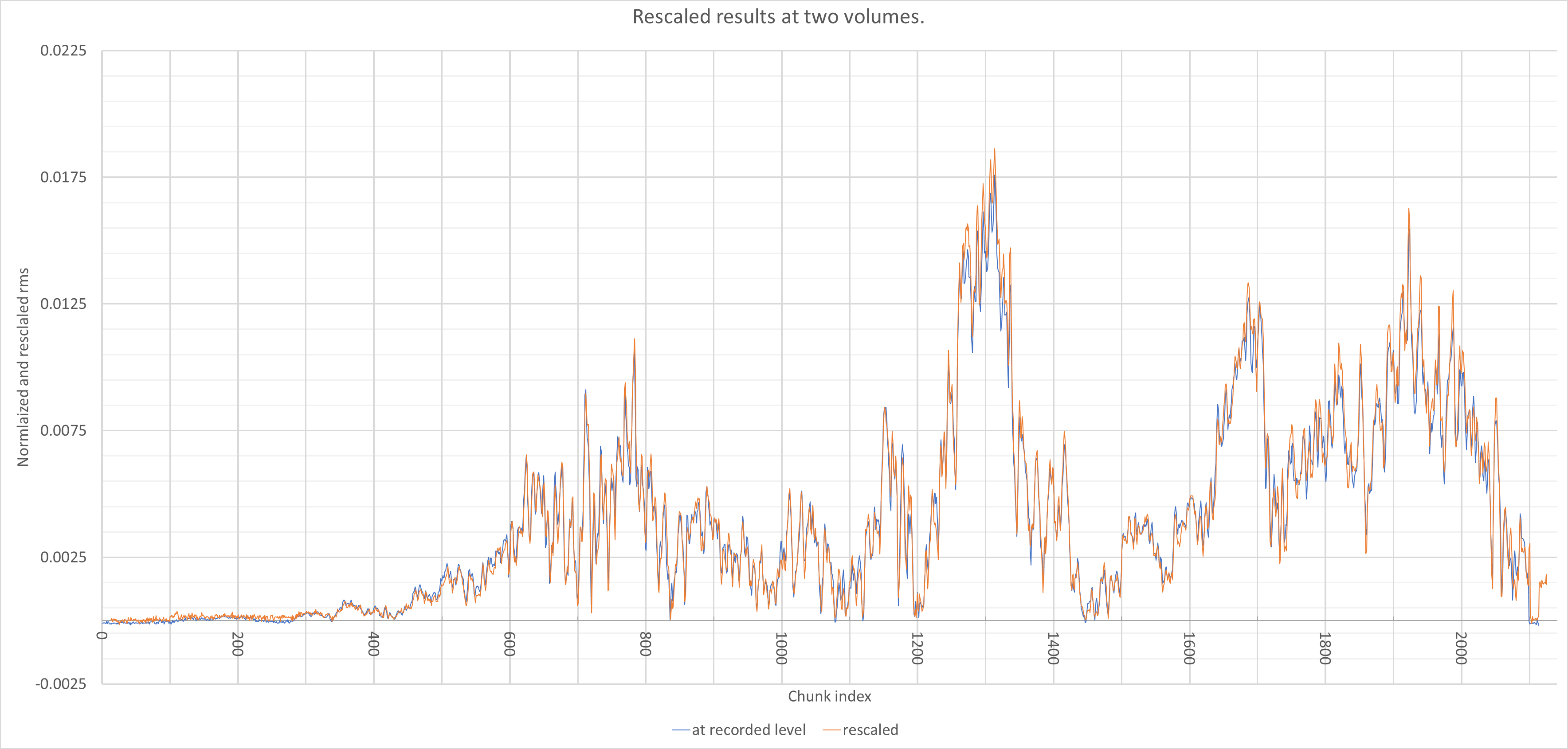
The first effect I found was that the same configuration creates the same signal. I thought that the oscillating waveforms would an effect of random noise. The surprising part is that although it looks like a noisy waveform, it’s a reproducible and pretty consistent.

This graph shows two runs with the same speaker and microphoone in the same geometry but different volume input signal. There were minimal adjustment to get the graphs to line up. However, if they lined up perfectly, there would be no blue.

One interesting measurement is that temporally stretching the sweep into different duration scans also have a similar consistency in different runs.

The way I get these graphs is to record the microphone and then break the waveform into short chunks that are delimited by zero crossings of the signal. Each chunk has its samples squared and the square root of the average recorded.

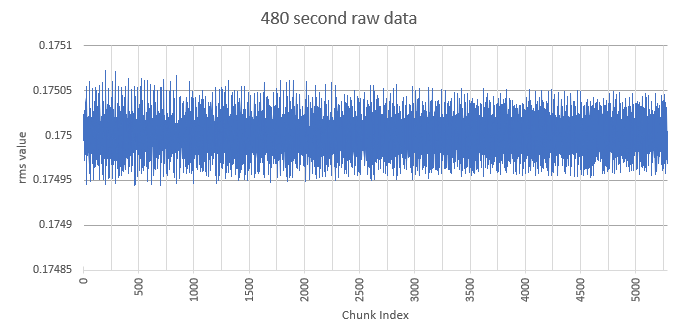
Although the graph above looks pretty noisy, because the graph is consistent, there’s more going on. I performed the same chunking with the raw input signal below. There is a little noise, but it is substantially smaller than the variations in the above signal.

The x axis of each graph is indexed by the chunks in sequence.

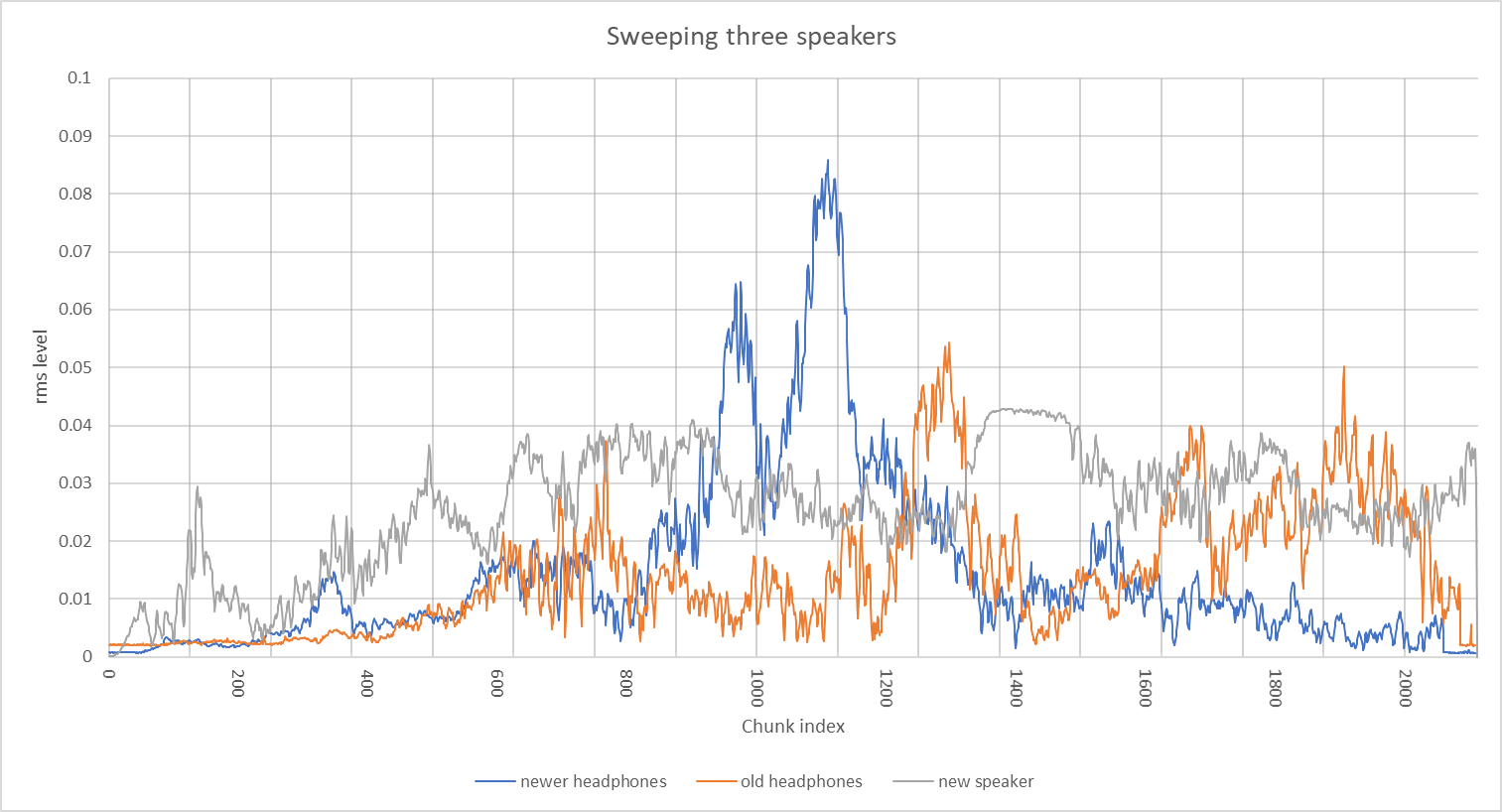
The other question that I would like to answer is the manner that the speaker or microphone have different frequency response curves. I took three speakers that I have and ran the same input sequence. I couldn’t get the geometry of the speakers identical between the runs, so the effects of reflections off objects in the room are an unexplored effect.

What I saw when I analyzed the graphs and placed them together is that there is a big variation in the sounds recorded from each speaker. I don’t see anything that is obviously due to distortion from the microphone. I can’t say that it isn’t there but the effects of the geometry and the difference between the speakers appear to swamp any effect of the microphone.

I’d like to do more work exploring the effects of changing the geometry on the results as well as trying to identify the frequency response of each part of the system, microphone, speaker and room configuration. I’m not confident that I have enough data streams available to separate them.

One thing I learned is that making recordings during the day is fraught because of noisy traffic, construction work or lawnmowers. In the evening, the external noise sources are much lower. Another thing I learned is that collecting this data is time consuming. Each run takes 4 – 8 minutes which adds up.

One goal is to make some jigs so that I can reproduce the geometry from one day to the next.

Musical instruments and resonance

I’ve started a project exploring musical instruments and the physics controlling their audio properties. Mostly I’m interested in brass instruments like a trumpet or trombone‒instruments that are tubular for much of their length. Brass instruments have a constant diameter at their beginning. As the tube approaches the end, the instruments become more conical until terminating in a flared bell. I chose them because I played the trumpet in high school. It’s familiar.

One book that I’m using to help understand what is happening is “The Physics of Musical Instruments, 2nd edition” by Neville H. Fletcher and Thomas D. Rossing. It has quantitative descriptions of the properties of real instruments.

One interesting idea is to consider brass instruments as “reed instruments.” For a brass instrument, the “reed” is the lips of the performer. This allows brass instruments to use the same equations as woodwinds. As a first approximation, lips and reeds have similar properties of interrupted air flow. It does make a difference whether the opening closes with increasing pressure or opens with increasing pressure so the analogy has its limits.

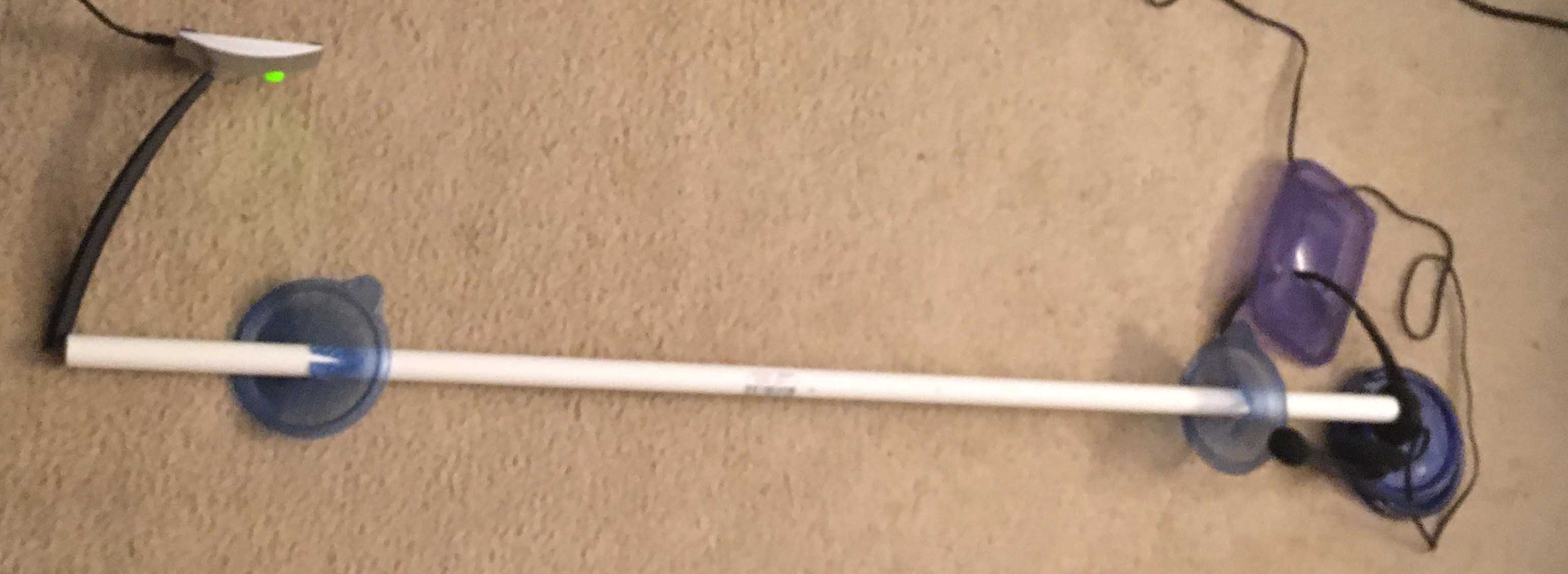
My first experiments have been with a pipe resonating at different frequencies. My method of creating data is to input a sweeping pitched sound to one end of a pipe with a speaker. The pipe resonates at different frequencies so that the intensity of the sound so the other end varies over time. This is a example configuration with headphones presenting the sound on the right end and a microphone picking up sound on the left. I haven’t calibrated the frequency response curve of the microphone and speakers.

For example, when I sweep the input sine wave from 50 Hz to 2000 Hz over 2 minutes on one end of a 1m 1/2″ PVC tube, the amplitude from the other end creates this graph. I measure the amplitude as rms (root mean square) by squaring the values of each sample in a block and then taking their average. This helps in comparing one block to the next.

time vs. amplitude

One thing I notice with such examples is that as the frequency goes up, there is more and more noise in the wave form. The shapes become more ragged. It should be easy to identify the time of the different peaks and thus their frequency but this and other sources of noise interfere.

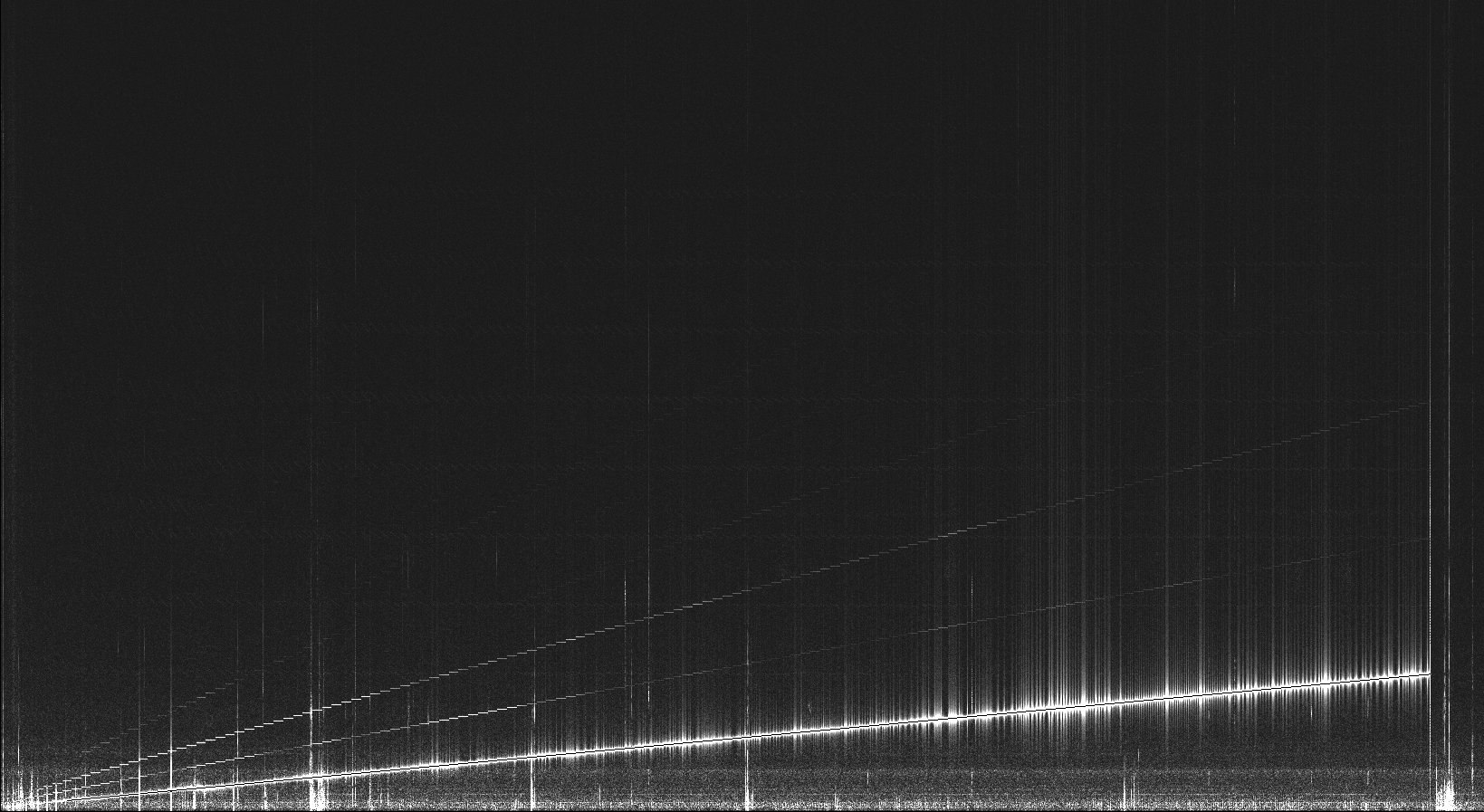
If I take above run and make an image of its frequency distribution, I get this. The Y axis isn’t calibrated, but starts at 0Hz at the bottom. This chart has the whole duration of a single observation session. The graph above is trimmed to exclude the times that I wasn’t activating the system.

Time vs. frequency

An interesting feature of the graph are the higher overtones from the input sweep. They show up as lines with higher slopes than the main output. This example, I can see 4 extra lines, but different configurations of microphone and pipe may show only one or two. (The third overtone is barely visible above the middle of the run.) Also, if I look closely, I see very faint equispaced horizontal lines. I suspect that those are from my computer fan but I haven’t verified it.

The gray noise at the bottom of the graph are different noises from within my house. I haven’t identified the causes of those or their frequency. Some of the graph is marked with mechanical bumps that show up as lines starting at zero hertz. The vertical features centered on the main input frequency are a common feature of these charts. I’m not sure whether they are real or are an artifact of my processing.

(This representation doesn’t help me identify the position of the peaks.)

An interesting adjustment is needed when I break the signal into chunks. For the Fourier transform or other analyses, I need to block the chunks so that they end at the zero crossings of the input waveform. I pick a minimum number of samples for a block and then search further for the next positively sloped zero crossing. If I don’t do that, the sharp edges at the ends of a block add artifacts that hide real effects. The software I’m using for FFT, FFTW allows me to have non-power-of-two long blocks which is essential for seeing useful results.

Who do I see in the mirror?

One way to understand a complex system is to locate its holes and find what normally fills them. The brain is a system like that and one way of identifying functions of the brain is to describe deficits.

Examples include aphantasia and face blindness. Aphantasia refers to the inability to form visualizations in ones imagination. Face blindness (prosopagnosia) describes the inability to recognize faces. There are many other deficits, each with a different set of symptoms.

The change in capability could be due to a malfunctioning part of the brain or a disruption in the connection between areas. Perhaps an injury or disorder has damaged part, pointing toward the purpose of that region. Sometimes the affected area of the brain is well understood.

For me, I can recognize people really easily. It doesn’t take me looking at a person ‘s face to identify them. The face is an easy point of access to knowing who a person is. However, looking at a person from behind is often enough for me to know who I’m approaching.

The hole that puzzles me is the difficulty of recognizing myself. I can see photos of me or look at myself in a mirror. I don’t think that it is someone else, but rather it’s a conscious act to recognize that it is me. Old pictures or new, none of them look like “me.” I just don’t feel the same connection to myself that I do with other people.

It seems that this would be something a psychoanalyst might have comments on, but therapists and psychiatrists don’t hear anything alarming in this. It’s more “That’s interesting.”

There isn’t a strong emotional impact on me with the issue, just that it seems atypical of how most people react to their picture. I don’t know.

I can recognize you, but I can’t recognize me.

Gasoline and a Polyester Suit

I was putting away my laundry and realized how little I know about my clothes. It’s a wide span of ignorance covering something I interact with every day. Like my superficial knowledge of transportation, I trust the experts who make high quality garments to know how to create them.

A first level of ignorance involves the fabrics that clothes are made from. Dacron, cotton, linen, polyester, and wool just start the list of fibers. My list is short and shallow. I know some of them are natural, made from plants or animals. Others are synthetic, usually polymers, and are a recent invention. I know fabrics can be made from a combination of these substances. Some shrink when they are washed, others can be damaged in a clothes dryer set too hot.

What started me reminiscing on this began when I was looking at my laundry and wondering “Who designed this garment?” “How was it manufactured?” “What attributes were the designers considering?” “What is the science behind the little differences from one garment to the next?” “Who did the labor to put it together?” “What steps were automated?”

My cousin made a dress in the style of Jane Austen’s time. I also have the tools to make my own shirts, but don’t have the skills to be successful. I’d like to be better able to use my sewing machine, but I haven’t put in the effort. I’ve got thread and know where I can buy yards of cloth, find a pattern, and even get training. The whole exercise isn’t about the economics of clothing but rather the satisfaction of developing a new skill and making something to demonstrate that I have done so.

My Grandmother was skilled at crochet. My sisters, cousins and I have afghans that she made. It is a nice memento to keep her in my mind. The issues involved with those blankets are lost on me but it is a reminder of her love.

Transportation, I start by saying I don’t know the chemistry of gasoline and how it is manufactured. Next, I only have a cursory understanding of the physics behind the internal combustion energy. My vehicle seems like a straightforward object even though I know that it is not. Part metal, part plastic, it does the work to turn the wheels and follow my steering, but I don’t really understand the how and why. A simple example is that I can’t repair a door latch nor explain its mechanical principles.

In another facet of transportation, my knowledge of how roads are made, is mainly gleaned from watching construction teams working on a highway as I drive past–that’s horribly superficial. I know that there are inspections and standards for roads. The purpose of those regulations are to make roads reliable. I don’t see the calculations made in the design of bridges, but I do drive on them.

One of my shirts shows a simple design change that is evidence of its designer’s intervention. The bottom buttonholes of some of my button down shirts have a horizontal opening instead of the vertical buttonhole of the rest. That makes sense to me because it helps prevent the bottom button from popping open. Just as the top button is almost universally horizontal, these horizontal bottom holes were an insight by its clothing engineers. This gives me a a tiny window into the process of design and manufacture.

There’s so much I take for granted that someone else has expertise in. I don’t begrudge those experts and am glad when my car gets me home and my seams don’t rip.

It’s foolish to attack scientists and experts who use their expertise and advanced knowledge. Just because I don’t understand some point of that knowledge, doesn’t validate my rejection of it. Although I can wonder and try to learn more, I don’t reject them as “elites” and deny their science.

Worse than rejection is to impugn bad faith on professionals through conspiracy theories and denial of their commitment to ethical principles. One friend reminds me if you spot it, you got it. Shadowy accusations of bad faith and conspiracy are actually an indictment of their accuser’s bad faith, not a sign of insight, wisdom or superiority.