If at first you don’t succeed…

I remember from childhood the cliche “If at first you don’t succeed, try, try again.” I don’t remember learning the second part of it, “Then quit, there’s no use being silly about it,” so I keep trying at difficult tasks. After talking to a college professor about their students, it’s easy to believe that the second part of the quote might have prominence now, give up and don’t be silly about it. I would argue that there are plenty of reasons when the first half should be emphasized.

A trophy with a star on top and a spiral shaft.

Examples for persistence include practice and skill building. If they’re learning to play the oboe part of a Mozart sonata, an oboist would accept that the first try is not going to be the best. A cook trying to make a souffle would accept that their first try might even deserve to be labeled a disaster. My grandmother’s special chocolate cake is very difficult recipe to get right but we love it enough to keep trying. The recipe even includes a note that, if it sinks in the center, “fill up the hole with extra frosting.” However, the “traditional” caramel frosting that she always used is a lost art.

In a business, “then quit” is definitely not the motto of the best employees; they will be persistent. Inventing a new candy bar can take a lot of not-succeeding. (See the History Channel’s The Food That Built America for examples) Designing the perfect ultrasonic dental retainer cleaner is not going create something to market on the first try. Failure is part of the process. The mistakes might even be the ideal experience for the next success.

In some situations, not succeeding is a requirement. A sales call might fail for 9 out of 10 pitches, but the 10th will be a success to make up for the nine prior disappointments. Applying for a job is probably not going to succeed on the first resume sent out. One can even get to a first interview, or perhaps several interviews, and still be rejected. That’s not a reason to give up.

With technology and computer services, the tool might not do what you want. The ideal would be a system that offers “What You Get Is What You Want” (WYGIWYW). This motto implies that the developers of the tool are aware of its roadblocks. When a user gets stuck, having a way forward makes a product better. Perhaps a word processor like LibreOffice is difficult to set the page size correctly for someone new. A smart photo frame might not be easy for grandma to locate images of her new great-grandson. With the open-source photo editor GIMP, it may seem impossible to replace the blue sky with something more dramatic.

a finger pressing the correct button surrounded by rippling circles

These situations, “then give up” is perhaps better advice at times, with the caveat that giving up usually means start on a new road, not turning off the engine. When a tool assumes that users need a level of technical background to use them, how do the users learn to become proficient? When you want to adjust your slide show to use a different background theme, it might not be obvious how to do that. With technical expertise, you can search the menus and the internet and figure it out. For others to get what they want, it might not be obvious. When the TV menus are not cooperating, an online tutorial might not be available instantly when the menus to find Casablanca.

If you don’t have a level of proficiency, how do you learn what you need? Technology developers can think creatively about how to match the difficulty of using a tool to the skill of its users. Perhaps giving up is a good course of action, but, giving up should mean, look somewhere else for the solution, not throw the remote across the room.

Inventors should have anticipated your situation and made it easier not to be silly about it.

Red Stickers

a red arrow pointing right and a blue arrow pointling left

What to do with my collections? I’ve got lots of books. Many are niche, while others are textbooks or recordkeeping, some are antique, fiction is in the set too.

My cousin recently had to help her parents move into a memory care facility. In that process, she and her sisters had to struggle with all of the property that was left behind: books, kitchen supplies, hobbies, furniture and more. There was a long list of property to take care of without any planning or preparation. It took weeks and a lot of trips to resolve it.

What could I do to ease that process for my family?

If you come to my house one of the first things you see are my bookshelves. I think it would be nice for their contents to be less of a burden to my sisters if my health suddenly deteriorates. If I can’t live independently, or if I die suddenly, I could help with some preparation. I can create a system so that they could know what to do without needing to devote emotional resources.

My first foray into this project is to mark books that could be dealt with easily. I’ll go through them and mark them inside the front cover. The idea is that my family could go through the shelves and any that are marked red will be an easy first pass.

Perhaps a second level of this is to find places that would value the books as a donation. For example, I have 15 or 20 different Bible translations. Perhaps there is someone who would use them? There are a couple seminaries near here that might appreciate them. The reference books like a thesaurus, dictionary or writing style guides might be useful to someone and there are a few others that are there also might find them valuable.

I started by marking with a red marker, but for the rest, I’ll use a red sticker instead. Taking a book down, writing in it and putting it back is awkward; putting a sticker would be a lot easier.

It’s an interesting exercise to inventory what I have and see what I’ve forgotten about.

Constructing Social Capital

The future is a place of construction. What happens will be built on top of what is being done today. It’s easy for me to look back to search for answers, but the future is a place of dreams and aspiration. It can be a place that welcomes me if I build toward it today.

Where do I want to go? I like to come up with new ideas and new ways of organizing information. Other people have their own destinations.

The concept of social capital is useful for making a successful quest. The resources in the form of people and organizations whom I can connect with; people I can get feedback from and who can help me move from the origins of an idea into its completion. Social capital can be just as necessary as physical capital.

These memoji can represent some of the ways to build social capital. Depending on loved ones and people who care about the same things. Using physical resources to combine efforts. Building social capital by having something appealing to share. Finding people who want to come along toward the same goal. Having an idea that inspires people.

By building on their inspirations, many people could build a new future. Trusting that it will be successful is daunting without also constructing some social capital.

I believe many people currently are impoverished in their social capital. They might not belong anywhere and just need someone to help them climb up the mountain of fulfillment. Perhaps they feel unable to make something beautiful or reach the summit.

Social capital is a resource that would help many overcome their struggles.

Review: Doctor Strange in the Multiverse of Madness (2022)

a reel of film

Doctor Strange in the Multiverse of Madness is a film in the Marvel Cinematic universe from 2022. It stars Benedict Cumberbatch as Dr. Stephen Strange, Elizabeth Olsen as Wanda Maximoff/The Scarlet Witch. It also stared Xochitl Gomez as America Chavez and Rachel McAdams as Dr. Christine Palmer.

One hazard for Marvel Studios is the risk of requiring context from earlier releases to understand more recent movies. Doctor Strange in the Multiverse of Madness falls prey to this monster. There are a few Marvel Cinematic Universe feature films that would be helpful to understand. This includes the first Dr. Strange and Avengers: Age of Ultron. However, Multiverse of Madness also has the Disney+ series WandaVision as an almost obligatory prerequisite because it introduces the Scarlet Witch character and develops her story in ways essential to Multiverse.

The Marvel multiverse concept is explored further in this movie. The Disney+ TV series What If…? is a good introduction to the Marvel Studio understanding of that idea. One idea added by this film is that, in dreams, you are experiencing the life of a different version of yourself in another part of the multiverse.

The “canon events” of Doctor Strange’s story (to borrow an idea from Spiderman: Across the Spiderverse) are assumed to be familiar. The movie begins with the wedding of Christine Palmer and is the film’s first reference to their failed relationship. Their misaligned love affair is an important detail throughout the movie. (See the Disney+ show What If…? for a detailed demonstration of their disconnection.) These beats aren’t difficult to explain, but for someone coming to the film unprepared, they are puzzling situations.

The film had luscious visuals of the many different environments traversed through the film. America has a really interesting power that motivates the story: she can provide access to different parts of the multiverse. Having her superpower be a star shaped portal makes sense considering her name, America, as it alludes to the United States’ flag.

The story has some characteristics of a classical tragedy where one character has a fatal flaw that leads to their downfall. It’s unfortunate that WandaVision is the foundation that explains that part of the story. It is the whole motivation for most the film’s events. The movie doesn’t have a shortcut to understand the Scarlet Witch and her family dynamics.

When I was looking around for links for this review, I found a Dr. Strange TV movie from 1978 that might be fun to watch. It is available for streaming. There is also an animated Dr. Strange: The Sorcerer Supreme from 2007 that is available through my library.

I watched the movie again because it jumped in front of me at the library. It’s not a great movie but I didn’t regret watching it a second time, so it’s not awful. I think the number of threads in the movie coming from pre-requisites make it indecipherable without some background in Marvel Studio presentations.

Cool coincidence with the New Yorker

A speech bubble with abstract text

Today, I went to the New Yorker Fiction page on this blog and updated it for the new week. When I do that, I add the current week’s short story and add one to extend the history one more week into the past.

This time, the story from the October 16, 2017 issue was by the same author as this week’s, Tessa Hadley. Last week, my update of two weeks also included the same author twice. Both October 30, 2017 and January 26, 2026 had stories by Joseph O’Neill. I hadn’t noticed such coincidences in past updates.

When I looked more closely, I found that this is less exotic than it seems. Tessa Hadley has 9 stories in my table between 2017 and 2026. Joseph O’Neill has 8.

The process of building the table has changed recently. For past issues, I search Google. Today, for example, I searched “site:newyorker.com tessa hadley funny little snake”. The top of the search results had the story, a blog post interviewing the author, and the author reading the story. I find the author and title by looking at the issue’s home page, which has a consistent URL: https://newyorker.com/magazine/yyyy/mm/dd where the date of the issue is used for yyyy/mm/dd

Just recently, I’m switching to Google for the current issue. When I search the New Yorker website for the information, the URL has extra bookkeeping characters. I need to remove them before I add the links to the table which is annoying and error prone. The results from Google don’t need that extra step.

In case you can’t tell, I really like the short stories in the New Yorker.

Review: Rental Family (2025)

a reel of film

Rental Family is a beautiful film set in Japan. It has Philip Vanderploeg (Brendan Fraser) as a fish-out-of-water American in Japan. The film starts with him as an underemployed actor who wants to do more. Although the characters say that Japanese culture is inscrutable to the non-Japanese, the film shrinks from presenting Japanese culture in caricatured stereotypes. An exception to that is the funeral that opens the movie. It presents the culture of a funeral in a cartoon situation. However, it offers a transition to introduce the audience to the chaotic world of rental families.

An enduring feeling in the film is one of loneliness. Looking across the way toward the neighbor’s apartments, Fraser could see the everyday lives of his neighbors as they raise children and celebrate days full of comfort and companionship. When he is not working, this view from his apartment returns to ground the film in the alienation of big-city life. Sometimes the people who are important to him are able to redeem that sadness and remind him of more recent joys.

At times, the film was filled with the manic energy of Fraser jumping between roles in lives of the clients of the agency he works for. That agency had rescued him from his boredom and depression. The agency is led by Shinji Taja (Takehiro Hira) who arranges situations for Fraser and his coworkers to join. Before each “acting gig,” Fraser would study the families as if he were studying for a role in a TV show. Although the situations that he joins are meant to deceive other family members, the relationships simulate reality and provide a rental family member that can fill some need. His first role is especially fraught where he is marrying a young woman. Fraser balks so his coworker, Aiko Nakajima (Mari Yamamoto), has to prevent a catastrophe by insisting on his participation. The intensity of that marriage commitment has an unexpected but affirming resolution.

Themes that are explored include dealing with memory, age and death. Another theme is commitment and responsibility. Fatherhood is a situation that replaces Fraser’s youth without a father by his acting as father to a young girl. Despite the simulated relationships that are dishonest, they can help people process difficult transitions. However, they also have a complementary effect on the actors that is an inevitable consequence.

One feature of the movie that I really enjoyed were the panoramic views of the world outside of Tokyo. The intermissions contrast the rectilinear, man-made world of a city with the natural, analog, beauty surrounding Tokyo. The natural world has a rhythm that is stable and calming. One sequence travels away from the city into a rural beauty near the ocean.

The online resources such as imdb.com categorize the movie as both a comedy and a tragedy. I definitely could identify the comedy because the bizarre situations that Fraser and his coworkers insert themselves into are really funny. As for tragedy, I don’t really identify that. Perhaps one could call the crisis in the movie as a tragedy, but that was a way of bringing the energy down a notch, not to announce failure and despair.

The movie starts with Fraser hitting bottom. He finds a way out through the rental agency and hits a euphoric phase of interacting as a for-rent family member. As things get stable, the euphoria levels off and Fraser has to make a decision of what he wants to be committed to. As the deception reaches a climax, the story flows into a crisis of confidence. It ends in a cheerful balance that is peaceful and comfortable. By the end of the moving the characters have had a chance to reflect on their lives and feel balance and hope.

The director and co-writer, Hikari, brought the characters to a stage of chaos and unpredictable situations that reminds me of the film Parasite (2019) which also has its characters in a whirlpool of deception. Rental Family doesn’t have them crash and instead they transition into a feeling of success and competence.

Jupiter at its brightest

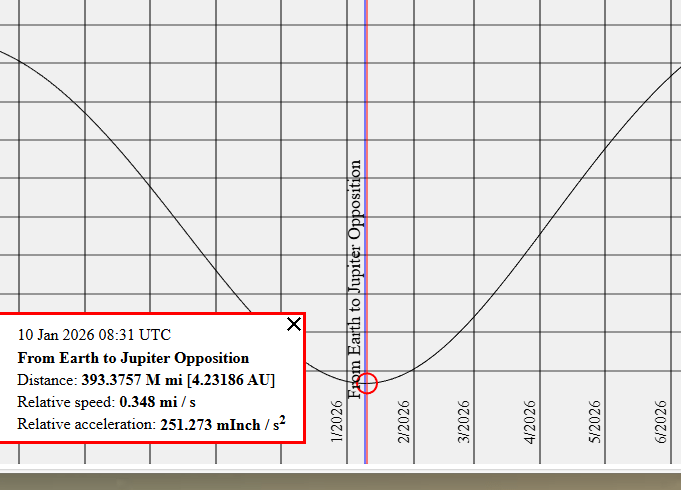
Today is going to be the brightest Jupiter will be in the sky for several years. It had its nearest approach last night 3:10AM EST (08:10 UTC) at a distance of 393.36 million miles or 4.232 AU. This is the closest Jupiter will be to the earth until 2033. However, it was about 26 million miles closer in 2022.

Tonight at 3:31AM EST (08:33 UTC) it will be in opposition where it is 180º away from the Sun.

These next few days will be great opportunities to see the planet. With binoculars, you should be able to see the Galilean moons of Jupiter as well.

Information about the relative motion of the different planets is linked at http://sesquibits.com/mars/index.html which is a page titled “Graphing Planetary Motion.” The formulas used by the website come from Planetary theories in rectangular and spherical variables-VSOP 87 solutions

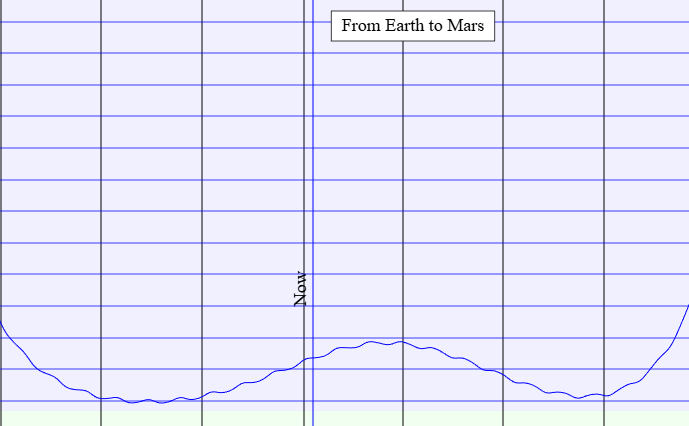
The website graphs the distance, relative speed, and acceleration between any pair of the 8 planets. The site allows you to scan for maximal and minimal events in the distance, speed, acceleration as well as conjunctions, quadrature and opposition. It also can display the time of perihelion and aphelion for each planet. It presents information from the year 300 to 3500. The “capture graph” button creates a link that will regenerate the current display.

One of the most interesting graphs is the relative acceleration between Earth and Mars. It shows dramatically the effect of the moon on the orbit of the Earth.

Fear into Hope; Hate into Joy

Life is fraught. Not like it was, now it’s more fragile and anxious. The public square is a place of fear and alienation. It appears that there is a vast army arrayed against us and we need to prevail.

Hidden in the mist is the message that a change is near. Things are going to change; we’ll be on top and our enemies will be washed away. Many of the holy books seem to talk of it. Although the words change, the outcome is the same. We’ll be avenged against the rest and our suffering will be replaced by eternal joy.

All of these stories are based in “Dethism,” the belief that the others should die and that their destruction, debasement and dissolution are justified. Their elimination is desirable because it satiates our grievances and it is expected to alleviate our suffering. Accelerating a prophesied apocalypse is a transaction with God: that if we stay faithful, He will reward us in the end.

Sacrifice is not a common word in modern political vocabularies. Often the thought is, rather, by giving, one will receive a benefit from the transaction. A transaction is a sorry way to interact with someone you care about. You don’t give your child a hug to get something in return. “Honey I’m home!” is an expression of love and enthusiasm for a special relationship; not an expectation of a reward. Expecting God to act a certain way based on one’s own righteousness is an attempt to activate a transaction with the Uncontrollable, to trammel Him in so He will satiate those desires more quickly.

Making another happy without hope of return can release an enduring joy. One’s own strength and humanity can abide against the ones who are plotting how to produce the dethist future they imagine. Dethists are moving toward their own lamentable exercise of power. They don’t have the thought that one can offer devotion to a stranger and that their devotion will raise them both up.

If fear is all they have to offer, I can combat it with dogged joy. Joy can outlast the attitudes of enmity, alienation and division. One of the powers of such love is that it does not ask for something in return.

Walk into a future with hope that is stronger than fear. Offer joy that is elevated above the hatred.

Grokipedia v0.2 observations

I was poking around on Grokipedia v0.2 on Nov. 25, 2025 to contrast it with Wikipedia. I was not evaluating its political orientation. The media reports that its political attitude is a primary point of interest but not for me.

Here are some observations.

  • GP tends to have long sentences that could be refactored into improved prose. There are a lot of comma splices. The style can be stilted and unnatural. The articles seem to be consistently too long. They include redundant content and repeat the same information in different sections of an article. Each topic has two or more subtopics. This contrasts with Wikipedia pages, which often have a flat outline and make judicious use of sub-topics and, rarely, sub-sub-topics, Grokipedia articles are always subdivided into two levels. The text of each Wikipedia article has been individually organized in a logical fashion. Grokipedia’s organizing principle is usually hidden. In addition, the section headings are long which makes them hard to scan quickly as you review a page.
  • GP only includes pure URLs as its citations. Wikipedia includes the date that the reference was accessed along with other information such as title, source and publisher when its available. Wikipedia can include citations that are not available online or are paywalled (for example in books or bibliographic databases) when the information is not available freely. Wikipedia heavily uses archive.org’s Wayback archive to preserve access to references that are gone or altered. A pure URL doesn’t help me grade the quality of sources or decide whether it is relevant to my purpose for visiting the site. When I did go to Grokipedia citations, it was be difficult to find where the referenced information was located. It also is a valid question to ask whether the citation actually supports the statement being cited or is it being misinterpreted.
  • With only a direct URL for the citations, Grokipedia will be brittle as the internet churns and pages come and go. Theoretically, a Grokipedia page could regenerate with new material, but that fragility inhibits consistent content over time. When source material is deleted, Grokipedia can’t stay current.
  • GP has some formatting issues. One ugly example was the mathematical page Brauer Group that had red errors in the mathematical equations. When you mouse over a citation index ([15] for example), the domain name popup is centered and hidden behind the mouse. In addition, because the target is small, you can’t move the mouse to uncover the domain. My mouse is big, but Wikipedia aligns the popup when you mouse over an internal link to the right of the mouse and there is enough room to move the mouse out of the way. When you mouse over an actual citation in Wikipedia, the entire citation is presented directly above the index number. In the body of an article, GP’s headings and subheadings are too similar in size and font weight so that they blend together. Although there is a line between top level outline elements, it is such low contrast that it’s not actually visible. This defeats the goal of adding a visual cue that a new section has begun.
  • GP has sparse internal links. Where Wikipedia has many cross links to other Wikipedia articles, GP has dramatically fewer. For example, I didn’t see any crosslinks in the article about Tasha Yar from Star Trek: The Next Generation. In most articles there are many obvious places to put an internal link that aren’t used.
  • Although it contains an edit history for each page, that feature is not very useful. You can’t put edits in context. If the edit is complicated, you can’t interpret it. Of the several pages I visited, there was only one edit and it was still being reviewed. Allowing users to thumb up/down to an edit as Grokipedia does might be ok for Reddit, but an encyclopedia requires more detailed evaluation. It’s not clear what will happen when a page with edits regenerates.
  • The pages are white on black. Since many of the pages are very long, that makes them hard to follow along. As I scroll on the page, I lose track of where I am. The page map on the left has all of the text in the same font size and weight which makes it hard to identify the top-level outline entries. Since the lengths of the outline entries are long, they are usually folded onto two lines, making the page map even harder to scan.

Although, I’m sure Grokipedia v0.3 will have improvements, right now I wouldn’t use it as a replacement for Wikipedia. Grokipedia is written by an anonymous, evolving blob and there is no one to intervene. I can visualize the Wikipedia community because I know there are people behind the scenes. In addition, I can find Wikipedia projects that I can contribute to there and be a contributor as well as a user.

Wikipedia is organic and uses principles compatible with Douglas Engelbart’s Language, Artifacts and Methodology to augment human intellect. Why reinvent the wheel?

Review: Mon Oncle (1958)

Jacques Tati directed the movie Mon Oncle (My Uncle) which was released in 1958 in French. Tati plays the protagonist, Monsieur Hulot, an eccentric man whose sister, Madame Arpel (Adrienne Servantie), is married to industrialist Charles Arpel (Jean-Pierre Zola). Hulot is the uncle in the title to the Arpel’s son Gérard (Alain Bécourt). The overarching plot is simple: Charles is supposed to find his brother-in-law a respectable job that can keep him busy and out of trouble. A lot of silliness occurs in pursuit of that goal.

While I was watching the film, I was mindful of the theme that modernity is providing waves of technology for a modern homemaker to be proud of. That is a subtext of the reality that the Arpel’s move through. Their house is strikingly spartan. It has minimal furniture with no decorations nor signs of personality beyond its touches of automation. Outside, the garden is stark with only tiny patches of lawn and concrete stepping stones amidst gravel patches. The stones form paths from the outer gate to the house and small places to entertain guests.

a silver colored fish

The one embellishment of the yard is a ridiculous fish fountain. When a visitor presses the buzzer to request entry, Madame Arpel turns a knob to release a stream of water from the fish’s mouth. Next, she pushes a button to unlock the outer door. There is something peculiar about the fountain because it is never the same height and when it is turned off, the water hesitates to stop. Once the guest leaves, the fountain is turned off right away. Later, it’s the origin of a lot of silliness when it’s damaged by Mr. Hulot’s ever-present umbrella.

a drawing of a finger pressing a button with rings of action emanating from the fingertip

Newly invented technology is a theme in the “modern” world that the Arpel’s belong to. At his work, the phones are treated as fancy novelties. Mr. Arpel’s boss, Monsieur Pichard (Lucien Frégis) has his importance indicated by having two doors in his office that he can direct staff and visitors to choose. The factory makes kilometers of rubber hoses with a complicated machine that Hulot manages to crash. At home, the Arpel’s kitchen is controlled by a few mysterious buttons. Monsieur Hulot tries to open one of the cabinets and can’t find the correct (unlabeled) button in the console to get a snack. Suddenly, a cabinet to open and reveals a pitcher. Hulot accidentally discovers that the pitcher bounces satisfyingly. The glass that was in the same shelf didn’t bounce as well. A recurring theme is that the button is an essential feature of modernity. They can be found all through the house.

Mr. Hulot’s world is quite different. It’s a world of interesting people, their games and everyday amusements. Nothing is new and the market is full of (expensive) food options. His apartment is on the top floor of a three-story building. To get there, he follows a maze-like path to the roof. The windows in the house let the viewer see the stairs and corridors he passes on his trip. The first time he makes the trip, his slow, seeming random, progress is intriguing. Hulot introduces Gérard to this traditional world as he brings him home from school. Gérard has friends who are fond of pranks. For one trick, when cars are returning from dropping the kids off at school, the kids make a noise as if a stopped car was hit from behind, causing the consternation of the driver. Another game is to distract people walking so that they run into a lamp post.

The filmographer Thomas Flight has a recent video In Praise of Comfort Films which reported that Mon Oncle has the most cute dogs in a movie. The dogs are running the neighborhood and looking for whatever dogs look for. According to IMDB, the dogs came from a local pound. It reports that Tati found adoptive homes for the dogs after the movie was finished, promoting them as movie stars. The Arpels are wealthy and their home contrasts with the background images of generic, industrialized apartment buildings.

Although the movie is subtitled in English, the first few minutes of the film don’t have any dialog, just music and the activity of the everyday world that Hulot belongs to. The film was pretty funny with lots of LOL moments. The transition from traditional life to the technological world of modern cars and Arpel’s factory is full of dissonances. It seems that every opportunity for Hulot to fit into the future was a complete failure, but it didn’t affect Hulot’s playfulness and humor. A final show of opulence is the Arpel’s new pink and purple Cadillac, offering a ride into the future for Hulot.

Mon Oncle is really funny. It won a 1959 Oscar for Best Foreign Language film. The version that I saw was the French Language version with English Subtitles and not the dubbed English version. The disk was released by Criterion and also included a humorous short “L’ecole des facteurs” (The Postman’s School) that has Tati as a newly trained bicycle postman. Tati made several movies with Monsieur Hulot of which Mon Oncle is the most successful.

I was surprised that my search for the movie in the statewide library consortium, Evergreen, only found two copies of the film. I was really glad that one of them was in my local library. The library has a section of “Binge Boxes” which provide a wide selection of themed collections to binge watch with the whole crew. Mon Oncle was in the “Criterion 3” binge box.