Review: Rental Family (2025)

a reel of film

Rental Family is a beautiful film set in Japan. It has Philip Vanderploeg (Brendan Fraser) as a fish-out-of-water American in Japan. The film starts with him as an underemployed actor who wants to do more. Although the characters say that Japanese culture is inscrutable to the non-Japanese, the film shrinks from presenting Japanese culture in caricatured stereotypes. An exception to that is the funeral that opens the movie. It presents the culture of a funeral in a cartoon situation. However, it offers a transition to introduce the audience to the chaotic world of rental families.

An enduring feeling in the film is one of loneliness. Looking across the way toward the neighbor’s apartments, Fraser could see the everyday lives of his neighbors as they raise children and celebrate days full of comfort and companionship. When he is not working, this view from his apartment returns to ground the film in the alienation of big-city life. Sometimes the people who are important to him are able to redeem that sadness and remind him of more recent joys.

At times, the film was filled with the manic energy of Fraser jumping between roles in lives of the clients of the agency he works for. That agency had rescued him from his boredom and depression. The agency is led by Shinji Taja (Takehiro Hira) who arranges situations for Fraser and his coworkers to join. Before each “acting gig,” Fraser would study the families as if he were studying for a role in a TV show. Although the situations that he joins are meant to deceive other family members, the relationships simulate reality and provide a rental family member that can fill some need. His first role is especially fraught where he is marrying a young woman. Fraser balks so his coworker, Aiko Nakajima (Mari Yamamoto), has to prevent a catastrophe by insisting on his participation. The intensity of that marriage commitment has an unexpected but affirming resolution.

Themes that are explored include dealing with memory, age and death. Another theme is commitment and responsibility. Fatherhood is a situation that replaces Fraser’s youth without a father by his acting as father to a young girl. Despite the simulated relationships that are dishonest, they can help people process difficult transitions. However, they also have a complementary effect on the actors that is an inevitable consequence.

One feature of the movie that I really enjoyed were the panoramic views of the world outside of Tokyo. The intermissions contrast the rectilinear, man-made world of a city with the natural, analog, beauty surrounding Tokyo. The natural world has a rhythm that is stable and calming. One sequence travels away from the city into a rural beauty near the ocean.

The online resources such as imdb.com categorize the movie as both a comedy and a tragedy. I definitely could identify the comedy because the bizarre situations that Fraser and his coworkers insert themselves into are really funny. As for tragedy, I don’t really identify that. Perhaps one could call the crisis in the movie as a tragedy, but that was a way of bringing the energy down a notch, not to announce failure and despair.

The movie starts with Fraser hitting bottom. He finds a way out through the rental agency and hits a euphoric phase of interacting as a for-rent family member. As things get stable, the euphoria levels off and Fraser has to make a decision of what he wants to be committed to. As the deception reaches a climax, the story flows into a crisis of confidence. It ends in a cheerful balance that is peaceful and comfortable. By the end of the moving the characters have had a chance to reflect on their lives and feel balance and hope.

The director and co-writer, Hikari, brought the characters to a stage of chaos and unpredictable situations that reminds me of the film Parasite (2019) which also has its characters in a whirlpool of deception. Rental Family doesn’t have them crash and instead they transition into a feeling of success and competence.
Jupiter at its brightest

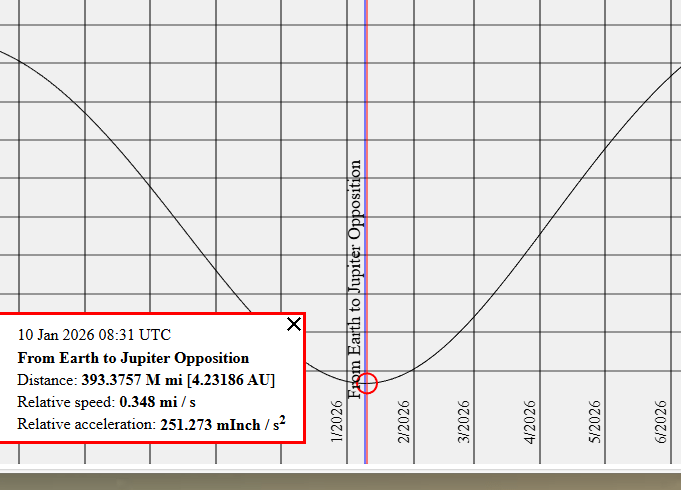
Today is going to be the brightest Jupiter will be in the sky for several years. It had its nearest approach last night 3:10AM EST (08:10 UTC) at a distance of 393.36 million miles or 4.232 AU. This is the closest Jupiter will be to the earth until 2033. However, it was about 26 million miles closer in 2022.

Tonight at 3:31AM EST (08:33 UTC) it will be in opposition where it is 180º away from the Sun.

These next few days will be great opportunities to see the planet. With binoculars, you should be able to see the Galilean moons of Jupiter as well.

Information about the relative motion of the different planets is linked at http://sesquibits.com/mars/index.html which is a page titled “Graphing Planetary Motion.” The formulas used by the website come from Planetary theories in rectangular and spherical variables-VSOP 87 solutions

The website graphs the distance, relative speed, and acceleration between any pair of the 8 planets. The site allows you to scan for maximal and minimal events in the distance, speed, acceleration as well as conjunctions, quadrature and opposition. It also can display the time of perihelion and aphelion for each planet. It presents information from the year 300 to 3500. The “capture graph” button creates a link that will regenerate the current display.

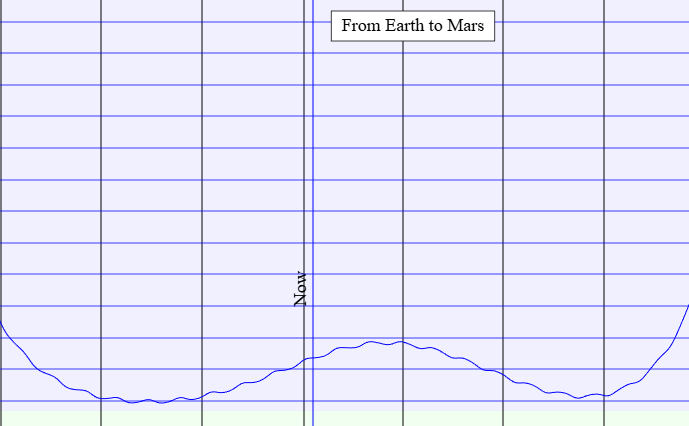
One of the most interesting graphs is the relative acceleration between Earth and Mars. It shows dramatically the effect of the moon on the orbit of the Earth.

Fear into Hope; Hate into Joy

Life is fraught. Not like it was, now it’s more fragile and anxious. The public square is a place of fear and alienation. It appears that there is a vast army arrayed against us and we need to prevail.

Hidden in the mist is the message that a change is near. Things are going to change; we’ll be on top and our enemies will be washed away. Many of the holy books seem to talk of it. Although the words change, the outcome is the same. We’ll be avenged against the rest and our suffering will be replaced by eternal joy.

All of these stories are based in “Dethism,” the belief that the others should die and that their destruction, debasement and dissolution are justified. Their elimination is desirable because it satiates our grievances and it is expected to alleviate our suffering. Accelerating a prophesied apocalypse is a transaction with God: that if we stay faithful, He will reward us in the end.

Sacrifice is not a common word in modern political vocabularies. Often the thought is, rather, by giving, one will receive a benefit from the transaction. A transaction is a sorry way to interact with someone you care about. You don’t give your child a hug to get something in return. “Honey I’m home!” is an expression of love and enthusiasm for a special relationship; not an expectation of a reward. Expecting God to act a certain way based on one’s own righteousness is an attempt to activate a transaction with the Uncontrollable, to trammel Him in so He will satiate those desires more quickly.

Making another happy without hope of return can release an enduring joy. One’s own strength and humanity can abide against the ones who are plotting how to produce the dethist future they imagine. Dethists are moving toward their own lamentable exercise of power. They don’t have the thought that one can offer devotion to a stranger and that their devotion will raise them both up.

If fear is all they have to offer, I can combat it with dogged joy. Joy can outlast the attitudes of enmity, alienation and division. One of the powers of such love is that it does not ask for something in return.

Walk into a future with hope that is stronger than fear. Offer joy that is elevated above the hatred.

Grokipedia v0.2 observations

I was poking around on Grokipedia v0.2 on Nov. 25, 2025 to contrast it with Wikipedia. I was not evaluating its political orientation. The media reports that its political attitude is a primary point of interest but not for me.

Here are some observations.

  • GP tends to have long sentences that could be refactored into improved prose. There are a lot of comma splices. The style can be stilted and unnatural. The articles seem to be consistently too long. They include redundant content and repeat the same information in different sections of an article. Each topic has two or more subtopics. This contrasts with Wikipedia pages, which often have a flat outline and make judicious use of sub-topics and, rarely, sub-sub-topics, Grokipedia articles are always subdivided into two levels. The text of each Wikipedia article has been individually organized in a logical fashion. Grokipedia’s organizing principle is usually hidden. In addition, the section headings are long which makes them hard to scan quickly as you review a page.
  • GP only includes pure URLs as its citations. Wikipedia includes the date that the reference was accessed along with other information such as title, source and publisher when its available. Wikipedia can include citations that are not available online or are paywalled (for example in books or bibliographic databases) when the information is not available freely. Wikipedia heavily uses archive.org’s Wayback archive to preserve access to references that are gone or altered. A pure URL doesn’t help me grade the quality of sources or decide whether it is relevant to my purpose for visiting the site. When I did go to Grokipedia citations, it was be difficult to find where the referenced information was located. It also is a valid question to ask whether the citation actually supports the statement being cited or is it being misinterpreted.
  • With only a direct URL for the citations, Grokipedia will be brittle as the internet churns and pages come and go. Theoretically, a Grokipedia page could regenerate with new material, but that fragility inhibits consistent content over time. When source material is deleted, Grokipedia can’t stay current.
  • GP has some formatting issues. One ugly example was the mathematical page Brauer Group that had red errors in the mathematical equations. When you mouse over a citation index ([15] for example), the domain name popup is centered and hidden behind the mouse. In addition, because the target is small, you can’t move the mouse to uncover the domain. My mouse is big, but Wikipedia aligns the popup when you mouse over an internal link to the right of the mouse and there is enough room to move the mouse out of the way. When you mouse over an actual citation in Wikipedia, the entire citation is presented directly above the index number. In the body of an article, GP’s headings and subheadings are too similar in size and font weight so that they blend together. Although there is a line between top level outline elements, it is such low contrast that it’s not actually visible. This defeats the goal of adding a visual cue that a new section has begun.
  • GP has sparse internal links. Where Wikipedia has many cross links to other Wikipedia articles, GP has dramatically fewer. For example, I didn’t see any crosslinks in the article about Tasha Yar from Star Trek: The Next Generation. In most articles there are many obvious places to put an internal link that aren’t used.
  • Although it contains an edit history for each page, that feature is not very useful. You can’t put edits in context. If the edit is complicated, you can’t interpret it. Of the several pages I visited, there was only one edit and it was still being reviewed. Allowing users to thumb up/down to an edit as Grokipedia does might be ok for Reddit, but an encyclopedia requires more detailed evaluation. It’s not clear what will happen when a page with edits regenerates.
  • The pages are white on black. Since many of the pages are very long, that makes them hard to follow along. As I scroll on the page, I lose track of where I am. The page map on the left has all of the text in the same font size and weight which makes it hard to identify the top-level outline entries. Since the lengths of the outline entries are long, they are usually folded onto two lines, making the page map even harder to scan.

Although, I’m sure Grokipedia v0.3 will have improvements, right now I wouldn’t use it as a replacement for Wikipedia. Grokipedia is written by an anonymous, evolving blob and there is no one to intervene. I can visualize the Wikipedia community because I know there are people behind the scenes. In addition, I can find Wikipedia projects that I can contribute to there and be a contributor as well as a user.

Wikipedia is organic and uses principles compatible with Douglas Engelbart’s Language, Artifacts and Methodology to augment human intellect. Why reinvent the wheel?

Review: Mon Oncle (1958)

Jacques Tati directed the movie Mon Oncle (My Uncle) which was released in 1958 in French. Tati plays the protagonist, Monsieur Hulot, an eccentric man whose sister, Madame Arpel (Adrienne Servantie), is married to industrialist Charles Arpel (Jean-Pierre Zola). Hulot is the uncle in the title to the Arpel’s son Gérard (Alain Bécourt). The overarching plot is simple: Charles is supposed to find his brother-in-law a respectable job that can keep him busy and out of trouble. A lot of silliness occurs in pursuit of that goal.

While I was watching the film, I was mindful of the theme that modernity is providing waves of technology for a modern homemaker to be proud of. That is a subtext of the reality that the Arpel’s move through. Their house is strikingly spartan. It has minimal furniture with no decorations nor signs of personality beyond its touches of automation. Outside, the garden is stark with only tiny patches of lawn and concrete stepping stones amidst gravel patches. The stones form paths from the outer gate to the house and small places to entertain guests.

a silver colored fish

The one embellishment of the yard is a ridiculous fish fountain. When a visitor presses the buzzer to request entry, Madame Arpel turns a knob to release a stream of water from the fish’s mouth. Next, she pushes a button to unlock the outer door. There is something peculiar about the fountain because it is never the same height and when it is turned off, the water hesitates to stop. Once the guest leaves, the fountain is turned off right away. Later, it’s the origin of a lot of silliness when it’s damaged by Mr. Hulot’s ever-present umbrella.

a drawing of a finger pressing a button with rings of action emanating from the fingertip

Newly invented technology is a theme in the “modern” world that the Arpel’s belong to. At his work, the phones are treated as fancy novelties. Mr. Arpel’s boss, Monsieur Pichard (Lucien Frégis) has his importance indicated by having two doors in his office that he can direct staff and visitors to choose. The factory makes kilometers of rubber hoses with a complicated machine that Hulot manages to crash. At home, the Arpel’s kitchen is controlled by a few mysterious buttons. Monsieur Hulot tries to open one of the cabinets and can’t find the correct (unlabeled) button in the console to get a snack. Suddenly, a cabinet to open and reveals a pitcher. Hulot accidentally discovers that the pitcher bounces satisfyingly. The glass that was in the same shelf didn’t bounce as well. A recurring theme is that the button is an essential feature of modernity. They can be found all through the house.

Mr. Hulot’s world is quite different. It’s a world of interesting people, their games and everyday amusements. Nothing is new and the market is full of (expensive) food options. His apartment is on the top floor of a three-story building. To get there, he follows a maze-like path to the roof. The windows in the house let the viewer see the stairs and corridors he passes on his trip. The first time he makes the trip, his slow, seeming random, progress is intriguing. Hulot introduces Gérard to this traditional world as he brings him home from school. Gérard has friends who are fond of pranks. For one trick, when cars are returning from dropping the kids off at school, the kids make a noise as if a stopped car was hit from behind, causing the consternation of the driver. Another game is to distract people walking so that they run into a lamp post.

The filmographer Thomas Flight has a recent video In Praise of Comfort Films which reported that Mon Oncle has the most cute dogs in a movie. The dogs are running the neighborhood and looking for whatever dogs look for. According to IMDB, the dogs came from a local pound. It reports that Tati found adoptive homes for the dogs after the movie was finished, promoting them as movie stars. The Arpels are wealthy and their home contrasts with the background images of generic, industrialized apartment buildings.

Although the movie is subtitled in English, the first few minutes of the film don’t have any dialog, just music and the activity of the everyday world that Hulot belongs to. The film was pretty funny with lots of LOL moments. The transition from traditional life to the technological world of modern cars and Arpel’s factory is full of dissonances. It seems that every opportunity for Hulot to fit into the future was a complete failure, but it didn’t affect Hulot’s playfulness and humor. A final show of opulence is the Arpel’s new pink and purple Cadillac, offering a ride into the future for Hulot.

Mon Oncle is really funny. It won a 1959 Oscar for Best Foreign Language film. The version that I saw was the French Language version with English Subtitles and not the dubbed English version. The disk was released by Criterion and also included a humorous short “L’ecole des facteurs” (The Postman’s School) that has Tati as a newly trained bicycle postman. Tati made several movies with Monsieur Hulot of which Mon Oncle is the most successful.

I was surprised that my search for the movie in the statewide library consortium, Evergreen, only found two copies of the film. I was really glad that one of them was in my local library. The library has a section of “Binge Boxes” which provide a wide selection of themed collections to binge watch with the whole crew. Mon Oncle was in the “Criterion 3” binge box.

Non-Foreign Language

Modern browsers help break the language barrier by including features that translate the text of a website into the reader’s language. I find the Edge browser to be most useful for this. I’ll show how these features can help me use DeviantArt, Wikipedia and Twitch. My experience is based on the browsers available in Windows 11.


I’ve got some friends on DeviantArt who are from France. Often, they have image descriptions, comment threads and blog posts in French. Rather than being locked out of their community, Edge helps me automatically translate the messages to English.

Edge offers a few multilingual options.

One allows me to highlight the text I want to read, right click, and select “Translate to English.” This will replace the French (or other language) text with English and preserve the formatting.

Another option happens when the browser recognizes a page is French and offers to translate the page once it loads.

Once language features have been activated on a page, an extra icon is added to the right end of the address bar. There are two modes this icon offers. After highlighting a section and translating it with the context menu, the icon allows you to “show original” to undo the translation. After doing that, when you press the icon again, you can select a language and translate the whole page. That’s awkward but it’s a tradeoff because Edge prefers to translate individual blocks of text and not the whole page

There are a few additional tricks that these features include. In addition to inlining the translation, hyperlinks have their text translated but they go to the same destination. When the page has mixed languages, it leaves the English text unchanged. Edge can identify the language of a page without the language being tagged in the HTML.


Another multi-lingual place I go to is the home page of Wikipedia. If I select a language link such as Deutsch it will open the home page for that language’s version of Wikipedia. When the language is supported, Bing will offer to translate the page. The pleasant surprise of translating a whole page is that pages reached from it by a link are also translated automatically.

It is really cool to see the different versions of Wikipedia in different languages since pages are not translated by the Wiki. For example, one surprise discovery was American Football in Germany. I had never heard of professional (American) football teams in Europe.


A third place that I visit that has text in a different language is Twitch. Twitch is an interactive streaming platform that can provide income to the streamers. Often the streamer is playing a computer game but some streamers just hang out or stream about anything else. Usually there is an interactive chat running alongside the video. When the streamer is using a different language, if I select some of the chat, I can have Edge translate the whole page using the language icon in the address bar. My use of this is limited because the audio is not translated.

The additional translation feature that this unlocks causes the chat to be translated as it is updated so that I can follow the conversation smoothly without knowing the streamer’s language.


Of these features, the one that is unique to Edge is that you can select several separate areas of text and translate them individually in place while keeping the formatting the same. The text that hasn’t been selected is left alone. The sections do not need to be in the same language.


Firefox and Chrome have similar translation features. One feature that is different is that they prefer to translate the whole page instead of sections of it. In addition, they aren’t as successful at preserving the formatting. An additional weakness of the current version of Firefox is that it can mangle English text that is mixed in when it translates the full page. (Firefox marks its features as beta at this time so that will probably improve.)

Firefox and Chrome are weaker than Edge when you want to translate blocks of text. Firefox will show the translation of the text in a separate edit control and Chrome only previews a short section of the translation. Both will not show the translation in place unless the whole page is translated. Another weakness of Chrome is that it does not dynamically follow a chat window as it updates.

An interesting feature is how they deal with documents that contain three or more languages. For this, Chrome wins. When it translates the whole page, it translates each language section to English. Edge can be coaxed to translate both languages, but it requires several steps. Firefox will only change a single language when it tries to translate the whole page in place.


These translation features are really useful. They let users read text from all over the world without needing to learn a new language. I didn’t evaluate the quality of the translated text so it would be a separate project to evaluate the Edge’s translator, the Bergamot translator used by Firefox and the translator used by Chrome. Those are surely under active development so any evaluation would be limited to the moment the evaluation takes place.

The help pages for these browsers don’t appear to describe the ‘Translate to English” context menu that all of the browsers have. They allow one to translate a section of a page instead of translating the whole page. Even though it is missing from documentation, all three browsers support it. Edge has the block translation capability more thoroughly integrated into the browser. I use that most often.

Embroidery animation

Taking a sequence of frames, each made as an embroidery design, is a challenging way to make animation. Rather than an animation of the embroidery process, these artists add life to embroidered fabrics.

Here are some examples:

Alexis Sugden has several humorous shorts including animated cats and racoons. This is one of them:

Embroidery animations Alexis Sugden [Instagram]


Minha Yoo made this running horse design that reaches back to the origins of motion pictures with a jockey riding a horse

A running horse embroidery by Minha Yoo [Instagram]


Miracle de Mille (Pauline and César Chevalier) collaborate on a variety of art projects including these animated fabrics.

Delightful Animated Fabrics by Miracle de Mille [Instagram]


Huw Messie has created several bizarre machines using animated embroidery

Bizarre Fabrications Series by Huw Messie huwmessie.com [Instagram]


This is a reflexive embroidery animation. An embroidery animation made of a person making embroidery.

By Phil Archer

Ubik, by Philip K. Dick

an aerosol spray can labeled Ubik with a pink spray coming out of it

Philip K. Dick is an influential science fiction writer. Many of his stories have become films including Blade Runner (1982), Total Recall (1990) and (2012), Minority Report (2002), and A Scanner Darkly (2006).

Each chapter of the novel begins with a promotional paragraph for Ubik. Those paragraphs act as a mood-set for the chapter. Ubik seems like some surreal perfecting substance. Later, Ubik appears to be an antique, useless, patent medicine but eventually Ubik becomes something modern and real.

In the imagined world of 1992, everything is a vending machine. It takes coins to wash your dishes, to take a shower or even to leave one’s home. Joe is skilled at rating the level of candidate’s parapsychological powers but not at managing his money. He has the talent of being able to test psychic powers and evaluate candidate’s usefulness to Runciter’s corporation. These employees can help prevent and detect industrial espionage by other psychics. There is cutthroat competition between different protection firms.

During a catastrophic trip to a moon base, Runciter is killed. The survivors prepare his body to return to earth and transport him to a half-life center (where deceased people can be kept, protected from full death, so that they can continue to communicate.)

The broad structure of the book is as a murder mystery. Once half-life is described, it seems that it would make murders easy to decipher by putting the murder victim in half-life and asking them to confirm the killer. However, half-life is not always possible or may not last, so finding evidence is a race against time. The story is a phantasm where time is fluid and the boundary between life and death is faded.

Things begin to dissociate for Joe when Runciter’s face shows on coins and money that Joe has. That money gets rejected by the vending machines. The bizarre occurrences can’t be explained but it doesn’t register with Joe. Once a video at Runciter’s headquarters is directly speaking to Joe as if it were somehow recorded just for him, Joe decides to travel to Runciter’s funeral to meet with the other people who were on the moon trip. Before he can leave, some of his coworkers die strangely. Joe heads to the funeral to confer with his coworkers and learn what is actually happening.

As he travels, time appears to rewind to a pre-technological era. What was a modern elevator transform into an antique lift with an attendant and a lattice door. Cigarettes become antiques, modes of transportation devolve and the equipment in Joe’s house transforms into logically-equivalent items from the past. For example, a console radio replaces a TV. One antique variant of Ubik is made with gold flecks which helps him rent a biplane on his journey. (Without explaining what Ubik does/)

I think the book is worth reading because it has some thought provoking puzzles. As you get more and more accurate information about the story, the level of tension keeps ramping up. The transfer of information between half-life and the real world does not follow obvious rules. It starts as just an intercom connecting the almost-dead with the living. As the interaction styles develop more power, the mystery seems solved until everything is turned upside down for a new beginning.

It burns hot

A story from the red book:

an ice cream cone with strawberry ice cream

I say that I am angry, but I should use a more precise word. What is that word?

It burns hot as I run through the hall. I see the apartments rush by. Some doors are open to life shining brightly. Love drifts out in pure laughter. I don’t stop; I urgently push on so that I cannot hear the voices trailing off behind me.

I have been here before, but every time it feels new. One time I left behind a luscious feast. On another, the party was just getting rowdy when my tripwire was triggered. I pride my self-awareness but this pattern is invisible to me. I am alarmed once I stop running but I never go back.

I try to live by the principles of a life in the sunlight. I am kind and willing to help. I walk to the park and laugh at the squirrels. I don’t understand the explosions.

Once I reach home, I search for something to eat. Maybe I will reward myself with some ice cream. I never remember the route I took. I guess it doesn’t matter. It was a safe journey.

No one asks me how I know it is time to go. I get quizzical messages as I flee. What did they do wrong? Why did I have to ruin the celebration? It’s one worry or another. By now, they should realize I will ignore their entreaties.

It has been a long time since I was able to laugh at myself. My breath is a struggle once it starts. If only I would let go of the door. I could be undamaged.

Am I in a loop? What repairs do I need? Instead of my disorder, I could give my regrets when I am invited. I could make an excuse just before I should have arrived. It would be easy. After a few withdrawals, I might stop getting invitations. After that, I might not be aware of what I have done. I might get peevish and isolated. I can erect strong fences of resentment but that won’t fix anything.

I could find someone to blame but it would just be denying the truth: I am my own trouble. I think it would be better if I could admit my quirks. I could make it into a funny story. Calling it a quirk would remove the firing pin. I could say, pardon, I need to take a break and then move into another room. I would find an empty chamber. The hammer would strike a void.

The email account that will not die

a closed envelope

One of my first email accounts was with my internet service provider, SBC Global. The management of the account was transferred to ATT when they merged. When the email service was transferred to Yahoo, I understood that if I didn’t create a paired Yahoo account, the account would be deleted. I didn’t want yet another account, so I let the wait time expire and assumed the account was gone.

Imagine my surprise when I got an email today announcing that that email account would be deleted in about a month if I didn’t log it. I was suspicious of the email but, after checking the information, it seemed legitimate.

Once I went through the gyrations to get a new password on the account, I was able to see 1165 emails that had accumulated over the past 6 1/2 years. There were even a few from just last month. Many were phishing but there were some that were from companies I did business with many years ago.

I added the email address to my Thunderbird email client so that I can know what’s coming in without needing to go to a separate webpage. It’s at the very bottom of the list and I don’t plan to use it for anything beyond canceling sources that are sending to it.

It’s more evidence that even when internet companies say that they have deleted your data, it still might be laying around waiting to resurface.