XMLIN, XMLOUT

tShirt "I Heart XML"
In addition to the standard STDIN, STDOUT and STDERR I/O streams available to processes, the concept of XMLIN and XMLOUT streams could be very useful. I’m not talking about XML pipelines such as described in https://www.w3.org/TR/xml-pipeline/ I don’t want to make tools that are programmed to manipulate all XML but rather use XML as an encoding of the data that is more flexible than flat files.

In a pipeline of processes, passing the information as structured data would allow the pipes to analyze information in a more intelligent manner. I would treat the XMLIN/OUT streams as a sequence of XML documents. The goal would be to help in processing complex data.

I have growing tables of user properties from deviantart. I could create filters to extract fields of the data and format them as XML. This formatted data could feed more specialized tools later in the pipeline.

For example, I could extract the number of works that each user has over time. The first filter would extract all of the records for each user. The next level in the pipeline would perform a regression analysis and the final tool would encode the information graphically.

Information formatted as XML allows more generic tools. They will be able to ignore information that the an earlier tool produced more easily. Tags that are unexpected will be invisible. When formatting the information as flat text through STDIN and STDOUT, the tool has to know to ignore column 3 and 5 more specifically. XML can make the data more robust.

XML license plate
One reason for logically separating STDIN/OUT from XMLIN/OUT is that filters may work in either mode. If an standard tool is useful, it will use the data from STDIN. It won’t negate the more general purpose formatting from XMLIN. Alternatively, STDIN could pass configuration information while XMLIN is data based.

Implementing two input streams and two output streams in a way that is cooperative is a technical challenge. Opening the extra pipes is easy, but the tools could easily deadlock if it was done incorrectly.

Embedding the XML and free format output as an escaped sections of the normal STDIN/OUT pipe is another possibility.

In a less ambitious project, XMLIN/OUT would just be conceptual and the filter apps would have flags indicating which mode to use.

Original image: P9150078. By Steve Singer [Image license]
Original image: XML. By lambdageek [Image license]


A Mouse in the Mountains

A long time ago there was a small mouse who was all alone in the mountains. He could never find enough food and was always hungry. He longed for his home on the plains where he grew up. Mouse

Each day the mouse would search for something to eat. He would go from shrub to shrub hoping to find something to eat. Sometimes he would find a pine cone while other days he might be lucky and find a walnut or acorn. Wherever he went, it was never enough.

He was getting desperate and lonely. A wise crow watched him struggle in the brush and wanted to help. He called “Mouse, what do you need?” His voice was lost in the wind. He flew down closer and asked again. This time the mouse heard the question.

He replied, “Wise crow, I am all alone in this giant forest. I never have enough to eat. Every day I feel lost and alone.

The crow asked, “Are you far from home?”

The moue replied, “Yes I am far away from the fields of my childhood. I wish I could go home.”

The crow thought carefully. He said, “I am too old to take you there myself, but I know a young eagle what would enjoy the expedition.”

“But wise crow, won’t he eagle eat me and not take me home?”

The crow said, “The eagle’s family owes me greatly. They are an honorable people. He will do this for me if I ask.”

The mouse thought about how hungry he was. He was not sure, but after a while, he said, “Ok, let’s go!”

The crow flew away and soon an eagle came.

The mouse said, “Powerful eagle, I am so small. I am afraid of your sharp talons and giant beak.”

The eagle said “Dear mouse, do not fear. I am doing a favor for wise crow. I will get you home safely.”

The mouse and eagle lifted off into the sky and flew toward the plains.

Many hours later, the travelers arrived at the plain. The eagle said “See small mouse, I have kept my word. Be kind to the people you meet and remember my gift.”

Little mouse said “Thank you kind eagle. I am forever grateful.”

After a few weeks, the mouse found enough food. He wasn’t hungry any more. He remembered the mountain and was glad that life was so much easier now.

Later, the mouse met a tiny cricket. They became friends and were always together. The cricket had his own story of being rescued. Not too long before he met the mouse, a cardinal attacked the cricket. A cat in the field saw the bird and chased it away before the bird was able to eat the cricket.

The mouse said, “I am so grateful for these strangers. The eagle and the cat. Without their help we would have never met.”

As their friendship grew, the always looked for opportunities to be a kind stranger to the others on the plain.

Life was not always easy for the mouse and cricket, but the chances they found to help others kept them busy.

In the end, they took their difficult times and used them to make the world better. They felt that if that did not give to others what was given to them, they would become hard and cold.

Now that they have lived many seasons, they see how much they had to offer. They became a warm source of light for their neighbors. All of this joy was the result of one wise crow offering to help a helpless creature in the mountains. Now they are also wise and give to everyone they meet.

Original image: Mouse. By Diggler Photography [Image license]

The Stone Corridors

I’d rather write about the war on women’s health going on in many parts of the country, but I want to focus on a slightly different theme.

It’s obvious that Texas’ legislators don’t care about getting proper care for the women of their state… STD & HIV testing, cancer screenings, pregnancy services, birth control support, and health problems that need a gynecologist are irrelevant to them, perhaps even a waste of money. They’re more interested in killing Planned Parenthood than they care about the needs of the young women in their state.

Indiana’s governor decided to support a Pennsylvania-based anti-abortion group Real Alternatives. He claims they’ve been successful in a pilot program because they’re anti-abortion and opposed to birth control.

There’s lots more to say than fits about the war on women, the war on the poor and the war on poor women–wars that many legislators are happy to pursue at all costs.

People like to talk about academic ivory towers where intellectuals pursue their own agendas and have lost touch with real issues.

A view down a long white corridorOur legislators have set up their own stone corridors instead. They have idealized views of how things should be. The issues that are important to them have let them lose track of what’s practical. What they think needs to be done has let them ignore what’s prudent.

In a stone corridor, the leaders can hear their own voices echoing and think they’re getting confirmation. The walls and floors are kept clean so that messy, real-world problems don’t interfere with their abstract principles. They make decisions without wisdom and compassion. They don’t care about the real world experiences of the people in their communities.

I had an experience a few months ago that shocked me about the place people have been shoved into.

I came to a gas station’s convenience store to get some snacks. While I was there, I met couple who’d had been cheated out of some gas they’d paid for. What struck me most was how desperate they were about $10 of gas. That such a small amount of money could be so important was really eye opening. After begging for some help from the gas station attendant, someone listening came and gave them the money they had lost.

I was totally shocked at the graphic example of how difficult life is for so many people. People in the stone corridors don’t go to a local factory to find out how the workers are coping. They’re more interested in bragging about how their policies are helping the business grow.

Now that both major parties’ candidates are funded by the wealthy and powerful, they don’t have any incentive to leave the stone corridors and walk through the neighborhoods. A bank executive has a lot more to say about what’s going to happen this year than the hundreds of people in my neighborhood that are suffering every day. The people who are desperately struggling with paying their bills, staying fed, keeping healthy, and not having their car break down don’t matter.

I abhore the abuse that women are suffering. Many can’t afford basic health care needs yet they are unimportant in the stone corridors. A couple with two children that doesn’t want more doesn’t need Pence’s “Real Alternatives” organization to say, no, you don’t need any birth control. All you need to do is be abstinent and it will all be good.

Follow your dreams (Cancelled)The stone corridors are not a good place to raise a family. Those who walk there don’t worry about how to pay their rent and the electric bill each month. They see the pure marble of the corridor walls and revel in the pure society that they think they’ll create. If the women and their partners would follow their demands, a perfect society is going to come all the sooner.

Original image: Corridor. By OiMax [Image license]
Original image: Banksy in Boston. By Chris Devers [Image license]

Hypothes.is in education

[here’s something I wrote for one of my professors about Hypothes.is. I thought it might be of more general interest.]

One of the strengths of scientific publishing is that other experts may comment on documents before the publication. This allows other experts in the field to vet ideas. However, for others who are not part of the review process, when they see the research paper, they don’t have access to the comments and questions raised about the research study. In addition, connecting the research with other sources is difficult because there is not a way for researchers and students to add notes in-context.

Vannevar Bush wrote an essay “As We May Think” in the Atlantic in July 1945. One of the ideas the essay described was a device he called “memex.” The memex would make knowledge available to anyone by displaying it on a screen. It allowed cross-references and hyperlinks. In many ways, it foreshadowed the world wide web. However, in addition to the documents, users could create trails of their exploration through the system. These trails would be able to be shared and published, just like original documents.

The vision of being able to share information trails about one’s studies on the internet hasn’t been available. Either the technology was not adequate or the ideas required the cooperation of the hosts of a website to allow the annotations to be stored. Information was not available in a standardized way. Annotation is the implementation of the memex idea by allowing web text to receive comments, links, images related to the original text.

A photograph of the hypothes.is logo on a tshirtHypothes.is offers “To enable a conversation over the world’s knowledge.” https://hypothes.is/about/ The project is creating software and pushing for standards in annotation. They want to “foster community.” It’s a non-profit organization that is funded by the Knight, Mellon and Sloan foundations as well as others. They allow direct linking to information in-context so that one does not need to locate the connections on a blog or other website.

Some of the principles that they espouse include that the annotation system is free, non-profit, neutral and lasting. They hope to “standardize annotation” as another component of the Web. There is a World Wide Web Consortium (W3C) working group actively developing these standards.

There is a coalition of scholarly publishers, libraries and others cooperating to make annotation available on scholarly publications. They include MIT Press, The University of Illinois Libraries, Carnegie Mellon University, Oxford University Press, Stanford University Libraries and many others. They’re developing the ability to collaborate on the web and allowing one to write to the internet just as you can read from it now.

According to their terms of service, annotations that are created as part of a group are reserve all rights from copyright law for the content added to the group. Publicly released information is released as public domain. They encourage using their platform in education. https://hypothes.is/education/ has information about using the platform in different levels of education.

It is possible to use the Annotator platform by Hypothes.is without installing software by using a portal that lets you paste URLs. However, the Chrome extension makes accessing the annotations much more convenient. By using annotations, the class can enrich the content of the documents we are reading bryomd to what is possible with written analyses or summaries.

Bush, Vannevar. “As we may think. Atlantic Magazine.” (1945)
Original image: Hypothes.is Shirt. By Ryan Ozawa [Image license]

Logging the miles

As you can see from my earlier post of the gas price data Gas Price History I can be a data pack-rat at times.

Sometimes it’s worthwhile, sometimes not so much.

This summer I had a friend change my spark plugs. We did something incorrectly and my gas mileage has been worse ever since. With the cold weather, the problem has been more dramatic.

A hand and gas pump filling a gas tankBecause of my data charts, I know that the change this winter is worse than the normal seasonal variation of gas mileage. I’ll be getting the plugs redone soon and I hope that that will help.

Original image: Pumping Gas Nozzle Pump. By Mike Mozart [Image license]

Subtitles on Presidential Campaign Ads

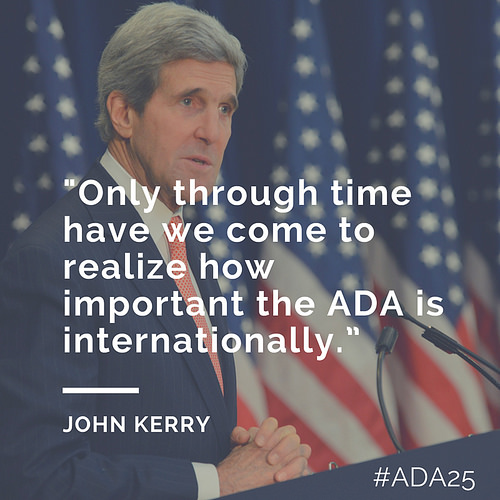
Only through time have we come to realize how important the ADA is internationally. John KerryI was at the gym watching the (x) news channel and saw a Marco Rubio ad. It was paid by his committee.

I was frustrated because it had no subtitles. It isn’t that difficult to get that part right. Not everywhere has the sound available while the TV is on. Not everyone can hear well. Are the candidates willing to communicate to everyone, not just those who can hear? The Americans with Disabilities Act is not new.

Do presidential candidates care about the disabled community? How do they show it?

Original image: John Kerry, quote on the ADA. By Exchanges Photos [Image license]

The Tree

This week I’ve seen news of a lot of really bad weather. Tornadoes, blizzards, floods…. It would be interesting to see an analysis of the costs. The National Centers for Environmental Information have studied the issue. Billion-Dollar Weather and Climate Disasters: Overview introduces some of the issues in performing an analysis. This graph is interesting and it has a cut off of events costing 1 billion or more, so it still ignores many substantial disasters.

Some people scoff that these costs are not serious, that they’re not increasing or that to talk about the cost of climate change as being a threat to the country is ludicrous. I think that is very ostrich-like–if we willfully don’t look at it, it won’t be a problem.

Some countries have higher stakes in the climate. Some of the Pacific island nations can’t survive the sea level going up–they won’t have any land to be a nation over. I remember the glaciers that have shrunken so dramatically in the Rockies. Greenland and the Antarctic are melting too. If you calculate the volume of ice in those two places and divide it by the surface area of the ocean, if even part of them melt, the ocean will flood many places. Eventually, beach front property won’t be a good investment anymore.

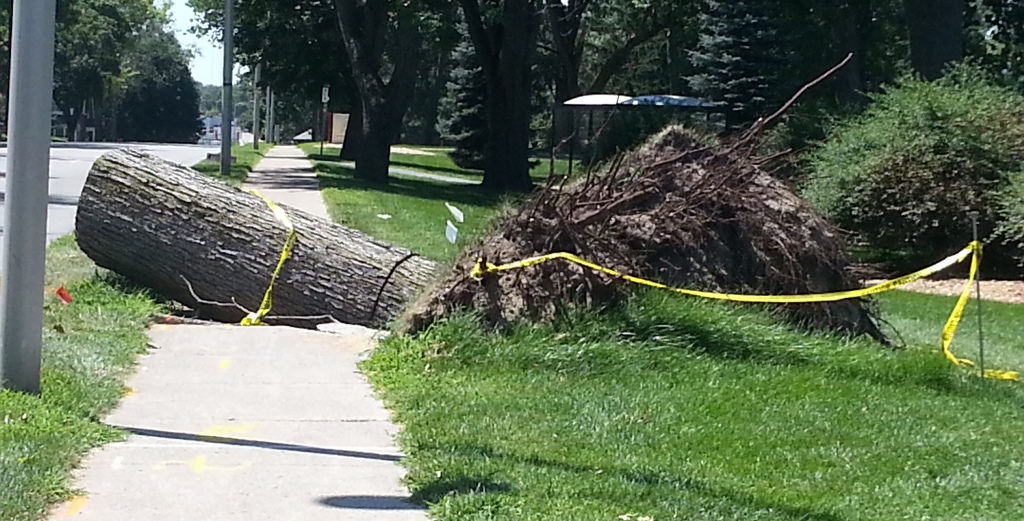
A fallen tree crushing the sidewalkBut, more to home, I found some branches on the sidewalk from my tree. I was pretty fortunate. None of them were really big–I could break them into smaller pieces with my knee. My neighbors to the west had more serious problems with their tree last year. The extreme cold killed about 3/4 of the tree and the city cut it down before it hurt someone. The picture isn’t of my tree, but I thought it fit–I’ve been really fortunate and am grateful.

The Unreasonable Virus

Recently, I was talking with a clinic’s office on the phone. I had trouble getting the information I needed. Until I stopped myself, I started thinking that they were trying to be intentionally difficult. It seemed that the person had set up arbitrary walls to keep me from talking to the right person.

I realized that my experience with past businesses that have unreasonable call centers led me to expect that all phone services want to avoid helping. I have called phone company A and they have many levels of menus that all lead to the same place: not talking to a human. If I do reach a human, they forward me through several offices who each provide minimal information. Credit card company W has many ways to get lost on their customer service number.

Rubber stamps on a carouselIn my recent experience, I’d been hit by the unreasonable thought-virus: The expectation that service businesses are unreasonable and provide as little service as they can. The virus goes to the level of expecting to be abused; that it is a normal way of doing business.

The thought is a virus because it can be spread. A service professional who’s had experience with unreasonable systems, will help propagate their own version of the same negative experiences.

Organizations that have good customer service help the virus go away, but it is a difficult thought to clear up.

Internet mega-services company G is really helpful. Every time I have a question, I get to someone knowledgeable right away. They help me with my questions and give some extra information for the likely next questions I’ll have soon.

I wish there were a lot more G’s and a lot fewer A’s and W’s.

Original image: Stamp Carousel . By Christian Schnettelker (see Webdesign Agency) [Image license]