The price of gas is flat

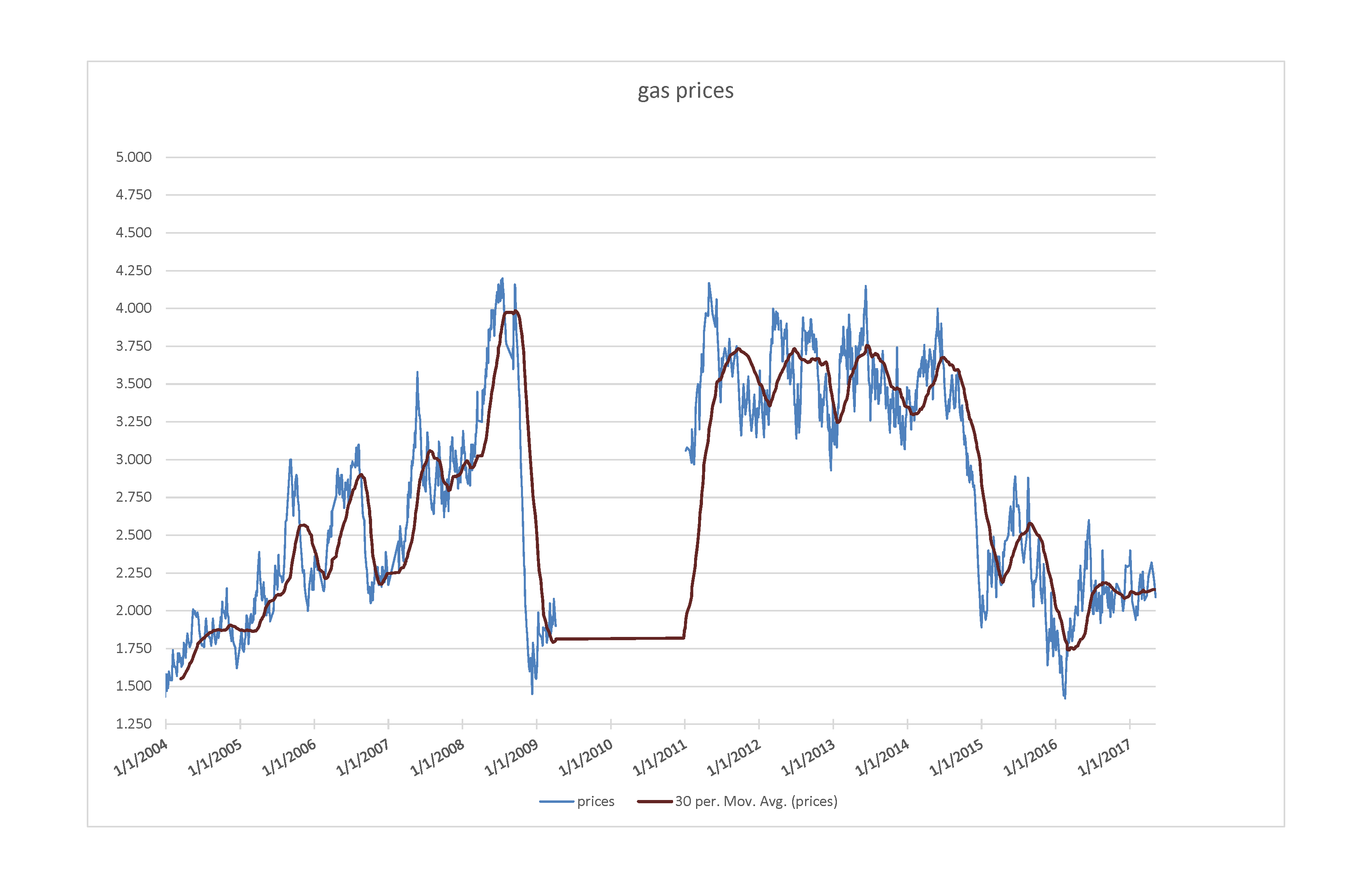
I keep track of how much I pay for gas. As you can see from the graphic, it’s really variable. However, the past 10 – 12 months, the price has been unusually stable. The red line is a 30 sample moving average.

The numbers for this graph comes from what I’ve actually paid for gas.  Most of the purchases are in the Northeastern Indiana area.

Several online sources blame the great recession on a sharp rise in the cost of energy.   A flat cost probably has the opposite effect of stabilizing the economy. One reason would be that it allows more effective planning by businesses that are dependent on energy prices.

An analysis of the factors leading to this price stability would be interesting to study.

A graph of the prices of gasoline from 2004 to 2017

(The gap between 2009 and 2001 is due to the loss of the file containing that information. I’ve attached a PDF with the same graph.)

GasPrices-2004-2017

1913 Bible

I went to the local antique shop and found this beautiful Bible. It has an engraved wooden cover. I also appreciate it’s using photographs for some of the illustrations inside the book.

Engraved Cover

The title page says that is the Authorised Version from 1913.

The inscription in the back of the title page reads:

“In terms of the Letters Patent granted by Her late Majesty Queen Victoria to Her Printers for Scotland, and of the instructions issued by Her Majesty in Council, dated Eleventh July, Eighteen Hundred and Thirty-nine, I hereby License and Authorise William Collins, Sons and Company, Limited to Print and Publish, as by the Authority of His Majesty King George the Fifth, an Edition of the New Testament, in Brevier Antique Type, decimo-sexto size, to consist of Six Thousand Copies, as proposed in their Declaration, dated the Twentieth day of February, Nineteen Hundred and Thirteen, the terms and conditions of the said Instructions being always and to all points fully complied with and observed by the said William Collins, Sons and Company, Limited. Dated at London, the Eighth day of March, Nineteen Hundred and Thirteen. Alex. Ure.

A couple of the plates include:

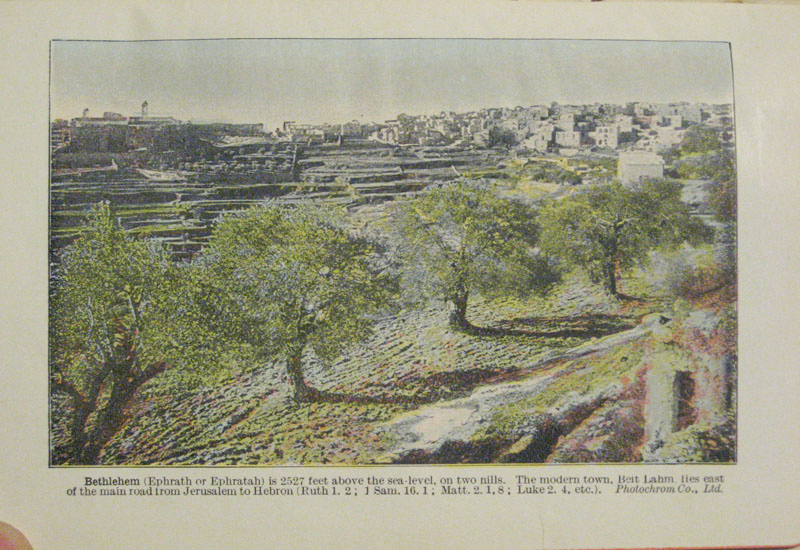
“Bethlehem (Ephrath or Ephratah) is 2527 feet above the sea-level, on two hills. The modern town. Beit Lahm lies east of the main road from Jerusalem to Hebron (Ruth 1.2; 1 Sam. 16.11; Matt. 2.1, 8; Luke 2.4 etc.)”

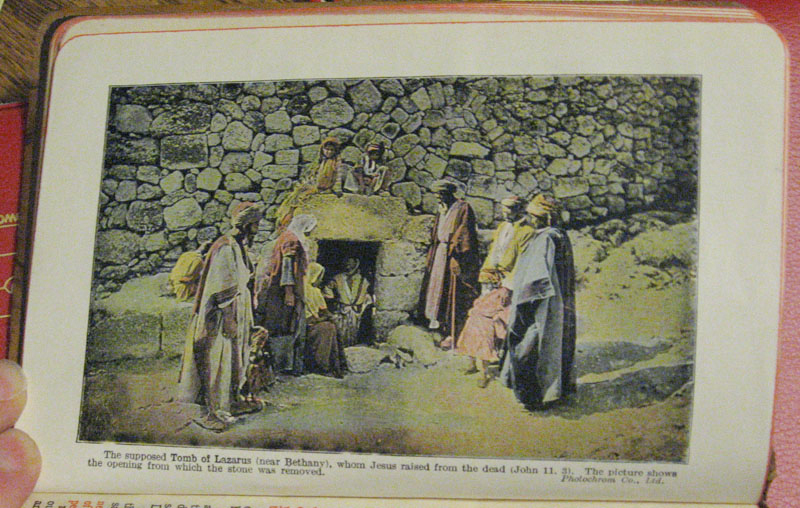
“The supposed tomb of Lazarus (near Bethany), whom Jesus raised from the dead (John 11.3) The picture shows the opening from which the stone was removed.”

Usually in my Bible collection, I collect different translations, but this is a beautiful enough volume, that I intend to keep it as a duplicate.

Imbalanced

The universal model for depression is that it a chemical imbalance in the brain. I have serious reservations about the value of that model.

The core problem with the idea is that it is disempowering. The message is “you can’t help yourself get better.”

What thoughts that follow once a person believes that their depression is due to a chemical imbalance?

  • I’m broken.” Since my brain is what I use for all of my thoughts and memories, I’m basically defective.
  • There isn’t anything I can do.” Chemistry is complicated; I don’t understand it, so how can I do anything to help?
  • It’s not going to go away on its own.” Since my brain is a bunch of microscopic neurons firing, they’re not going to fix something as severe as a chemical imbalance.
  • It’s a medical problem.” Doctors are the ones who treat medical problems, so I need a psychiatrist and medications.

When you cut your hand, you know what is hygienic. Rinse it in water. Keep it clean and cover it with a bandage. Watch for signs of infection or use an antibiotic ointment.

A person can be suffering and depressed. Today, the person learns very few tools for recovery. There isn’t any hygiene to practice; no prevention strategies.

A treatment plan might be little more than not to get worse. The tacit meaning of “chemical imbalance” is that a depressed person needs to look to doctors. Then, people with letters after their name can help make the best of it.

Although this can be an appropriate treatment, the model for a disease needs to be useful.

“Chemical imbalance in the brain” is glib. It rolls of the tongue so easily that it doesn’t get inspection. However, it doesn’t help anyone understand depression nor take action.

Don’t shoot the message

A well-known cliche is “Don’t shoot the messenger.” When someone brings bad news, don’t blame the messengers who brought it.

A related principle is “Don’t shoot the message.” This principle notes that a good idea that comes from an bad source is still a good idea.

A thought experiment:

Some physicians and medical scientists defect to ISIS. They discover a cure for cancer that is extremely inexpensive. In addition, this cure has a 95% 10 year survival rate. The cure is simple to use and very safe. What would you, as a patient, do with a cure that was created by terrorists?

One situation to apply the principle is in religious spheres. The spiritual principles from an incompatible faith community can still deserve a fair hearing.

Perhaps the most obvious way this principle is violated today is in the political arena. If the minority party in the Senate has a good idea, the majority opponents won’t consider it for more than a minute.

If you’re making a decision, don’t shoot the message.

Easter, Passover and refugees

A green thought bubbleThe coming of Passover commemorates God’s deliverance of the Israelites from Egypt.

Easter is intimately tied to Passover. Easter is a celebration of deliverance for Christians.

Exodus 22:21 admonishes “Do not wrong or oppress any outsiders living among you, for there was a time when you lived as outsiders in the land of Egypt.” (The Voice)

The outsiders of Exodus fleeing Pharaoh’s Egypt are no different than the outsiders fleeing wars and oppression today. Uncounted refugees are fleeing their own form of Pharaoh’s Egypt.

America can wrong and oppress them if it chooses. Our elected leaders appear to be at the front of the line….

Alone Together – Sherry Turkle

A green thought bubbleHere are some comments about Together Alone. I wrote them in response to a query about Sherry Turkle’s book “Alone Together.” They got to be way too long for the class forum, so I’ve put them here. The comments were prompted by the paper by Frank Pasquale “The Algorithmic Self:” Pasquale, F. (2015). The algorithmic self. The Hedgehog Review, 17(1). Available at: http://www.iasc-culture.org/THR/THR_article_2015_Spring_Pasquale.php

Alone Together by Sherry Turkle goes in two directions. The first direction is in discussing emotional technology–technology that can affect human emotions and attitudes. Examples go from the primitive, but compelling “therapist” ELIZA to a Furby and beyond. She’s dubious on the wisdom of them.

Paro is a seal-like emotive robot that was designed to comfort elderly people, which it can be successful at. It uses comforting sounds and interactions to help the person’s anxiety and loneliness. Sherry Turkle is appalled by that; She feels strongly that people who are in the end stages of their life deserve someone who can understand and share meaning with them instead of a piece of machinery that provides comfort through synthetic trickery, but shares no meaning. (Part of her attitude that led to the book started when she and other MIT researchers were testing Paro. The others were enthusiastic and excited while Sherry was turned away from that line of research based on, to her, the repugnance of the experience.)

Partly from her discussion and partly my opinionated part, The Algorithmic Self’s argument “If there really is no alternative, no human or animal available to show concern or affection, isn’t the Paro better than nothing?” is a false dichotomy. There are people who could care and support individuals, society just doesn’t value it. It could a service just as important as home health care workers and volunteers who support younger people that can’t meet all of their own needs.

People don’t see the elderly in a nursing home or those needing advanced support, so they can ignore the problem. The comment that “care needs could easily overwhelm private means and public coffers” should be shocking in that once people reach a certain level of disability, they’re not important enough to get human comfort and attention. “Where there’s a will, there’s a way” would be a relevant cliche.

The second part of the book is interviews about people who communicate with technology such as texting, social media and email and don’t deal with the messy person to person contact directly or through voice conversations. She considers the technologial dependency a psychological symptom from a psychoanalytic perspective. She reports on interviews and individuals’ ambivalence to the technologies, while still not being able to pull away from. Many couldn’t complete the thought that maybe it would be ok to do something different. Some people she interviewed weren’t comfortable, but didn’t see an alternative.

The subtitle of the book is “Why we expect more from technology and less from each other.” Her conclusion discusses the connection with her mother through saved correspondence. She hopes for something similar with her distant daughter. “Perhaps we need at least the fiction that we are not archiving. For surely, in the archived life, we begin to live for the record, for how we shall be seen.”

Everyone can be scientists

ThoughtsOne things scientists do is to perform experiments.

Some experiments are really technical. Measuring the position of atoms or the properties of a supernova. Determining what nutrients an amoeba needs to thrive and how to diagnose prostate cancer.

I don’t know how to do any of these. I know that there are people trained to find the answers. As experts in their field, they have experience and skills that are more trustworthy than my friends.

Even so, my friends and I can all do experiments. We don’t need to pick up a ruler or pencil. No paper, measuring cup or calculator needed. You can do the same.

The most powerful experiments are thought experiments. Human minds have intense abilities to imagine.

A thought experiment uses that imagination to reveal the truth.

What if ….

The almost empty glass of the Spectacular Age

Thought bubbleThe question of the day is “is the glass almost empty or is it almost full?”

The lens that identified a glass as half empty or half full hardly seems relevant. Such subtle semantic differences don’t matter in the Spectacular Age we are in.

I noticed a bumper sticker today. “Refugees Welcome” with the outline of Indiana. I suggested to a friend that it was really a good message. My friend was concerned that we’re running out and can’t afford such people.

It made me think about how much American perceptions are disassociated.

One can look at the glass and see that it is almost full. We have enough creativity, dedication, courage and hope to solve the problems facing the world.

Or, one can see an almost empty glass. The government is too expensive, the cost of doing business is excessive, society is about to collapse and only radical action can help.

I don’t know how to find a way to pour from my almost full glass to help relieve the thirst of the almost empty glasses. Do you?

Memories

Recently, Pandora put on one of my feeds “Year of the Cat” by Al Stewart.

I hadn’t heard the song for a long time and after hearing it a few times, I decided I wanted more like it.

I created a Year of the Cat channel and have been rewarded with a lot of nostalgia.

With my tablet playing it, I get all of the late 70s music I could ever ask for.

Some of it is pretty awful, but I get a lot of nice memories from the non-awful stuff.

Why a (bald) chef wears a hat

I was cooking a burger and some sausage on the stove tonight. After a I realized the top of my head was feeling uncomfortable.

Then I realized that the grease spattering in the pan was flying up and hitting my scalp.

Now I’m in the market for a chef’s hat!