Bing is certain

I was imagining a different world where lead was a deadly poison and how history would have been changed as a result. By deadly poison, I mean that it would quickly sicken and kill someone. Our lead is toxic, but it is more of a chronic poison with damage that builds up over time.

My first thought was that the Romans couldn’t use lead in their plumbing projects. Perhaps they would have used iron or bronze. That might have delayed the process of building large cities until they could mass produce an alternative technology. Finding an alternative soft metal would be challenging. Perhaps a silicon or tin alloy would be easy to use and plentiful.

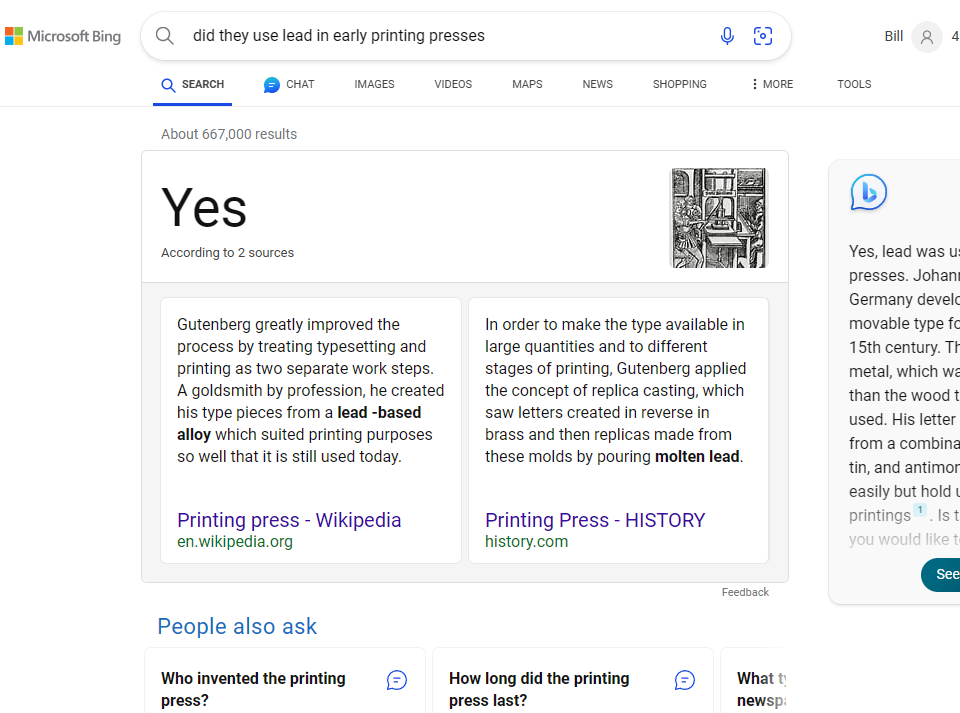
The next technology I thought about that would have been affected by lead’s toxicity is the printing press. I remembered that lead was used in the type slugs used in the printing press. I asked Bing to verify that Gutenberg used lead and it came back with an emphatic:

It’s nice when technology can be confident about the information it presents!

The history reports that Gutenberg was a goldsmith. I suspect that he if couldn’t use lead or an alloy of lead, he would be able to find other alloys that would meet his needs. He wouldn’t have been delayed much. (But obtaining an alternative might have been more expensive.)

Looking deeper, I can see that my understanding of lead’s history is pretty limited. There have been many other uses of the metal. Even modern plumbing has used lead as Flint, Michigan, discovered. I even forgot about an everyday modern technology, the lead-acid battery.

Answering the question what the world would be like would needs an in-depth study of history beyond an initial couple of ideas that first come to mind. It would be a fun thought experiment!

Black hole moderation

If someone violates community guidelines, they can be given a suspension or ban.

A suspension is a temporary hold. It could be a warning that is meaningful for someone who is pushing the boundaries too far and needs a digital rap on the knuckles with a ruler. A ban, forbidding access to the site, can be appropriate for people who are malicious and harming a web site’s community. Once they are pushed out, over time, their influence will be fade.

Black hole moderation is more demonstrative way of rejecting an account. To implement a black hole moderation decision, all content created by the user will be erased from the site. The incentive for such users to leave a “mark on the trees” will be eliminated.

Although black hole moderation could be a disincentive to bad actors, it might be painful to the site. It would not be something done lightly. For example, content that is copied into a reply or reposted might also be deleted. Technical solutions for such a search and destroy mission would be interesting to develop.

In a simple example, black hole moderation on DeviantArt would remove all of the user’s messages, art and interaction. On a message board, the hosts would remove all of the user’s messages and interaction with other users. Very difficult examples of a black hole moderation would occur on crowdsourced sites like Wikipedia and Fandom.com.

Adding black hole moderation to social media sites might be more useful and less difficult.

The purpose of the black hole moderation is to give a disincentive to the troll who incessantly adds bad content that doesn’t quite breach community standards but when taken as a whole is harmful.

If privacy of an individual can justify the right to be forgotten, black hole moderation embodies the right to forget.

The Red Book

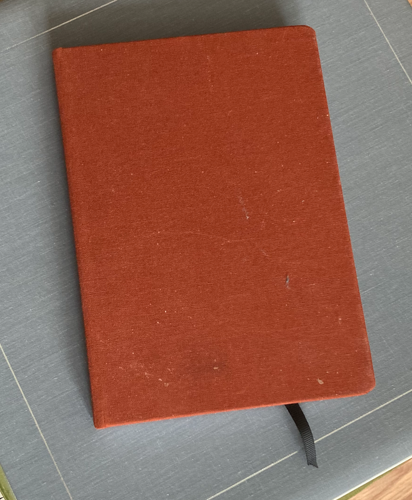
A couple years ago, I bought a notebook from Bespoke Post. It’s a very nice book with a red hard cover and a ribbon bookmark. I’ve been using it as an alternative journal.

Several years ago, I trained myself to write with my left hand. To build the skill, I would journal with it and scribble the alphabet. My left hand is definitely slower and less legible than my right. However, my penmanship is strong enough now. I can consider myself left hand an adequate writer.

I’ve read that the left brain has verbal processing capabilities and my right brain, controlling to my left side, is mostly non-verbal. My thought is that, if I would write with my left hand, I might kick-start the language capabilities of my right brain. Maybe I could access new ideas and new modes of thinking.

Once I got the Red Book, I started to explore that idea. I write the text by alternating words between my left and right hand. It goes more slowly than typing or writing the journal with my right hand solo.

I don’t know how to analyze the differences between the words from each hand. Is there a vocabulary shift? Am I more creative or more non-linear? It’s interesting to ponder ideas like this but not interesting enough work for an answer. One definite effect of this mode is that I write more slowly. I don’t plan my text more than a couple of words ahead and I often don’t write my first thought.

Eventually, I transcribe the Red Book notes and edit them into something worth sharing. Often the released versions of the journal are pretty fantastical as they mix imagination with real experiences. I blur the edges between the two.

I don’t have the scientific expertise to analyze the results of my experiment. I’m not sure that it even qualifies as an experiment. Perhaps, it is an ethnographic exercise to reveal text that might not be uncovered in an interview or a typewritten essay.

I find the Red Book to be a generator of ideas. I try to synthesize interesting posts from its pages.

The Pristine Forest

Walking through a pristine forest is not possible anymore. Even though I can go anywhere I want, it’s not possible to see this place as it once was. I find paths that are cut through a once-wild understory. Someone was here before me. To the left, I could step over a fallen trunk. On the right, a thornbush flourishes. There’s a bridge over the creek. Its wild water has been trained to stay tame now. The streambed is leveled out and the woods are ready for every season.

I can also travel to a remote railroad bridge. It is barren with a stone underpass cased in graffiti. The names of people, long gone, are sheltered by the tracks passing above. I laugh and imagine that they are buttressing the walls with their ink. Other names are carved into the stone that will last as long as anything.

My mind has its own paths made of persistent memories. They are reinforced by the phantoms of sad dreams and shadows of regret. I demand that my mind can solve its own dilemmas. When their patterns persist, they show me that I carry their burden anyways. They confuse the neural channels with wasteful thoughts and I grudgingly admit that more will follow. Rarely pristine, my memories should help me grow wiser but instead they make me stumble.

I look around my house and see reminders of when I had been free. Mementos fill the shelves. I wonder who I should remember and where they came from. Many are gifts of old friends’ love. I know someone took time to find them yet I’m heedless and don’t notice them as I pass from one room to the next.

There is plenty to see in my neighborhood. When I walk past the church, I see the trees that have grown tall around it. Their refuge has become its own pristine reality. I see how they too are trails that I can follow. I’m not sad about the changes I see and enjoy them as gifts from an unseen caretaker.

This Blog’s Pages

Each New Yorker issue includes a short story. It’s one of the reasons that I like the magazine. Their website also shares an interview with the author about the topic of the story. There is often a podcast with the author reading their story.

I’ve been building a table with links to these resources. In addition to keeping the table current, I am working through the New Yorker archives to extend the index backwards in time. The table is behind the upper right hamburger menu. The list also includes a link to each issue’s landing page.

I have two other pages available right now. One is an index to the “link dumps” from Evil Mad Scientist Laboratories. The links are down the page, below a description of the Evil Mad Scientist’s project. EMSL just released another link dump for April 2023. Their link dumps are a list of cool websites that they find. They are interesting and the archive is worth exploring.

The other page is an index of the movie reviews that I’ve posted here.

So, if you like good short stories, the New Yorker fiction page links to a growing collection.

Review: Looper (2012)

Time travel. What if you went back to disappear? If a Looper is waiting for you, nothing but an appointment with a blunderbuss is your welcome party. Once you’re killed, the looper gets a deposit of silver and another chance while the mob 30 years into the future has solved the sticky problem of where to hide the body.

With the arrival of TK (telekinesis), doped up guys can pick up girls by magically floating a quarter in their hands. The world of a looper is surrounded by mob-run cities and vagrants wandering the countryside hoping to find another meal or fix.

You can escape this dystopia as a looper when you get your golden ticket: taking out yourself when you are sent back with a cache of gold. This closes the loop and gives you 30 years to celebrate your freedom until your irreversible doom when you are sent back. Joe (Joseph Gordon-Levitt) is a looper planning for his escape by caching up his silver.

The consequences of letting a hit go creates an urgent rush by the present day (2034) mob to prevent time travel paradoxes to muddy the world. How much more so if you pass when your loop is being closed. Seth (Paul Dano) lets his old self go (Frank Brennan). Joe is convinced to give Seth up to the wrath of boss Abe (Jeff Daniels) to gruesome results.

Joe’s loop is to be closed, but Joe from the future (Bruce Willis) is determined to prevent his wife thirty years hence from being killed. Joe’s memories fade and become solid as the future gradually is linked with his past.

The film is able to bring the time travel genre to a grimy finish. Time travel, being illegal, is only used by future criminals. Old Seth shows how acts in the present affect his physical body as they are telegraphed to his future body immediately. Seth doesn’t remember that past so that he is surprised by the mutilations that he undergoes as retribution.

Sara (Emily Blunt) is thrown into the time travel maelstrom when her son becomes a target of Joe’s attempt to preemptively fix the future he remembers. Her son Cid (Pierce Gagnon) has TK abilities like his mother. They live on a cane farm that is normally insulated from the big city’s problems. Cid is an angry child that Sara tries to encourage with her love for him.

The technology of Looper is not that advanced although some people have glamorous flying motorcycles. There is a popular drug that the mobsters use. This affects the tenor of the action and the chaos of the addicted characters.

The soundtrack by Nathan Johnson adds to the tension and destruction with a sharp, angular score that drifts the mood into progressively increasing danger and accompanies one through a world that has gone wrong.

The Pond

I remember the odd rectangular pond. It was near the old road down the hill. Looking back, I think it was dug for a construction project years before I was there.

The water was full of algae and I saw a lot of frogs and salamanders there. Sometimes I saw some egg clusters in the Spring. They were a glob of small marbles with a little bit of dark in the center. There were tadpoles sometimes too.

There was a real lake near there. The beach was rocky with only a little sand. They gave swimming lessons in the summer, but I always failed. I couldn’t get over the unpleasant feeling of the water up my nose.

I wonder what the other kids thought of me. We lived far from town and we never went to parties. Or at least I never did. I was too busy reading encyclopedias to go out and play sports or hang out. I was terrified of getting in trouble. I would feel a horrible burning sensation on the back of my neck, so I stayed good.

I didn’t know other places to find salamanders. They were exotic brown amphibians that usually ran away before I could catch them. They had little toes on their feet. I think their legs were more coming from the sides of the bodies instead of below.

I was glad when “mud season” was there. The clay ground near the surface had mud underneath it so that you could squish on the top and water would come up through the cracks. I’ve always liked playing with water.

Our house had a metal roof that was painted green. My bedroom was upstairs so when the rain came, it made a lot of noise. The outside of the house was cedar shakes. The slabs of wood were layered on each other. They changed color as they aged. My parents liked their memory and included them in the Indiana house that was on a hill.

The Vermont house is still there as is the maple tree that hung the swing. It was big when I was little. Now it must be huge.

Cooking

From the red book…

They say I’m a good cook. I try new dishes. Just tell me the ingredients and often I can figure it out. I’m always learning.

Sometimes my mom wasn’t a very good cook when I was little. Sometimes the scrambled eggs had shell fragments. But once I grew up, I have some favorite dishes that she made. Her pot roasts had awesome carrots onions and potatoes. The chuck roast was ready to tear into and I would cover it all with gravy. I always put pepper on top.

We had a beverage we called pond scum. It was a couple different Kool-Aid packets with 7-Up. Usually, it was only for parties. Another dish we had that I loved was “beany goop” which was a casserole with different kinds of beans in it and a breaded topping.

One of my friends says that she has to follow a recipe religiously careful. I’m more flexible. I don’t think I’m a cooking heretic. I just have things I make.

The old kitchen had shiny copper titles on the wall. There was a window over the sink looking out at the field and the mountain behind it. The dinner table was off to the left and we had a lot of family dinners there. I don’t remember much specific besides my insistence that “no singing at the table” was a rule.

I get a little sad when I think of those days. We lived far away. The school bus took us in to school. I sat in the middle on the right. It let me watch the roads go by and I could stay out of the target of the mean kids.

In the winter, snow drifts piled high. I liked playing. We would lob snowballs at the trees. The weather never seemed radical back then. We got rain when we needed it and the snow was not oppressive. For some reason, I don’t remember shoveling snow. We didn’t have a sidewalk—living out in the country, there wasn’t any point.

I remember the snow cones with real snow. We would dribble maple syrup on them. It was nice.

I’m a late bloomer in my cooking. When I was in school, I didn’t cook much. I don’t remember anything to remark on. I was glad that I could eat in the cafeteria. Sometimes I have nightmares that the cafeteria would be out or that I got there too late. My cooking now might be a subconscious wish to never be late.

My First ChatGPT

I dialed into ChatGPT today for the first time. I was pretty happy with my experience. I didn’t intend to bang on my shiny new toy with a mallet but rather use it as something to enhance my life. Thus, I didn’t intend to expose its political biases or trick it into acting foolish, inappropriate, or to provoke controversy.

However, it’s easy to want to probe the boundaries. One thing I did in that vein was to ask for its favorite tongue twister. It gave me one that was pretty easy. It used phrasing that I took to mean that this was a “classic” tongue twister that might be well known. The tool also mentioned that since it was just a language model, it didn’t have a personal preference. (That’s the gist of its disclaimer, not the exact wording.)

Perhaps, going back to my first experiences with Siri, I could wonder whether there were easter eggs hidden in ChatGPT. Siri was obviously programmed to have clever answers to certain stock questions. Why would I admire this tool if it had the same tricks? I would be disappointed rather than impressed if they were there.

After getting used to it, I decided to use it for something useful. I’ve been writing some JavaScript code lately and I wondered whether it could help me learn more about that.

I directed the conversation to JavaScript generator functions and async functions. It gave useful information. For one question, the code it generated didn’t match the explanation. However, the concept’s description was accurate, and the coding error was obvious. When I continued questioning about other features of JavaScript, I opened a tab and used DuckDuckGo to point me to a developer.mozilla.org article to confirm its description. I also got more thoroughly vetted information there.

I used that additional info to direct the conversation further. I also turned to caniuse.com to see whether one language feature was commonly available in different browsers. I was impressed that ChatGPT was explicit on reporting the different versions of ECMAScript involved. That helped identify when certain syntax was added to the language standard. Some of what it explained went over my head. I need to use those features in real code and read the explanations again. Also, it assumed I understood a related feature better than I actually do.

To me ChatGPT is not a toy. It can be played with, certainly. But so can a can of whipped cream. I don’t learn much playing with either. Eventually I’ll knock off the valve or make a mess to clean up. I’d rather learn how to use it efficiently. The language model is not god-like or without flaws. A word processer’s spell checker is not without flaws either, so I learned how to use it efficiently and moved on from there.

When I was done, I tried to capture the discussion by copying the text and pasting it into Word, but the code that it generated didn’t paste properly. The line breaks in the code were lost. Another problem was that I was pasting white text in a document with a white background. When I went to Acrobat Pro and pasted it using the Edit Text tool, the pasted text came out correctly except that the font changed for the code.

If I represent something that ChatGPT does as if it were my own work, that’s simple plagiarism. It might appear to pass when writing a blog post or two, but a professional writer shouldn’t use it as a substitute for his or her own work. Even using it to improve a paragraph needs more effort. I should use my own words instead of mimicking ChatGPT’s robotic syntax.

I asked it to improve three of paragraphs here. It didn’t understand what I was trying to emphasize. One “improvement” was such a mess that I couldn’t use it at all. The other two were far from my normal style–too formal with a stilted vocabulary–and had to be overhauled. Mostly, I used them as an inspiration for further editing.

My attitude can be to treat it more as a thesaurus than as a copywriter-for-hire. You have to know what you’re doing when you use a thesaurus.