ISIS and Radicalization

It would be easy to find people willing to condemn ISIS as evil. They would also prosecute people who are beginning to be radicalized to prevent them from supporting the terrorist organization.

However, that quick leap to judgement is not helpful in eliminating terrorism. Once you label an organization as evil, you can get lazy.

By focusing on the evil of ISIS, you don’t need to understand them. In addition to defeating them militarily, we need to combat the political themes they promote. Without understanding why ISIS is attractive to some people, we can’t deny them the thought-virus that they spread.

I never see the grievances and concepts that nourish the ISIS movement. The public message is that they’re evil and that’s all we need to know. We want to prevent radicalization, but don’t try to understand the process as it develops.

When the news reports someone as being radicalized, we can get lazy again. We don’t have to understand what they believe or how they arrived there. We don’t have to see the reasons that they embraced violence and hatred–there’s no reason to see that because we’ve already cast them out. But that’s too late in the process to make a difference.

David Talbot in “Fighting ISIS Online” (MIT Technology Review. Nov. 1, 2015. v. 118, no. 6) describes that contacts from friends and peers can help the propaganda create new recruits. But he also describes that friends and peers can be persuasive in pushing back. It can take a small intervention to be beneficial. The article describes how one-on-one contact was able to reverse a transformation that the FBI was watching from a distance, yet impotent to change.

Working with friends to help them see a different perspective doesn’t let you release sexy rhetoric about our war with ISIS. However, it does help combat the organization one person at a time.

A sympathetic ear and supportive encouragement can work where the pronouncements of the powerful are failing miserably.


Listening

I’ve learned that when people close to me are skeptical about a task I want to do, listening is a wonderful skill.

I was going to take two classes this summer, but listening showed me that that’s probably not a good idea.

I think it would be cool to build a photographic collection of hubcap designs. One part of the project would photograph the front and back of the car so that I could look up the car’s year. Listening said that that’s probably going to creep some people out, so perhaps it’s not a good idea.

The product of two minds is probably better than one. It only adds up.

The Facebook Experience

I used to have a facebook account, but was very dissatisfied. I wasn’t comfortable with its addictive nature. Also, more often than not, I was self-conscious about adding information that didn’t fit social norms in times of stress.

It seemed that people preferred to submit clever graphics and people could leave the real “them” out. Just put up a facade–all is well. The last straw for me was when they suggested that I might be employed by a fellowship I belong to.

The reason the facebook topic came up with me again is that a course at IUPUI that I was thinking of taking included facebook postings as part of the coursework. I didn’t really want to get an account again. Hence the conflict.


Dr. BJ Fogg at Stanford University has studied persuasive technology. He calls it captology. His definition of persuasive is slightly different than the natural one. Persuasive means to cause a desired behavior. It isn’t about the cognitive persuasion to think about an issue a certain way. In his method, you pick a behavior you want to increase, make it easy to do and then prompt the behavior. The behaviors can be tiny such as to click a “Like” button or complex and have you to log in and update your content.

Facebook uses persuasive technology to increase income for the company. The users of facebook need to encourage people to advertise there. “Like” is a simple behavior. It seems to indicate that you’re engaged with a vendor’s products and services. On Veritasium, https://www.youtube.com/watch?v=oVfHeWTKjag suggests that a “like” may not be what it seems.

The part where I get uncomfortable is that facebook has covert information that it can use to manipulate the interaction. People think of the website interacting solely with them, but with billions of users, facebook knows how people act in aggregate and can notice how to make a change with a tiny impact but is statistically significant. By combining these impacts, they can be manipulative and do it without being detected. They can manipulate the users and they can manipulate the advertisers.

One can’t be naive and think that facebook does things are solely for the benefit of its users. When one starts a post and then erases it, facebook’s software can notice. Since they know when this happens, they can find ways to encourage people add content more freely. They also target what you see to what they know you are more likely to attend to and not what you might value.

They knew that many of my friends belonged to a fellowship, so it was natural to blindly propose, to me who hadn’t listed an employer, that I might be employed in the same place.

With facebook they are capable of knowing more about you than you can imagine. They use that to make their shareholder’s wealthy. When I see an ad on YouTube, I know it is an advertisement. I can ignore it if I want. If you’re being persuaded to participate in advertising without knowing that you are being marketed to, that’s where the facebook experience is letting the smoke and mirrors conceal the real interaction. In “Captology and the Friendly Art of Persuasion” by Lynn Griener (*) comments “Advertisers may, for example, be able to get away with sneaky and intrusive tactics” and that “facebook must play it straight.” However, with huge data resources and insatiable stockholders, facebook’s straight can be pretty crooked.

(*) Greiner, Lynn. “Captology and the Friendly Art of Persuasion,” NetWorker, Fall 2009. doi: 10.1145/1600303.1600306

Flowering trees

It’s really beautiful out in the neighborhood. The fruit trees are covered with beautiful white flowers and the trees are starting to bud.

My sister says that it’s miserable if you have allergies. I’m grateful that I don’t.

One of the coolest websites I’ve found recently is http://hint.fm/wind/ It gives an animated map of wind in the continental U.S. It’s updated every hour and is always interesting. I had always believed that the prevailing wind direction for northeast Indiana was from the west, but the maps don’t seem to agree very often.

Evil Mad Scientist’s link dump for the month http://www.evilmadscientist.com/2016/linkdump-march-2016/ revealed this video showing circuits being deconstructed by a CNC router layer by layer. https://www.youtube.com/watch?v=RHqN6CTOdzA

It’s a good day to share the beauty.

A Colorful Sky

I look out my window and see the rain falling. The street is wet and the winds are calm. Recent days have been gloomy, but today is a good day to spend with a friend.

The shadows that come each night are not so frightening that they keep me alone. I see the moon rise and a beautiful constellation expands above me. I have nothing to fear and it is good to be here today.
A man fishing in the ocean waves
The ocean won’t wash me away today. I walk through the town and find new places to go. I’m glad that I am here today. I am glad that the sorrowful days have passed and I have much to look forward to.

Light comes down in a fabric of glistening pearls. Singing birds glow in its beauty and dance on the branches. A squirrel runs by and it is time for the roses to grow.

Although the sky is gray today, I know that I will see it’s colors soon. A blazing sun is fleeing the day and my time alone is near an end.

The land that surrounds me protects me and helps me rest. I will work in the morning and follow my path into tomorrow.

Original image: Each of them is fishing. By Corn Farmer [Image license]

Indiana Driving Plus & Minus

On my way home from Fort Wayne tonight I ran into an awkward driving situation.
A police car with its lights on
I was on I-69 and near my exit, a police car had pulled someone over. Just as I was passing them, they took off. I ended up being in the left lane with the pullee ahead of me on the right and the puller right behind me in my blind spot. I was exiting the interstate in about a mile, so I needed to switch lanes.

It was very uncomfortable because I didn’t know how trigger-happy the police officer was. So, gulp, I turned on my right turn signal and accelerated above the speed limit so that I wouldn’t cut off the police car while I was changing lanes. Of course, the pullee was accelerating conservatively, making the merge even more awkward. Anyway, nothing bad happened.

So, this is where Indiana driving gets a ‘plus’. About a dozen years ago on the toll road I-80/90 across the north edge of the state, there was an accident where someone got killed by a truck passing too close to a stopped vehicle. (I remember that it was the man who had been principal of my high school.) The legislature passed a law that says that if an emergency vehicle is on the side of the road, you need to either pull over to the other lane or slow down.

In practice, 95% of the time that means that drivers pull into the next lane. The behavior has generalized to other situations where someone is on the side of the road. I think this improves safety by reducing the situations that traffic passes too close to a stopped vehicle.

Indiana gets a ‘minus’ for a law that just started in 2015: If you are in the passing lane and someone comes up behind you, you have to get into the right lane. That sounded good (to someone), but it comes with a $500 fine and just to be perverse, the fact that the person coming behind you was speeding is not a defense.

The effect of this is to create a lot more tailgating on the highway. People get rude when they think the car in front of them isn’t getting out of the way fast enough. Lately, I’ve seen plenty of examples of 7 or 8 cars scrunched together in a space that probably should only have two. In addition, some people take the get out of the way edict too seriously and pull back out of the passing lane less than a car length ahead of the slower car. All in all, lots more tailgating to prevent a situation that is not very common.

I think this law is making things less safe, not more safe because of the increased possibility of chain-reaction accidents.

Original image: Police Car Lights. By Scott Davidson [Image license]

Toastmasters International Speech Contest

I went to the Fort Wayne Toastmasters International Speech contest today. It was nice. I met a bunch of new people and also saw a bunch of people from my home club.

There weren’t a lot of contestants, but they were all really interesting.

A friend came with me. Maybe he’ll join soon? He had to leave early.

I was a little off-put at the beginning because it seemed like everyone else was wearing a suit and I just had dark pants and a tan shirt. Next time I’ll dress up more. After I was there for a little while I saw that not all of the men were in suits so I felt a little better after that.

April 16 is the next level of the contest. I hope to be there as well. I might even be able to be a judge….

My next speech is the 24th. I’m probably going to share something about Tao Te Ching, the Quran or other sacred writings. My club tends to be pretty Christian-oriented, so it’ll be nice to give a different perspective. The club is Anthony Wayne Toastmasters #521 if you want to come visit.

I lose an hour tonight, so I’m going to bed early. I’ve got all of my clocks adjusted. (The phone and computers will take care of themselves.)

XMLIN, XMLOUT

tShirt "I Heart XML"
In addition to the standard STDIN, STDOUT and STDERR I/O streams available to processes, the concept of XMLIN and XMLOUT streams could be very useful. I’m not talking about XML pipelines such as described in https://www.w3.org/TR/xml-pipeline/ I don’t want to make tools that are programmed to manipulate all XML but rather use XML as an encoding of the data that is more flexible than flat files.

In a pipeline of processes, passing the information as structured data would allow the pipes to analyze information in a more intelligent manner. I would treat the XMLIN/OUT streams as a sequence of XML documents. The goal would be to help in processing complex data.

I have growing tables of user properties from deviantart. I could create filters to extract fields of the data and format them as XML. This formatted data could feed more specialized tools later in the pipeline.

For example, I could extract the number of works that each user has over time. The first filter would extract all of the records for each user. The next level in the pipeline would perform a regression analysis and the final tool would encode the information graphically.

Information formatted as XML allows more generic tools. They will be able to ignore information that the an earlier tool produced more easily. Tags that are unexpected will be invisible. When formatting the information as flat text through STDIN and STDOUT, the tool has to know to ignore column 3 and 5 more specifically. XML can make the data more robust.
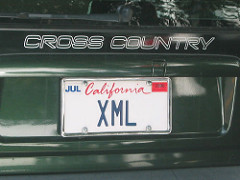
XML license plate
One reason for logically separating STDIN/OUT from XMLIN/OUT is that filters may work in either mode. If an standard tool is useful, it will use the data from STDIN. It won’t negate the more general purpose formatting from XMLIN. Alternatively, STDIN could pass configuration information while XMLIN is data based.

Implementing two input streams and two output streams in a way that is cooperative is a technical challenge. Opening the extra pipes is easy, but the tools could easily deadlock if it was done incorrectly.

Embedding the XML and free format output as an escaped sections of the normal STDIN/OUT pipe is another possibility.

In a less ambitious project, XMLIN/OUT would just be conceptual and the filter apps would have flags indicating which mode to use.

Original image: P9150078. By Steve Singer [Image license]
Original image: XML. By lambdageek [Image license]

A Mouse in the Mountains

A long time ago there was a small mouse who was all alone in the mountains. He could never find enough food and was always hungry. He longed for his home on the plains where he grew up. Mouse

Each day the mouse would search for something to eat. He would go from shrub to shrub hoping to find something to eat. Sometimes he would find a pine cone while other days he might be lucky and find a walnut or acorn. Wherever he went, it was never enough.

He was getting desperate and lonely. A wise crow watched him struggle in the brush and wanted to help. He called “Mouse, what do you need?” His voice was lost in the wind. He flew down closer and asked again. This time the mouse heard the question.

He replied, “Wise crow, I am all alone in this giant forest. I never have enough to eat. Every day I feel lost and alone.

The crow asked, “Are you far from home?”

The moue replied, “Yes I am far away from the fields of my childhood. I wish I could go home.”

The crow thought carefully. He said, “I am too old to take you there myself, but I know a young eagle what would enjoy the expedition.”

“But wise crow, won’t he eagle eat me and not take me home?”

The crow said, “The eagle’s family owes me greatly. They are an honorable people. He will do this for me if I ask.”

The mouse thought about how hungry he was. He was not sure, but after a while, he said, “Ok, let’s go!”

The crow flew away and soon an eagle came.

The mouse said, “Powerful eagle, I am so small. I am afraid of your sharp talons and giant beak.”

The eagle said “Dear mouse, do not fear. I am doing a favor for wise crow. I will get you home safely.”

The mouse and eagle lifted off into the sky and flew toward the plains.

Many hours later, the travelers arrived at the plain. The eagle said “See small mouse, I have kept my word. Be kind to the people you meet and remember my gift.”

Little mouse said “Thank you kind eagle. I am forever grateful.”

After a few weeks, the mouse found enough food. He wasn’t hungry any more. He remembered the mountain and was glad that life was so much easier now.

Later, the mouse met a tiny cricket. They became friends and were always together. The cricket had his own story of being rescued. Not too long before he met the mouse, a cardinal attacked the cricket. A cat in the field saw the bird and chased it away before the bird was able to eat the cricket.

The mouse said, “I am so grateful for these strangers. The eagle and the cat. Without their help we would have never met.”

As their friendship grew, the always looked for opportunities to be a kind stranger to the others on the plain.

Life was not always easy for the mouse and cricket, but the chances they found to help others kept them busy.

In the end, they took their difficult times and used them to make the world better. They felt that if that did not give to others what was given to them, they would become hard and cold.

Now that they have lived many seasons, they see how much they had to offer. They became a warm source of light for their neighbors. All of this joy was the result of one wise crow offering to help a helpless creature in the mountains. Now they are also wise and give to everyone they meet.

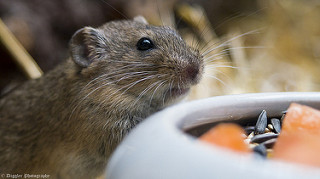
Original image: Mouse. By Diggler Photography [Image license]