Contribute to Wikipedia

Wikipedia has plenty of ways to contribute. The obvious one is to add content or edit pages. There are also many “WikiProjects” There’s something for everybody’s taste.Wikipedia sphere

Some of the projects cover different topic areas: Bacon, Batman and Birds

An assignment for a class last year sent me looking for a WikiProject. I found the Maintenance project Citation Cleanup and then I specialized into “Pages with broken reference names” It’s fairly esoteric and the list of things to do on the projects is unbounded. Knock down one page by fixing its citations and there’s ten more waiting for attention.

It’s interesting to learn the inner workings of Wikipedia. I don’t have to do anything more than read it, but by contributing I take a little bit of (mostly anonymous) ownership.

I learned that there are robots that go through the encyclopedia that identify likely vandalism. Others find citations that look similar for a person to make them consistent. There is a robot flotilla helping out. There are guidelines for making your own robot.

As I looked more and more into the inner workings of Wikipedia, it seems to be more of a community. I don’t have to worry about “breaking” it and I can, in my own small way, make a contribution.

Original image. By Wikipedia [Image license: CC BY-SA 3.0]

Hot Glass

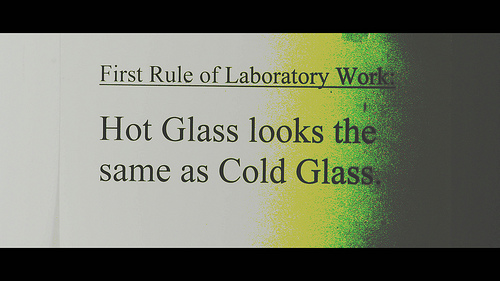
First Rule of Laboratory Work
One of the lessons from my chemistry classes in high school was that “hot glass looks like cold glass.” This was a lesson like “don’t touch the stove or you will get burned.” I never felt a need to verify this.

However, hot solder looks like cold solder. I was working to test my “ARC Generator.” I have a bench power supply. I was trying to protect the LEDs in the ARC generator from accidental shorts as I probed them by limiting the current & voltage on the power supply to a safe level.

I was getting pretty frustrated. Nothing was happening. I even tried powering up my little 5V regulator on a proto board and nothing happened there either. I decided to test the test equipment and I found that the red power lead was open. Then it became really obvious because the connector fell off onto the floor–cold solder joint.

I pulled out my soldering iron and solder and tried fixing the cable. The first try was a failure because when I picked the (supposedly) repaired wire, the tip fell off again. This is where the hot metal looks like cold metal applies: I tried to tap the loose part on the floor to gauge if it was cool enough. Well, it wasn’t. I picked it up and burned my fingers and tossed the piece of metal across the room.

I was more cautious on the second try and I think I’ve got the connection solid.

So, testing the testing equipment was a win. Picking up a piece of metal that was just soldered was a fail.

…and I still don’t know if the LEDs in the ARC generator (á la Iron Man) are wired correctly, but I can check that tomorrow.

Original image: ~toxin refinery Rule No. 1. By Leigh Anthony DEHANEY [Image license: CC 2.0 BY-NC]

Survey chimpanzee

Chimpanzee thinking

Thinking


Saturday I got to play survey chimpanzee.

I got a call about 11:30 for a survey about health related questions from “clearwater res”. It said that it was partly due to a WHO or NIH study. It was pretty long. I gave permission for them to contact me later if they needed to.

Toward the end it had questions about how much of different foods that you had eaten. That part of the survey was very poorly designed because it asked you to estimate frequency on a day, week or month basis (your choice). That was confusing and hard to decide how to answer. I don’t see how you could combine those different counts in a valid way.

About 12 I got another call from “convergys corpo”. This was on food shopping habits. It asked me to compare the two different grocery stores that I spent the most money on. I was supposed to rate WalMart and Kroger about my experiences. This one wasn’t out of blue because I’ve done that survey multiple times. At the end they ask me “Would you be willing to participate again in no less than 3 months from now?” which I always answer yes. I’ve done it maybe 5 times now.

This survey’s weakness was that I tend to compress my ratings toward the top: “1 for terrible” and “10 for outstanding”. I never give a rating < 6 and very rarely 10.

A little after 1pm I got a call from "SSRS" which was surveying for, I believe they said, The Washington Post and another sponsor. Only the first question was open-ended. They asked what issue was most important. I said education and the problem of the high-stakes testing. Most of the questions seemed to be trying to gauge the conservative support for the hot-button issues and candidates.

The rest was annoying. Many questions were presented as Yes/No and no other answers possible. I had to say the liberal position on a bunch of them because I couldn't pick a middle ground option that was more accurate. I wasn't sure what to answer for religious preference since I'm completely inactive in my declared religion and haven't found a replacement yet. In the end, I just said the most recent one–the surveyor had to go searching to find it in their software.

I wonder how I got called cold for two surveys on the same day. "SSRS" also called last Friday but I was away. My only guess is they the two companies were using the same software to make the randomized choices and the got the same result: namely me.

It was funny when I got a second survey about 10 minutes after I was done with the first, but when I got the third, it was just bizarre.

[[Original Image]] [[By Photo by Anup Shah and Fiona Rogers (Nature Picture Library / Rex Features.)]] [[Image license: CC BY-NC-SA 2.0]]

Running Away

small bird
In the moment, I might be afraid or different or apart-from. When I feel those feelings, it’s easy to see that something is wrong. I want to feel different but I don’t know how to get there.

In the moment, I instinctively try out my different skills to change the feeling. Some work better than others. The ones that work well, help me feel integrated.  I become part of the solution and the fear gradually dissipates. Some work for a moment, but leave me with other problems to solve.

In a relationship, I can engage or disengage. We can move forward together or I can pull back. One way to pull back is to physically or emotionally run away. I can get away from the situation by going to a new place… or I can go to a new place in my heart and get behind the familiar walls.

These forms of running away are examples of techniques that leave me with other problems to solve. The next time I feel it, I can just want to run away again, whether or not anything got better the last time I did it.

My impulse is to find a new path. I want to do it better; I want to be compassionate and kind to myself. Friends can help me find that way. Prayer can help me start moving in a good direction. I don’t need to have all the answers. Sharing with a friend who listens can reveal new ideas.

Prayer, over the course of a few days, causes things to shift. I hoped to feel a-part-of and as I looked at the days pass, I found it easier to get there.

I look out for ways to learn new skills. The ones I’m good at require cognition and not emotion. Learning the nurture the emotion skills has been worthwhile lately.

[original image: Wilson’s Warbler in Denver 2 CC BY-NC-ND 2.0]

John Martin Smith’s Books

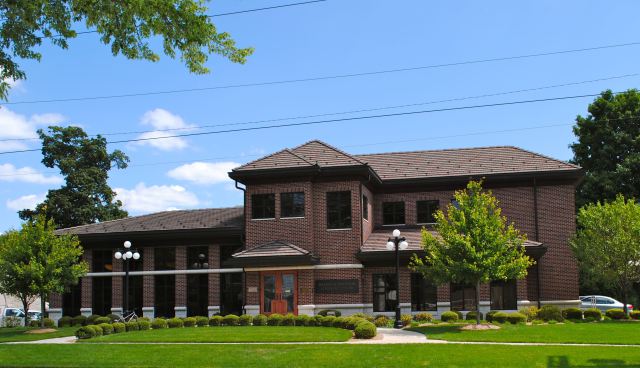
front view of Willennar Genealogy Center

Willennar Genealogy Center (Original photo from Charlie Chat)

Today I volunteered at the Auburn, Indiana Willennar Genealogy library. John Martin Smith was a historian in DeKalb County. According to his obituary from 2011, he was the founder of the DeKalb County Historical Society and had many other accolades. He had built a very large collection of historical documents and artifacts. His family loaned the materials to the genealogy library to be indexed and archived. The phase that I’m participating in now will index all of the books from the collection.

Books that I indexed today include The Cold Spring Tragedy about a murder near Indianapolis in the 1860s. Also, I added a trade catalog from the Atlas Engine Company and a self-promotion piece about Midwest Engine company from 1919. It turns out that the Atlas Engine company evolved into the Midwest Engine company. The Midwest Engine company was very proud of their part in helping win WW I.

It was very interesting glancing through these books. My part is to take the pre-scanned images of each page and add them to a PastPerfect record. I also write a description of the books and select search terms and subject topics.

The archive software has a locally developed list of subject keywords, but with the books, that list is usually inadequate.  I go to Library of Congress Authorities and search for topics.  After taking Cataloging last year and a related class “Organization and Representation of Knowledge and Information” this spring, I feel pretty comfortable using the authority file.

In the classes, we had access to an OCLC service, Connexion, that has a more powerful interface than the Library of Congress, but we are only supposed to use that for class-related work. There’s another useful tool available, Cataloging Calculator, but I don’t have its URL memorized.

After finding The Cold Spring Tragedy on WorldCat, I found that the authority file has records for the murderer and her victim in the database. I was surprised, but I guess I shouldn’t have been. Some of the collection’s conventional books are not rarities. However, today’s books about the engine companies probably are.

This cataloging project is a lot of fun for me.  It’s a mixture of activities and I get to look at very interesting books, usually from the 19th century.

Indiana SB-500: Education Deregulation and Disabled Children (editorial)

Dear Editor,

This week in the Auburn, Indiana newspaper, The Star, Senator Dennis Kruse wrote an editorial about SB-500, which he claims will “remove many of the obsolete regulations on our public schools.” The text of the law summarizes itself as “Education deregulation.” He sugarcoated this bill by reporting on one apparently positive aspect. Unfortunately, this law’s sugarcoated prescription has many poisonous components. The parts that are most shocking to me is the elimination of educational protections for disabled children. A society can be judged on its treatment of its citizens who are weak and without a voice and this law is a full-faced assault on them.

The bill is impossible to fully understand without extensive research and study. Bills often have unintended side effects. This bill has 355 sections, which is a huge opportunity for unintended side effects, but back to the provisions for disabled children.

One section no longer requires schools to make accommodations for deaf and hearing-impaired students. In addition, advice of proper medical care to parents for their hearing-impaired children is no longer guaranteed.

Another provision guts the division of special education. That board will no longer supervise classes and programs for children with disabilities. Its purpose will become to “take action to ensure school corporations, charter schools, and the department remain eligible for federal special education funds.” This is not looking for the needs of disabled students. This is not helping disabled students achieve their greatest potential.

This is an example of a program that could go away: A younger relative of mine was having severe emotional problems in high school and could not regularly attend classes. The school provided tutors through this difficult time. Now, this relative has a college degree and is pursuing an advanced degree. The law limits the responsibility of a school to only disabled students who can come to school. The program that helped my relative would not exist if this bill were enacted. The statement “A school corporation may provide for instruction of any child with a disability who is not able to attend a special class or school for children with disabilities” would be slashed out of the Indiana code.

These callous and calculated assaults on disabled children are not reflective of the society I grew up in. A sugarcoated poison is still poison.

Lest we forget, Senator Kruse was also a co-author of the catastrophic RFRA law. I am confident that he has written another catastrophic law that trades a few dollars for our disabled children’s futures.

Sincerely,

William Smith

Hypothes.is

There are several projects to add annotation to the Internet. The idea is that people can add comments to pages that are available to anyone without any changes to the web page by the web site administrators.  I think it’s really an exciting development.

The one that I’m most familiar with is hypothes.is.  They have a Chrome extension and the ability to work with Firefox as well as other platforms.

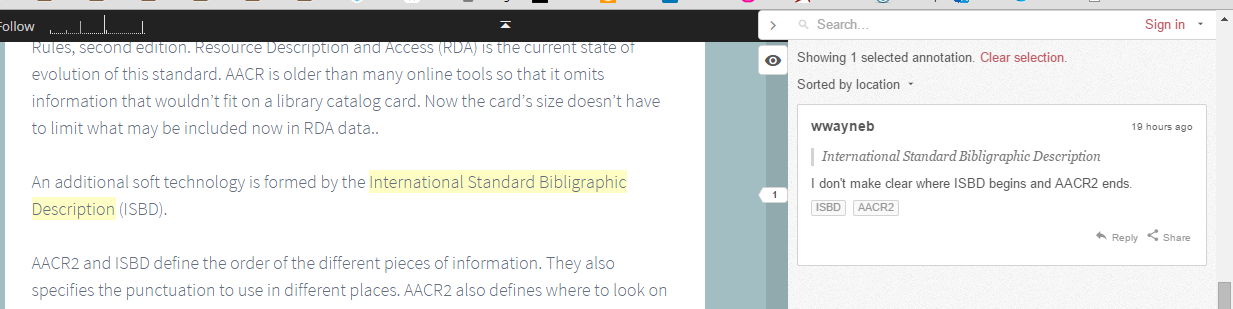
When I open the extension, in the right margin is a small bar listing the comments and highlighted areas of the page. An annotation is attached to a specific part of the web page so that you can highlight individual sentences or phrases. As you scroll, the annotations appear as small tags in the margins and take up very little screen real estate.

The annotations can be public or private. One may add tags. The comments can include graphics and mathematical typesetting using LaTeX notations.

Here’s an example of an annotation:

There are many ways of using it. The project http://climatefeedback.org/ allows scientists to give information about climate change documents and evaluate the articles scientific qualities.

With private annotations, one may use tags to tie together different resources for a research project.

This is a dynamic, developing project and I’m really can see how useful it could become.


“Soft” Technologies in the Library

In the library, there are technologies hiding behind the scenes to make the catalog work. Some are “soft” technologies that individuals implement instead the hard technologies used by a computer crunching data to fulfill a user’s search. These soft technologies give rules for organizing the cataloging information about a resource. When there were only card catalogs, the product of these technologies were visible, but not the rules used to make them. Now, even the soft technologies are behind-the-scenes.

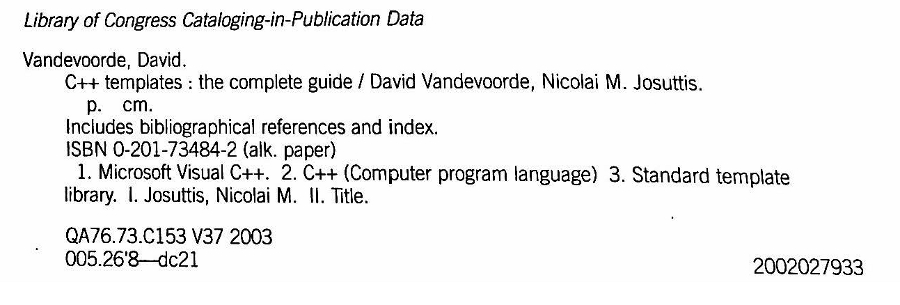
Look behind the title page on some books. You can often find text like this:
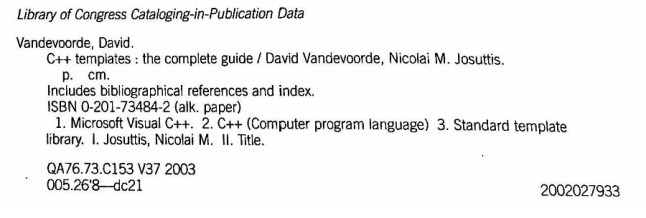
c++ Templates: The Complete Guide Cataloging Info

This Cataloging-in-Publication information helps librarians add the book’s information to a catalog. This text is similar to what one would have found in a card catalog. The Library of Congress is involved in preparing this summary.

The whole purpose of the textual format is to meet the needs of library users. Some tasks that the catalog helps include: Can the users find whether their library contains a copy of the resource (e.g. book) if they know the author or title? Can they find other works by the same author? Can they find where the resource is in their library?

The first soft technology that this is based on is AACR2 – the Anglo-American Cataloguing Rules, second edition. Resource Description and Access (RDA) is the current state of evolution of this standard. AACR is older than many online tools so that it omits information that wouldn’t fit on a library catalog card. Now the card’s size doesn’t have to limit what may be included now in RDA data..

An additional soft technology is formed by the International Standard Bibligraphic Description (ISBD).

AACR2 and ISBD define the order of the different pieces of information. They also specifies the punctuation to use in different places. AACR2 also defines where to look on a resource to find the information. Some information should be from the title page or reverse of the title page. Some can come from anywhere.

Later, this textual data is massaged into a form convenient for the computer to search. The formatting is a hard technology containing detailed rules for every aspect of the record. This more detailed representation helps software search the catalog.

The online catalog uses this technically precise information and presents it to the users in a form that the users can understand. Each cataloging system presents the information in different styles. If you look for this book in different libraries, you will see different text from each service.

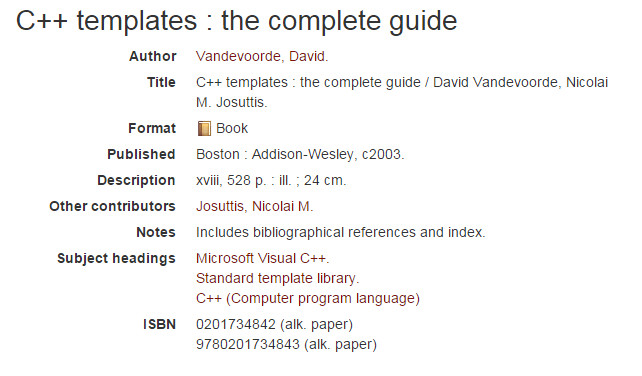
You can see most of the information from above in this clip from Indiana University’s catalog.

Library Catalog Entry for C++ Templates:: The Complete Guide

The most obvious difference is that the catalog has the size and page counts which the Cataloging in Publication information did not. The book hadn’t been printed before the Library of Congress created the record so that it is missing page counts and sizes. Also, the Cataloging-in-Publication data doesn’t contain information about the publisher.

The process of cataloging is very detail oriented and, when done well, is completely invisible.

Focus

Hi

This blog is a companion to http://blog.wwayneb.com It will focus on software, library science and technology.

Bill