
Review? Allegory? Commentary?

3 clouds of imagination

Film reviews explain and summarize the contents of creative expression. The results of an influential director’s efforts include a potent message. A film can donate an original idea to a culture’s growing lexicon. A review takes those ideas and puts them in a broader context. Film analysis is its own style of literature.

Film reviews not derived from a separate work would stand on their own. Rather than describing a released movie, it presents ideas from an imaginary film. It offers the film as an allegory or commentary while actually containing only the reviewer’s ideas.

A clever review can couch an important idea in a compact form. The review framework deflects the responsibility for the ideas to an imagined director. Generally, a review is neutral conduit for an idea. However, the text may adopt the review vehicle and make it a discussion about a controversial topic.

A successful review of a potential movie might be more palatable to our modern 5-minute attention span than a 3-hour cinematic masterpiece. Some essays might succeed as an analysis of potential films. An ingenious review could contain its own powerful message.
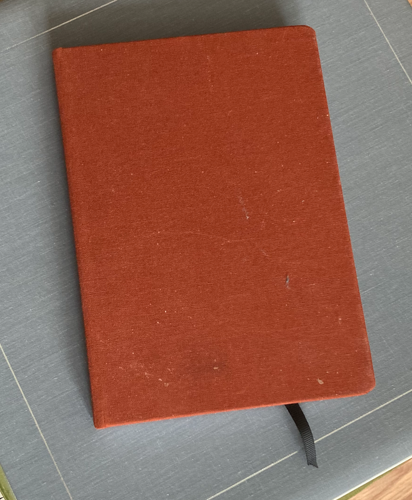
The Red Book

A couple years ago, I bought a notebook from Bespoke Post. It’s a very nice book with a red hard cover and a ribbon bookmark. I’ve been using it as an alternative journal.

Several years ago, I trained myself to write with my left hand. To build the skill, I would journal with it and scribble the alphabet. My left hand is definitely slower and less legible than my right. However, my penmanship is strong enough now. I can consider myself left hand an adequate writer.

I’ve read that the left brain has verbal processing capabilities and my right brain, controlling to my left side, is mostly non-verbal. My thought is that, if I would write with my left hand, I might kick-start the language capabilities of my right brain. Maybe I could access new ideas and new modes of thinking.

Once I got the Red Book, I started to explore that idea. I write the text by alternating words between my left and right hand. It goes more slowly than typing or writing the journal with my right hand solo.

I don’t know how to analyze the differences between the words from each hand. Is there a vocabulary shift? Am I more creative or more non-linear? It’s interesting to ponder ideas like this but not interesting enough work for an answer. One definite effect of this mode is that I write more slowly. I don’t plan my text more than a couple of words ahead and I often don’t write my first thought.

Eventually, I transcribe the Red Book notes and edit them into something worth sharing. Often the released versions of the journal are pretty fantastical as they mix imagination with real experiences. I blur the edges between the two.

I don’t have the scientific expertise to analyze the results of my experiment. I’m not sure that it even qualifies as an experiment. Perhaps, it is an ethnographic exercise to reveal text that might not be uncovered in an interview or a typewritten essay.

I find the Red Book to be a generator of ideas. I try to synthesize interesting posts from its pages.

Alone Tomorrow

I’ll be alone tomorrow.

My friends have found the truth.
I have said it aloud; now I’m in shame.

I thought they would forgive me.
I wanted understanding and acceptance.
Instead, their judgment was unanimous.

Will I be stuck as an eternal “I”?
“We” and “our” are foreign words now.
I know that I have made a grievous error.
With no one to share with, I began to despair.

The days have been passing slowly.
I cannot expect freedom again.
The world around me is black.
I can wish for friends, but it will be in vain.
I will be alone again and again.

William Wayne Smith

One of my worries had been that I do something bad and lose a friend.  My imagination can be vivid so that I can compound simple conflicts into a lost friendship.  If I can’t forgive myself—why would anyone else?

This poem takes that fear to new levels.  Not only have I made a mistake, it is so severe that everyone abandons me.  They reject me because some secret sin had been revealed.

If I am alone, I cannot use “we” and “us” again. This is as if one mistake would be a dead end for my life in the world.

I make mistakes all of the time.   They do not mean that I am unworthy of the caring and friendships that I cherish.

This poem paints a bleak outlook on reality.   I don’t embrace that perspective, but my imagination could bring it forth at times.


I published the poem initially at Alone Tomorrow. The image It takes a lot to give, to ask for help is by 10 Mix licensed with CC-BY-NC 2.0

Everyone can be scientists

ThoughtsOne things scientists do is to perform experiments.

Some experiments are really technical. Measuring the position of atoms or the properties of a supernova. Determining what nutrients an amoeba needs to thrive and how to diagnose prostate cancer.

I don’t know how to do any of these. I know that there are people trained to find the answers. As experts in their field, they have experience and skills that are more trustworthy than my friends.

Even so, my friends and I can all do experiments. We don’t need to pick up a ruler or pencil. No paper, measuring cup or calculator needed. You can do the same.

The most powerful experiments are thought experiments. Human minds have intense abilities to imagine.

A thought experiment uses that imagination to reveal the truth.

What if ….

Imagination Cuts Delusion

Jon Kabat-Zinn describes how people are trapped in a cycle of fear, hatred and delusion. If you look at front page news stories, you can usually find one or more of them very close to the surface.

clouds with a ladder leading to one of themIf these three are negative qualities, there must be counteracting positive qualities. There are obvious candidates like love to counteract hate, but I don’t think love has been very effective. Fear can feed hate and love has no power over that mixture.

In my past couple of blog posts, I’ve described the three qualities as elements of a game reminiscent of rock, paper, scissors. I claim that trust covers fear and curiosity smashes hatred. These pairs of spiritual qualities are mutually exclusive. They cannot exist together.

It is challenging to find the third element of a celestial elixir to replace the last element of delusion. One idea is understanding, another is knowledge. The one I like best is imagination, but none of these three are mutually exclusive to delusion.

A delusion is a fixed idea that stands up despite evidence to the contrary. The mind grabs onto a thought and runs with it. Paranoia which is supported by fear and prejudice that is fed by hatred are two of the strongest delusions. Since they’re both based on the other parts of the trio: fear and hate, it’s understandable that they have such power.

Consider whether imagination cuts delusion. A fixed idea is like the flowing of a river, it has deep banks and a straight path. Imagination looks around the landscape and can see that there are quiet pools and beautiful tributaries. A clump of dead leaves that follows the natural route will never find these bounties..

The application of spiritual principles takes work. If they were easy, people could accept and act on them continuously. Trust, Curiosity and Imagination are three qualities that are positive spiritual principles. They may not be spoken of in the church, synagogue or mosque, but they are still important.

Faith, hope, and love are necessary utensils for the spiritual kitchen. Trust, Curiosity and Imagination are like spices to keep in the cupboard. They can help everyone share spiritual feasts.

Original image: Access to Cloud / Ladder to Heaven. By FutUndBeidl [Image license]