
Round robin

two parallel arrows pointing in opposite directions

As my grandparents moved on through their lives, some important friends joined them in a round robin correspondence. They had a cycle of friends who each contributed a letter to the circuit. When a group of letters arrived, after reading their friends’ messages, they removed their own and replaced it with a new bulletin and forwarded the messages on to the next person in the list.

I don’t know when the project started, but I imagine it beginning with friends from church or their careers who wanted to keep in touch as their lives progressed. Rather than leaving the people behind, they kept their community going with their communiques.

When I was collecting stamps, I found the Cover Collectors Circuit Club. An originator would pick a list of members around the world. The list would specify its own one-shot round robin so that members would forward an original postal cover to the next person in the list.

Another correspondence project is Postcrossing which enables you to send postcards to someone randomly selected from around the world. In compensation, members receive postcards from a similarly selected person from another nation.

Bill and Madelyn’s round robin project is from a different era when people were starting to disperse but still chose to keep a community going. It might be the start of my family’s legacy of building a larger community than one of parents, siblings and children. The investment needed to support a relationship can’t really be sustained by tools designed for profit motives that debase the connection possible with real contacts and sincere support. Do I really want to hear from a synthetic pen pal?

Society’s connective tissue is built out of stories shared from one person to another. When it is dangerous to tell stories, the legacy of a round robin collection of friends is torn apart. I try to keep hearing new stories. Perhaps I should start telling stories as well.

Talking with a friend

A meditation I wrote a while ago…

As I spend time with people who care about me, my happiness grows. I don’t feel so lonely. Life seems worthwhile when I can offer my time and spend it with them.

As I grow closer to my friends, we develop jokes that are hidden within our memories. There may be a pun that we’ve said several times. It becomes a cliché that breaks us out into laughter.

When I spend time with nature, I can find a peace. I, by myself, don’t have the power to raise a fawn or grow a forest. I can assist by avoiding the negative, but I cannot do it on my own. 

With a friend, there is a similar peace. I don’t have the power to create it on my own. We like to give each other the priceless gift of caring each time we visit each other.

Keys to our friendship are feelings of love and feeling loved. By building a relationship carefully, feelings of fear and anger are rare. We may have a disagreement, but we don’t allow that to tear down our bridge.

I keep a friend with peace and happiness.

When I do not understand, I ask a question and we communicate. When I don’t say what I meant, we talk about it. I give an answer to explain what I meant.

When we laugh together, we feel happy. We feel a part of a bigger world. We watch each other’s back. Our lives together are enriched.

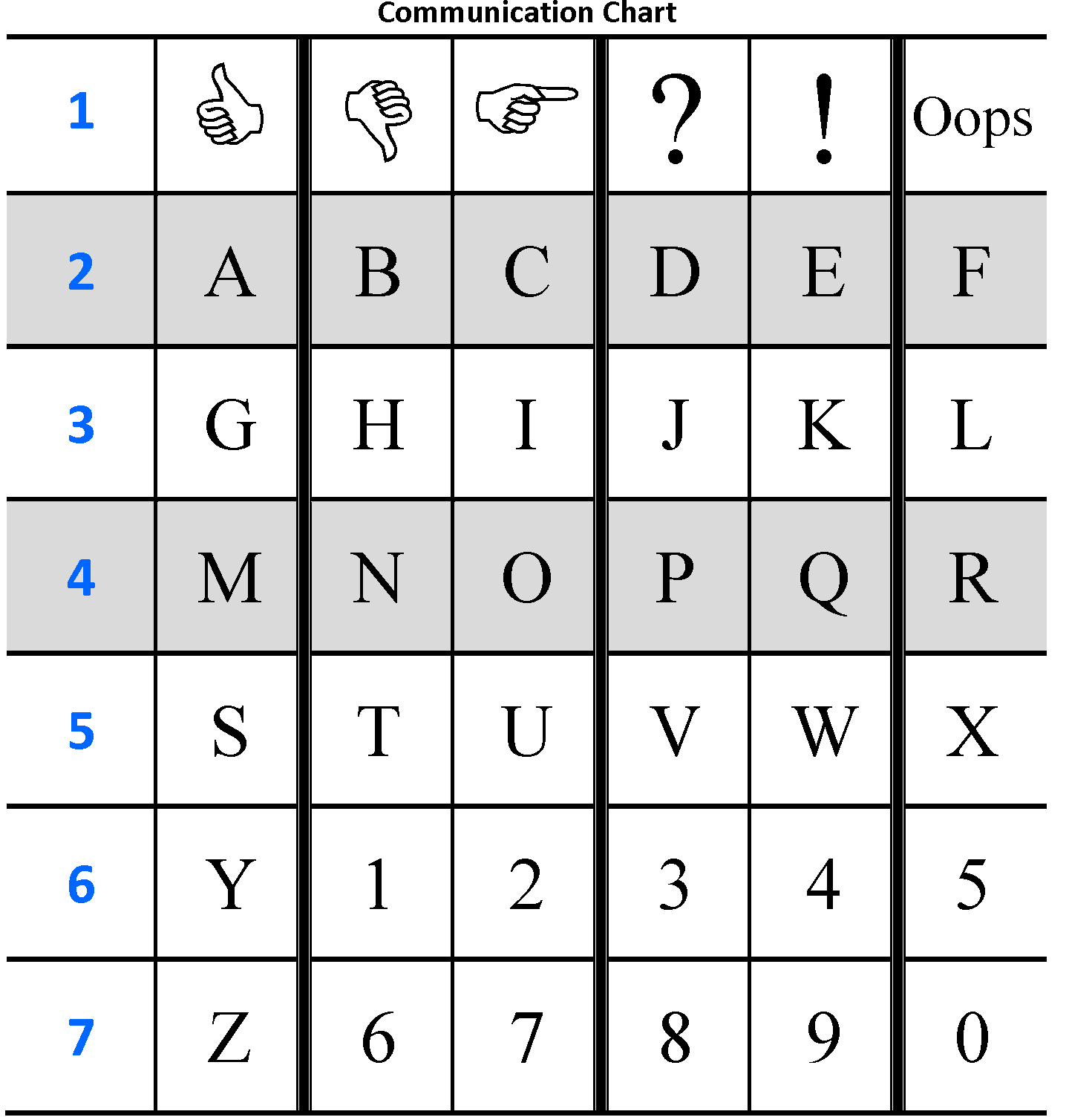
Locked in Communication Chart

When someone has locked in syndrome, it is difficult for the person to communicate more than just a yes/no answer.

Assistive technology devices exist to help in this situation, but they are expensive and usually aren’t immediately available.

One way to communicate is for an assistant to list the letters a, b, c, …. and have the person signal the correct letter is reached. Then, repeat this until a word is spelled out.

This chart is more efficient because it can select letters with fewer steps. The idea is to read 1, 2, 3, 4, 5, .. and stop when the person selects a row. Then the assistant would read the letters across the row. Once one letter is chosen, the process may be repeated until a word is completed.

I estimate on average this chart is will be at least twice as fast as spelling the alphabet to select words. It doesn’t require much training to be able to use it. It’s also easy to reproduce the chart by just printing the diagram.

The chart is released in a Creative Commons By-Same As license.

Kindly let me know of any improvements you make. Communication Chart PDF
Chart of letters to spell