A couple years ago, I bought a notebook from Bespoke Post. It’s a very nice book with a red hard cover and a ribbon bookmark. I’ve been using it as an alternative journal.
Several years ago, I trained myself to write with my left hand. To build the skill, I would journal with it and scribble the alphabet. My left hand is definitely slower and less legible than my right. However, my penmanship is strong enough now. I can consider myself left hand an adequate writer.
I’ve read that the left brain has verbal processing capabilities and my right brain, controlling to my left side, is mostly non-verbal. My thought is that, if I would write with my left hand, I might kick-start the language capabilities of my right brain. Maybe I could access new ideas and new modes of thinking.
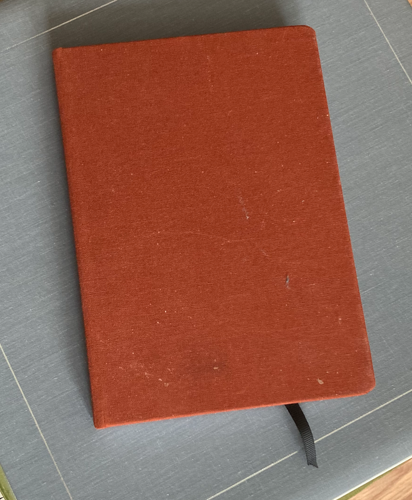
Once I got the Red Book, I started to explore that idea. I write the text by alternating words between my left and right hand. It goes more slowly than typing or writing the journal with my right hand solo.
I don’t know how to analyze the differences between the words from each hand. Is there a vocabulary shift? Am I more creative or more non-linear? It’s interesting to ponder ideas like this but not interesting enough work for an answer. One definite effect of this mode is that I write more slowly. I don’t plan my text more than a couple of words ahead and I often don’t write my first thought.
Eventually, I transcribe the Red Book notes and edit them into something worth sharing. Often the released versions of the journal are pretty fantastical as they mix imagination with real experiences. I blur the edges between the two.
I don’t have the scientific expertise to analyze the results of my experiment. I’m not sure that it even qualifies as an experiment. Perhaps, it is an ethnographic exercise to reveal text that might not be uncovered in an interview or a typewritten essay.
I find the Red Book to be a generator of ideas. I try to synthesize interesting posts from its pages.

 W. Smith