Today is going to be the brightest Jupiter will be in the sky for several years. It had its nearest approach last night 3:10AM EST (08:10 UTC) at a distance of 393.36 million miles or 4.232 AU. This is the closest Jupiter will be to the earth until 2033. However, it was about 26 million miles closer in 2022.
Tonight at 3:31AM EST (08:33 UTC) it will be in opposition where it is 180º away from the Sun.
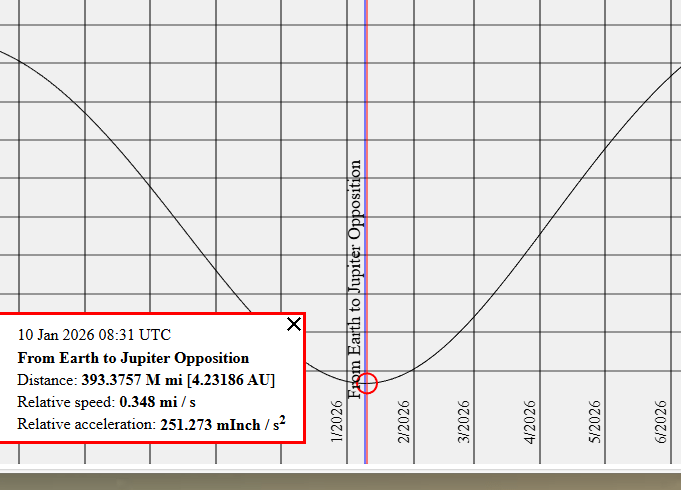
These next few days will be great opportunities to see the planet. With binoculars, you should be able to see the Galilean moons of Jupiter as well.
Information about the relative motion of the different planets is linked at http://sesquibits.com/mars/index.html which is a page titled “Graphing Planetary Motion.” The formulas used by the website come from Planetary theories in rectangular and spherical variables-VSOP 87 solutions
The website graphs the distance, relative speed, and acceleration between any pair of the 8 planets. The site allows you to scan for maximal and minimal events in the distance, speed, acceleration as well as conjunctions, quadrature and opposition. It also can display the time of perihelion and aphelion for each planet. It presents information from the year 300 to 3500. The “capture graph” button creates a link that will regenerate the current display.
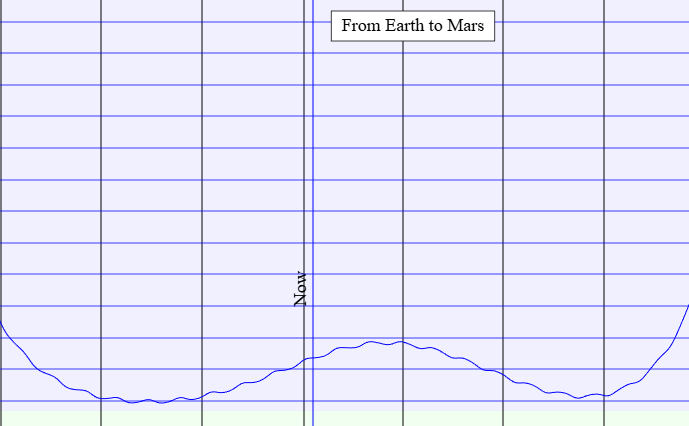
One of the most interesting graphs is the relative acceleration between Earth and Mars. It shows dramatically the effect of the moon on the orbit of the Earth.
 W. Smith