Sometimes I’m adding new contacts as I expand my social circle. At other times I’m removing people that I don’t have a connection with anymore.
Being social, it’s uncomfortable to remove people from the list. A lesser loss is when I remove a thread from my texting app. In that case, the connection is still there, but only tenuously. People that don’t have a thread going can be forgotten and the relationship that is already withering might finally die.
A sadder removal from the contacts and address book happens when someone I know has passed. When I remove them, the memories will fade, and I will think of them less and less. Perhaps, it’s a way that I can honor their memory by leaving them in the list. For special people, I might want to keep them listed as a sort of memorial.
My paper address book has six names per page. When all of the addresses aren’t valid anymore, I can take it out and discard it. It’s another way to let go of memories. The paper form is more permanent than a list in a phone but eventually the information gets out of date and people leave my life.
Letting go of people can be solidified by a funeral or ceremony. For a few friends that I lost track of over the years, I found out later that they’ve passed on. It makes me sad that I didn’t find out until years later.
I don’t want to let go of people with the same attitude that I have when I’m throwing away a dried-up pen. I think people deserve more consideration than that which is part of why ghosting seems malevolent to me. However, putting a piece of paper in the trash and removing the information from my phone can be just as easy.
Letting go is a transition that can take many forms. Loss is a part of the human condition and having fond memories of someone can make the loss feel meaningful.
52 weeks works out to be 364 days. Since a calendar year has 365 or 366 days, one could replace the current calendar with one that has one day a year denoted as a wildcard that won’t have a day of the week. That would make the weeks line up the same every year.
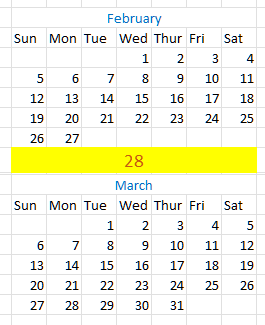
If the change would be made next year, this is what the calendar would look like for February and March, (as it would every year going forward.)
Instead of February 28 being a Tuesday, it has no day of the week anymore. The next day, March 1, takes the opened-up Tuesday slot. Every other day after that shifts left a day. On a leap year, the 29th would also have no day of the week.
From March 2023 to February 2024, an old-style Wednesday would be a Tuesday. From March 2024 to February 2025, the old Wednesday would be Sunday. It would continue from year to year that the day of the week would be altered by varying amounts.
The biggest advantage of this arrangement is that the same calendar could be used every year.
That’s pretty much the only advantage.
Federal holidays would get frozen on a specific day of the year. That would be nice because the holidays shifted to Monday would be consistent. But, if a holiday’s natural date now ends up on Wednesday every year, it would be messy for picking how to assign the paid day off.
Problems will show up really quickly. In addition to the Gregorian calendar, there are other calendars in common use such as the calendar used in Islamic countries and the Hebrew calendar. They won’t line up with the new calendar directly. Awildcard day would not fit consistently. If some arrangement could not be made, different calendars would give the same date different days of the week.
I don’t think an arrangement could be made, but it’s an idea. So far, not a good idea, but still an idea.
The next problem is that holidays that appear on a specific day of the week but not the same date would be hard to compute. There’s a formula to calculate the date of Easter and related special days. It would quit working. Easter is on a different week each year, but always on Sunday, so the week might be hard to form a consensus over.
Also, that defeats the goal of being able to use the same calendar every year.
The Hebrew calendar is very carefully designed so that special days, as appropriate, are on the sabbath or not on the sabbath automatically. That precision would be ruined.
The computer algorithms for day of the week would go up in smoke too. Date calculations start by counting the number of days from an epoch date, often January 1, 1970. One takes that count and reduce it modulo seven to get the day of the week. Breaking that rule would make the Y2K bug seem mild by comparison.
Honestly, the problems caused by this idea overwhelmingly make it infeasible to follow. It’s a simple idea that isn’t compatible with life as we know it.
But…. maybe we could make April 1 as the wild card day just once to see if we like it???
For several years I’ve known that my lilac bush has had some shrubs hiding within it. If I needed proof, in September, I saw a Rose of Sharon blossoming in the middle of it.
I knew there were also some maples and a couple other bushes intertwined. I had despaired of getting rid of them because they were so similar to the lilac branches and hard to identify.
However, I had a lucky break when I went out to do some other landscaping.
Most of the leaves of the lilac were gone but the other bushes still had their leaves. That let me pick out the branches to get rid of without damaging the lilac.
All of the green amidst the branches were weed shrubs that I wanted to get rid of.
It didn’t take too long to clip off all of the unwanted branches. I wasn’t able to get rid of them permanently. They’re pretty well established with big roots. However, I consider it a win to be able to cut them back as much as I did. I wasn’t expecting that.
.
This is what the lilac bush looked like after I was done.
It was a success that I wasn’t expecting.
My original goal for the exercise was to clip off all of the dead stems from my peonies which I was able to do in a separate part of the yard.
In the middle of the peonies is a sumac bush that I’m trying to discourage. I didn’t see it this week. I cut it back a lot not long before the weather turned cold, so it might not be able to grow back until spring.
All through the summer, my landscaping and garden would have different shrubs starting to grow. I would dig down around their roots as far as I could and then pull them up. I think I was successful at killing most of those before they got too big.
The story about walking home on the dirt road from where the bus dropped us off is hard to explain. Why didn’t the bus drop us off at home? We always said that the road was 0.7 miles. There were a couple of interesting sights along the way. One was a pond with a willow tree. I remember seeing dragonflies there. There was also a swamp that would wash out a culvert every year so that it blocked the road. I wonder how dad got to work when it was closed. I remember the hilly path as we walked home.
I went to only a few parties when I was in school. We were always isolated and far from people. I don’t know why that was. One sister was not receptive to discussing the topic when I brought it up. Maybe it isn’t that uncommon, but I don’t think it helped me. I don’t dwell on that because it will only make me sad.
One time I did go to a Halloween party. I made a pumpkin costume out of chicken wire and papier-mache. I was fully covered with the costume. It only had a slot in the stem to see out of. It was painted orange and green like the great pumpkin. We went to a party where I was ominous and chasing around the radio personality for a while.
I never really ran and was never athletic in school. Being isolated, there wasn’t anyone to play basketball or soccer with. Maybe I was too engrossed with the encyclopedia. I don’t remember being asked. I had a softball glove but never played much… maybe with Dad a few times.
I like playing with water, so I was happy when the spring rains came. The clay soil would have water accumulate below it so that you could make it squish and squirt. I liked making little rivers to move the water around. We didn’t play marbles when the ground was wet.
We lived between two small mountains. The trees must have been pretty in autumn. There were lots of maples, being Vermont. In addition, our house had a maple and an elm tree. The elm tree eventually died from Dutch elm disease. We cut the tree down when it was dead. A cub scout project was to plant some trees. I planted 50 maple trees. We brought the last two with us when we moved to Indiana. The final survivor was moved an additional time when the family left the dairy farm. Now it’s growing where my parents used to live near Kendallville.
It was nice that we had such beauty around the home so that I have some nice memories.
As I search for things to collect, I step into the antique bookstore. The range of subjects here is boundless. The words are in many tongues. The authors come from the four winds.
All of the books have a price. All of the scripts are black as night. The knowledge of the ages resides here.
I have found a new source for my purchases. The shopkeeper is very kind. His heart is seeping through this storehouse. He has built a business filled with the relics of time.
Sometimes, I search to fill my collection of Bible translations. I want their words to sing a chorus of devotion with each other.
Some of the books are covered with a thin layer of dust. Most are well preserved, but their origin has been forgotten. I will never know who brought the items I find that are filling my shelves.
Despite the age of their bindings, I can always find something new here. The magic words run deep. I can read them and fall into the arms of a mystical reverie.
I want to retrieve forgotten words. When I return, I know that I can find the wisdom the ancients. Perhaps I will discover a new reality hidden on the pages of the next book I pick up.
In the past, candidates campaigned with a quantum model of the voter. Each voter counts. The candidate needs to convince neighborhoods and each house on a block. It was quantum in the sense that individual action mattered. Every atom/voter needs a packet of energy to transform from one candidate another.
Now the quantum model of the voter can be replaced by a classical thermodynamic model. One thinks in terms of the temperature of groups instead of individuals. Rather than counting individuals, the campaign thinks of percentages.
For many issues, opinions are split nearly evenly. To get the electoral results for a candidate, moving a fraction of voters in the middle is enough. The effect is that, for the majority of the electorate, the candidates don’t need to address them. They won’t matter to the outcome because their votes are free energy to win an election without exerting any work.
Targeted advertising such as what is available with Facebook, YouTube and Google allow candidates to focus their appeals to the subgroups that are in the middle. Adding heat to targeted parts of the pot can be more successful.
Changing the votes of one or two percent in the right demographic can be enough to win the election. Narrow campaigns targeted to subgroups can be more efficient than mass appeals through TV and radio. A campaign’s money can be stretched further when it tries to change the temperature of small groups rather than trying to push individual votes one at a time.
In a quantum model of campaigning, each person matters. When a candidate shifts their efforts to a classical, thermodynamic model, what matters is convincing groups in the margins. People have been reduced from individual human voters into inhuman mathematical abstractions.
I notice that I visualize the letters of the words that people are speaking. I see the text as the words pass. I wonder whether other people experience a visualization like this.
If I were to learn a new language, the need to spell text might be limiting.
Arabic and Farsi would first require me to learn how to pronounce and write Arabic script. It would be an added step that I wouldn’t have learning new European languages. I don’t think visualizing it would be a great challenge once I could read and transcribe words.
Mandarin Chinese, in contrast, might be acutely difficult for me to learn. Since words are not written phonetically, I would need a completely new level of interpretation to see what I am hearing. I suspect that skill would develop very slowly (if at all.) There are phonetic transcriptions of the sounds, but if the variations in the pronunciation of words is subtle, I might not “see” the correct “text.”
In some languages, people speak more words per minute than in English. Would my ability to visualize the words be overwhelmed by the speed that the letters go by?
What would happen if I had a stroke that broke that neural link between my hearing and the visualizations? I wonder whether I could track a conversation when I couldn’t see the words anymore.
I believe song lyrics access a different part of my language system. When I read the lyrics to familiar songs, the words don’t register as familiar. Often, I find that I never really knew what the song was about. My visualizations didn’t seem to help. I’m wonder whether a PET or fMRI of me listening to a song and its lyrics would be different from one recorded while I listening to the same words as prose.
It’s interesting to notice skills that are natural to me. It would also be interesting to learn skills that are natural to other people that I’m unable to experience.
An aptitude might be broken down into micro-level skills. Some may take practice to develop fully. It is a form of neurodivergence to identify skills that might be missing in one person and robustly available in another.
Consider the ability to recognize faces and the ability to visualize images. I’ve heard informal suggestions that people have different levels of proficiency. These are examples of everyday skills that might have a spectrum of ability. Mathematics may be hard for some people because some necessary sub-skill is neurologically disadvantaged.
Brains are mysteries full of puzzles. They hide individual differences. I don’t know things that I can’t do that are natural for you. It’s hard for you to know things I take for granted that you struggle with.
In the past I’ve made some collection of comics. One was a collection of Frank & Ernest comics. Another was a collection of editorial cartoons from The Star newspaper in Auburn, Indiana.
The Frank and Ernest are organized by publication date. I would cut out a few weeks of comics and then glue them 5 comics to a page. I would start a new month at the top of the page. Once the pages covered a whole year, I would bind the pages together with my Velobind strip binding system. Comics are easy to organize chronologically because the artwork has the month and day within it. In contrast, I manually stamped the editorial cartoons each with a red date stamp to record their date of publication.
I consider these as just collections. There was no plan to organize the comics beyond sorting them by date.
I also started a collection of comics from the weekly magazine The New Yorker. The magazine includes 10 – 15 comics each issue. I have been cutting out the comics and filing them with the title page and cover in a page protector for each issue. That holds them together, so they don’t get mixed up. Recently, I had accumulated about a year and a half unprocessed. For a long time, I didn’t really have a purpose for them, I was just filing away each week’s drawings. I was getting more and more behind with no plan.
Recently I thought of turning the collection into an archive by asking the question: What are the differences between the styles of the comic’s creators? The New Yorker’s title page has an index of the artist names for each comic so that I could attribute them to the right artist. I wondered whether I could learn something from the different artists’ styles. That gave me the impetus to do more with the comics I had accumulated. I would separate the comics and organize them by each artist chronologically.
When I started processing them, I made a pipeline where I would take one of the page protectors and pencil the comics’ margin with the artist’s name and publication date. By having this basic information on the paper, if a comic falls out, it will have enough information to be put it back in place. After labeling them, I put each week in a manila envelope and made a pile of those. I would keep the pile from getting too tall by taking the bottom envelope and gluing its contents to artist pages. I took the penciled information and wrote it in ink next to the comic. The artist’s name is at the top of each page. When a page was full, I would create a new page for that artist. I only glued the comics on one side of a page which makes them easier to leaf through. After this, I would try to be efficient with a couple of filing steps before the comic is in its final position.
I keep the comics on paper instead of scanning them in. That would allow the archive to not be affected by technological change. Old digital archives can become useless because the software they need won’t work anymore. Digital archives can require substantial work by archivists to preserve. Although, at some level, the metadata will need to be in digital form, the ground floor will be something more permanent.
When I decided to turn the collection into an archive, I started thinking about what additional information would someone find useful if they were doing research? I was told that a historian would like to have full bibliographic information, so I started including page numbers with the date. Since the archive wasn’t started with that in mind, most of the older comics are missing their page number. Other useful data is to give each comic an index number so that researchers could easily find a comic in the archive after finding them in computer search. I haven’t chosen an indexing system yet.
Looking at what librarians would like to do with the comics, I thought of additional metadata that would be useful. The dimensions of the comics are easy to measure and useful. I could also pick keywords to describe each comic. I could evaluate different existing metadata standards from the Library Science courses that I took. Perhaps one of them will work well.
I should decide on the purpose of a keyword index. I would define a standardized vocabulary that I could use for keywords. An index could be kept in cataloging software. Without planning, choosing the keywords to describe each comic could become an ever-expanding job. I don’t want to give the comics keywords and then realize I need to go back and select more keywords to the old drawings. It would become an endless task! Information that I might want includes graphical details of the graphic such as drawing technique and style. Other keywords would describe the theme such as “sheep,” “pearly gates,” “therapist office,” or “royalty.” The purpose of the archive should inform my choices of what keywords to use. I can use what I have so far to suggest a more thorough list to move forward.
I didn’t start recording some of the metadata. I’m about a year behind the current publication, about 45 issues. I’m playing catchup. Some of the desirable metadata is lost, or at least impractical to recover. The order the comics appear in each issue might be interesting to analyze and is only available when I dissect an issue. Once the magazine is chopped up, that information is lost. I need to consider what is worth keeping and what is impractical.
I try to minimize is going back to older items to fill in missing data. To rewind several times would become frustrating and eventually overwhelming. It’s a matter deciding what’s practical to get vs. what is important. I need to make a good-enough archive, not try to make a perfect archive. Data entry is a substantial task and I need to estimate how much I really can take the time for.
Already, there are several artists who I can identify without needing to see the signature. Someday, it would be fun to interview some of the artists.
I just saw Lightyear for the second time this week. It was better the second time.
The framework of Lightyear is that it is the movie that Andy from Toy Story watched which led him to fall in love with his Buzz Lightyear toy. In this film, Buzz Lightyear (voiced by Chris Evans) is a Space Ranger devoted to “completing the mission.” His intense focus on that principle costs him a lot. He doesn’t seem have the insight to see that life can have more purpose than just fulfilling a singular goal.
One of the transformations Buzz undergoes is that he comes to a realization that his friends had worthwhile lives without escaping the strange planet that they landed on. He had been convinced that he was a failure when he couldn’t rescue them. Several of the characters make mistakes that seems to be impossible to correct. Their level of distress is managed because a humorous solution exists to solve the problem. However, Buzz revealed that his career started with failures and the confidence of a mentor helped him succeed.
For some, the fact that a woman falls in love with another woman is too much to accept. Their disapproval seems to be reflexive. Diversity in the film is more deeply rooted than the superficial reading of a half-second kiss between two women as a horrific affront. When Alicia Hawthorne (voiced by Uzo Aduba) tells Buzz of her engagement, Buzz asks what “her” name is, indicating that he knew she was attracted to a woman. The final energy crystal had a rainbow of colors, a nod to the rainbow LGBTQ flag.
The story can be choppy with abrupt transitions. It was almost as if they had too much story to stuff into the allotted time so that scenes need to move quickly from one to the next. For example, their visit to a mine seems like an arbitrary plot device. Although the film foreshadows that particular event, other unexpected situations are science fiction cliches. The robotic cat SOX, (voiced by Peter Sohn) is a good comedian. The ludicrous bee-boop bee-boop when the cat is scanning can be silly, but the cat’s running commentary is also light-hearted. The cat also has some surprises built in.
There was a running gag about life on the planet being dangerous or even hostile. Buzz’s initial reaction is to report that the planet is uninhabitable but they stay. Perhaps this initial reaction was part of Buzz’s determination to escape. I couldn’t see the characters expressing many emotions but a crucial turning point, you see a hint of Buzz’s sadness. That tension quickly fades as the adventures restart.
Although the movie wasn’t outstanding, the story was engaging. It was an action science-fiction story and not a psychological commentary. If I wanted the film to make the characters seem more 3 dimensional, I was pretty much dooming myself to be disappointed.
The movie was good enough to see twice and I enjoyed it both times. The first I was able to see it in a local theater before it closed. The last movie I saw before the pandemic began was Onward, another Disney film. Now that both are available on Disney+ and BluRay, I probably won’t be able to see them on the big screen again.
The theater I would go to for movies has closed. The closest one near me is on the other side of town and requires driving in some of the most congested parts of Fort Wayne.
Right now, I don’t subscribe to any of the premium services. I’m not sure which, if any, to choose. I don’t have a lot of incentive to subscribe. My TV has been on only a couple of times in the past few months.












 W. Smith