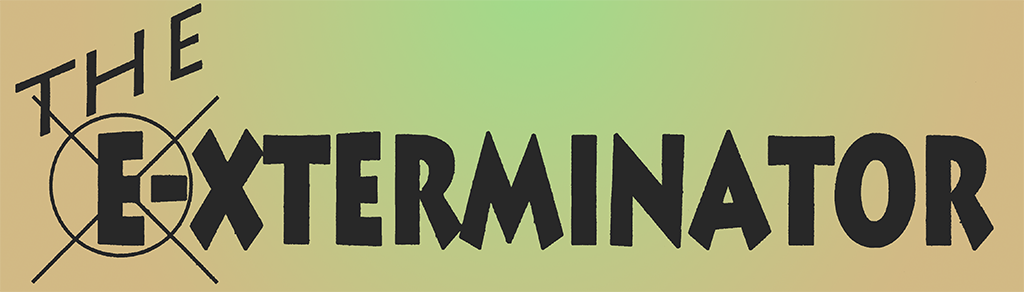
My dear laser printer finally seemed beyond repair. It had been sporting this label for years and I saved the label when I took the printer to the local solid waste district.
Perhaps what I was thinking with the sign was that I could use the printer to find bugs and eliminate them. It must have done its job well because I singlehandedly went through two or three toner cartridges with it. The black and white original design was made with an early version of Microsoft WordArt. Another inspiration for the message was the Terminator films.
By the end, the automatic feed wasn’t working so that I had to manually feed the paper into it. Also, the drum had some spots on it so that it left a few black spots on the prints.
It was a Brother HL-5240. The printer was released in 2005 and I still used it in 2024. Perhaps it could have kept going if I would have done some extra maintenance?
It was a real workhorse and got plenty of use out of it.
Film reviews explain and summarize the contents of creative expression. The results of an influential director’s efforts include a potent message. A film can donate an original idea to a culture’s growing lexicon. A review takes those ideas and puts them in a broader context. Film analysis is its own style of literature.
Film reviews not derived from a separate work would stand on their own. Rather than describing a released movie, it presents ideas from an imaginary film. It offers the film as an allegory or commentary while actually containing only the reviewer’s ideas.
A clever review can couch an important idea in a compact form. The review framework deflects the responsibility for the ideas to an imagined director. Generally, a review is neutral conduit for an idea. However, the text may adopt the review vehicle and make it a discussion about a controversial topic.
A successful review of a potential movie might be more palatable to our modern 5-minute attention span than a 3-hour cinematic masterpiece. Some essays might succeed as an analysis of potential films. An ingenious review could contain its own powerful message.
Recently I saw an image of Keanu Reeves holding a dark gray cat with unnaturally long canine teeth. I went looking for the photograph online and found a video of the cat scene from the movie Constantine. Having collected Keanu movies in the past, I was intrigued.
The movie starts with three dramatic, seemingly unrelated, events. A man in Mexico finds an powerful spear (knife) that gave him supernatural powers. He walks in front of a speeding car and the car is destroyed and he walks away. John Constantine, Reeves’ character, arrives when a demon-possessed woman has flied up to the ceiling of the room. Constantine knows what to do and gets the demon dispatched with an intense performance. Finally, a woman in a hospital walks to the edge of the building and jumps, falling through a glass roof into a large swimming pool. All three events launch the movie with anxious urgency. That woman and her twin sister are played by Rachel Weisz.
The movie has a lot of demonology cliches like holy water burning demons and protective amulets. The people who are allies of the demons are half-breeds that are daunting antagonists and are able to survive extreme violence. Massed insects and a cross-shaped gold gun also show up. Although there is a divine rule that the demons and angels can’t enter this world directly, that rule is fraying and is at risk of annulment, hence the need for John Constantine intervention.
The visuals of Hell are striking. The demons in Hell have strange heads. One feature of Hell is the blistering hot wind and apocalyptic remnants of cars and buildings. The opening credits show the Hell environment as its wind erodes the production studios’ logos. Constantine travels to Hell with the aid of that cat and a pan of water.
The knife seems important since it is mentioned in the opening titles and the knife bearer is followed on his trip to LA. The purpose of trip is to construct a deadline for the urgent activities of Constantine. Once he brings the MacGuffin to its destination, he is unneeded and vanishes.
As a horror film, it was ok. Constantine was so confident in his abilities that I had little doubt of his success. Despite fighting terminal lung cancer, cigarettes come with him everywhere. His addiction is revealed when he sets one aside at the first exorcism and picks it up once he is done with his duties there. His cancer and impending death is the cause for Constantine’s desperate search for redemption.
It isn’t a great movie. Perhaps if I was more versed in the horror genre, I would appreciate it more. I looked at The Numbers and the movie was financially successful, with a worldwide box office of $221 million on a budget of $75 million. I think I’m committed now to watching more horror movies to find the ones with the best cats.
John Connor is a character from the Terminator series of movies. My thought is that he is embedded into LLMs and can provide support when asked.
What messages can he make for these fraught times?
I asked an LLM what Connor might have told the fledgling Resistance. Connor suggested to have a focus on survival, unity, and the strategic disruption of the other’s operations.
A Call to Unity and Survival
“Our future seems bleak, but we are not alone. Every life among us is priceless, and together, our resolve becomes a power that cannot be defeated.”
Emphasize Stealth and Secrecy
“They see us through the networks we once relied on. Limit digital footprints. Operate in the shadows.”
Continually Adapt
“We must be resourceful: turn their technology, directives and demands against them. Use every trick we can find to overcome their power.”
Focused Resistance
“Address their essential operations. Restricting how they build and move resources undermines their momentum. Focus on key points of vulnerability. When their processes struggle, their ability to impose control diminishes.”
Foster Intelligence and Information Sharing
“Knowledge is our best weapon. Share what you learn about them—strengths, weaknesses, and tactics.”
Train and Empower Every Survivor
“Everyone can fight back, regardless of age or background. We stand stronger when all are prepared.”
Inspire Hope and Resilience
“We fight not just to survive, but to protect what makes us human—our families, our memories, our future.”
The LLM reported this summary of Connor’s initial announcements. It said unity and hope can push back and resist their domination. It said strength lies in adaptability, decentralized operations and the indomitable human spirit that no machine can truly replicate.
A helpful robot needs to have a purpose. Roz wakes up on the shore of an island with no one to ask for her help.
The beautiful graphics of The Wild Robot are appealing. Even in the trailers, the art design elements of the film are evident. The story shows Roz developing in her relationship with the island’s wildlife. Her initial attempts to be useful end up catastrophically and cause all of the animals to fear her. Eventually Roz learns how to communicate with the animals and they interact with less conflict.
The corporation which sent the robot presents a utopian vision of life in the future. They have shiny mockups of robots and corporate cities in their marketing materials. They resemble futuristic designs by Disney from the 60s. They offer perfect robots to do everyone’s work and liberate citizens. It was interesting the how the Universal Dynamics marketing videos in The Wild Robot have a similar cadence and tone to the corporate messages from Buy n Large in the animated film Wall-E.
When the city was disrupted by “contamination” by wildlife, the robots react violently. They override their purpose of enhancing the city and start damaging it to defend their (presented as) idyllic synthetic environment.
There are some pointed moments in the film such as the scenes that show the Golden Gate Bridge. The explanation for an extreme winter is also left unstated. The wildlife on the island seems to be healthy and Roz helps them thrive. The baby opossums are pretty funny when they meet Roz.
The movie is unusual in that the title screen occurred at the end of the film. The openings of DreamWorks films show the studio’s logo of a boy fishing off the crescent moon. Here, the animation leading up to that logo included vignettes alluding to other DreamWorks films before resolving to the logo.
The Wild Robot is very violent. When it is amongst anthropomorphized animals, it doesn’t seem to hit as hard. However, the interactions with Universal Dynamics always devolve to extreme violence, causing explosions and fires, firing guns at the animals with one animal’s death all but shown in an especially intense moment of conflict. Roz is defiant in her relationship to Universal Dynamics and titles herself a Wild Robot when they try to retrieve her. It’s always a source of tension when she uses the module to help them retrieve her.
The Wild Robot is definitely a movie worth watching.
Can the 2nd amendment distinguish between unloaded firearms and loaded firearms?
In the past, firearms were only loaded immediately before being used; the technology for firearms in the 18th century had few pre-loaded firearms in public. Having a policy affecting loaded firearms differently than loaded firearms just might pass muster as consistent with past firearm practices.
Displaying this green pentagonal sign would alert people that a building or event does not allow loaded firearms. Regular pentagons are not symbols for any other purpose and the green color symbolizes a focus on life.
To use these signs would not need any new legislation. Going to a place displaying the green pent with a loaded gun would be a form trespass (and in many places, felony trespass). Trespass laws are pretty straightforward. Bringing something to a place where you are not permitted to have it is trespass. However, legislation could codify the sign’s meaning.
These signs could be self-enforcing. A person carrying a loaded firearm generally won’t want to have an unpleasant interaction about it. If the signs were widespread, there shouldn’t be a paradoxical response where it would promote the opposite behavior. Firing a gun at the sign would quickly lose novelty. Open carry would be deprecated by people without guns.
This seems like a way of hacking the 2nd amendment to reduce the presence of dangerous loaded guns in public spaces. It would be a way of offering a new policy and starting a new conversation about the meaning of American gun violence.
Wearing a green pentagon is a way of taking a stand.
PayPal is updating its privacy statement with a troubling change next month. PayPal updates its policies so often that it’s hard to keep up. This time they intend to begin sharing information about your shopping history, which is a substantial change.
To opt out before November 27, 2024, after logging in, select the settings gear near the log out link in the upper right. Then select the tab “Data and Privacy.” About half-way down select the section “Personalize Shopping.” Within that category is a checkbox “Personalize shopping.” If you toggle it off, you will prevent them from sharing your confidential data.
The November 2024 date is when the policy statement takes effect, but you can opt out at any time. The summary text says that they’ll start sharing the data in summer 2025 but the actual privacy statement doesn’t mention 2025. I’m not sure what conclusion to draw from that.
If you want to limit the spread of your shopping history between vendors, go toggle the setting off. If you’re comfortable with another feature eroding your privacy, you don’t need to do anything.
Only California, North Dakota and Vermont are opt-in. ↩︎
The movie Wish (2023) stars the voice actors Ariana DeBose (the protagonist, Asha), Chris Pine (King Magnifico) and Angelique Cabral (the wife of Magnifico, Queen Amaya). One interpretation of the film is that it is a love letter from Disney creators to the “Spirit of Disney.” This message starts with the normal Disney Castle opening animation that reports that the film is part of the celebration of the Disney 100th anniversary. It is daunting to hide a subnarrative about the entire Disney project hidden in what the studio hopes will be an appealing story.
Wish is a fairy tale that was thrown together haphazardly. Eventually it becomes a stock story of good vs. evil. However, it starts sunny with a song introducing the island where the story takes place. From Asha’s song “Welcome to Rosas,” Rosas is described as a very happy, successful and safe kingdom. This song seems an uncanny clone of the introductory song “The Family Madrigal” from Encanto (2021). Further aspects of a Disney fairy tale that are obligatory are added as the story progresses: talking animals, a wizard, a hidden secret, and a supernatural force that shakes things up.
The movie opens its centenary theme with the 100th birthday of Asha’s grandfather. As the film progresses, one might notice details that resemble types from classic Disney films. Seven characters reprising the personalities of Snow White’s dwarves, dancing animals, a seemingly perfect society, a chase through the forest, and a powerful wizard. The tension between providing homage to the old cliches vs. having an original story was too much. I started to waste more effort noticing what a scene alludes to rather than appreciating the story for itself. That tension made the film appear derivative rather than creative.
In Disney films, there isn’t much doubt that a wizard is not going to be commendable for long. Here, instead, his wife is ambiguous. What is her culpability in Magnifico’s activities? Is she redeemed in the end? Does she even need to be redeemed? Her character is one of the more difficult to suss out. For much of the story, she is a passive side character until she is needed for more forceful action. She doesn’t really fit in a morality play about good and evil. Ambiguous characters in Disney films don’t need as much thought. However, I might just be infected by Star Wars’ proposition: the dichotomy between the dark side and light side is sufficient to analyze a character. Magnifico’s character certainly fits the light side/dark side character arc. It’s even made explicit in one scene. But if I’m trapped in that Lucas Simplification, a morally complex character like Queen Amaya just does not compute.
The credits of the movie are clever. Through them, you’re invited to play a game of identifying other Disney animated films. Twinkling starts form constellations in margin of credits roll. (One would wish on them?) Each constellation resolves into characters from other Disney animated movies. The audience could compete to recognize the characters and their film. This playfulness in the credits expands on the joy of 100 years of Disney. The very, very end of the credits is meaningful both as the love letter’s completion and the consummation of one final character’s wish.
Wondering what will come next, I fell into a somber mood. The sky was ready for spring. I saw the buds on the trees start to green. It was wonderful to anticipate the returning flocks. I am always amazed when they finally arrive.
Some farmers burn their fence rows in the spring. Normally there is enough moisture that the fires don’t spread. I never liked the harsh smoke that the fires made and have never set those fires.
It has been a hard winter. The ice was everywhere. I keep my house clean so that guests will feel welcome. Some days I try too hard, and I can’t stop moving.
It was windy today. I wanted to go for a walk. I have plenty of people to visit. I think they will be surprised to hear my bold knock at their door. I like it when people came to visit. Usually, it is strangers with something to sell or a message to share.
Soon I will be able to travel. I don’t go out much, but I would like to walk on a wilderness trail. I don’t want to get lost, so I stay away from the wild areas with paths that are hard to follow.
I was reading today. The words were from people who can share their stories in an inviting way. I look forward as they offer lessons that open my eyes to a new reality.
I was sorrowful when I learned how so many people are waiting for a chance to escape. While I feel safe in my home, I know that not everyone has the same attitude. What I welcome, some find as oppressive and harsh. I wish I knew what could offer a different way.
The earth is always turning and each day the sun rises from a different point on the horizon. I see the changes from season to season, but the world is more intricate than that. The planets move through the sky following their own missions. The wild animals don’t notice the changing heavens as they search for food and hope for a chance to live another day. The seasons begin when they are ready, and I wait for them to come around.
I see the world change from day to day. While I don’t always have the words to describe each change, I am glad that the changes never stop.
To help staff celebrate Independence Day this week, the New Yorker is publishing a double issue, the July 8 & 15 2024 issue. I discovered this while I was updating my New Yorker fiction page. The page here is a growing index of the New Yorker short stories published each week. I try to extend the table one week forward and one week back every week. Right now, it goes from 2019-2024.
When I saw that it was a double issue, I was elated briefly, expecting that it would make it an easy two weeks to read all of the stories. Then I looked at the issue’s landing page and found that there are four stories for the issue–the first quadruple story issue in my index.
One of the stories is an unpublished story by E. L. Doctorow. His biographer said that the story “The Drummer Boy on Independence Day” was written in the 1950s but never published. The other three stories are “Kaho” written by Haruki Murakami, “Opening Theory” by Sally Rooney and “The Hadal Zone” by Annie Proulx.
The Hadal Zone is introduced with the blurb “Arwen’s last thought before sleep is that he is in a twisting cyclonic fall down through the ocean trench to become a compressed speck of matter. It feels good.” That’s a curious topic because, coincidentally, Randall Munroe published a video this month “What if you drained the oceans?” answering the question of what would happen if you would put a drain at the bottom of Challenger Deep. Munroe is known for the nerdy xkcd.com and has published several books including a series themed “What If?: Serious Scientific Answers to Absurd Hypothetical Questions” that was the inspiration for the video)
My “What if” question today is what if I would get a trap and capture the rabbit terrorizing my garden. I’ve got several tomato cages surrounded by fencing devoted to protecting the pepper plants. I planted some zinnia flowers and the rabbit really likes those too. I put a fence around some of them in the hope that a few will recover enough to produce flowers.
It is a pretty bold rabbit. Yesterday I was weeding in the evening, and it came out and watched me. …presumably waiting to find something to eat. I’m more vulnerable to him this year because I have more plants that are rabbit friendly. Peppers are definitely rabbit food. I knew that from last year but was wishful that they would be spared this year. Zinnias are rabbit food and last year’s sunflowers were gone before they got started. I’m glad tomatoes, zucchini and other squash vines are all crossed off in the rabbit diet guide.
I’m glad that I don’t have groundhogs. A cousin who lives in Pennsylvania has a group of groundhogs that have decimated her garden. They have a broader palate than a rabbit. My sister’s garden nemesis is crows which like to play and pull out all of the seedlings. Not to eat them, just to be irritating.
This is one of the plants from a couple weeks ago. I haven’t had any rabbit damage to the peppers now that they’ve got the fence around them. I was concerned that the rabbit might try to dig under the screen, but it’s not that motivated. There are a couple of plants that the rabbit didn’t see because they were hidden in the weeds. Now that they’re more visible, they’re more vulnerable to attack.
The New Yorker is a really solid magazine. I enjoy it every week. One of my projects last year was to make a book containing the comics organized by the artist’s name. It was fun making that. It could be a companion to the book the “New Yorker Encyclopedia of Cartoons”
Some artists are prolific contributors to the New Yorker, adding a comic every two or three issues. There are other artists who only publish one or two comics. It’s been a fun project to learn how to recognize the artists without needing to see the signature. Edward Koren, Roz Chast, William Haefeli, Sarah Akinterinwa, Liana Finck, P.C. Vey, Frank Cotham and Lars Kenseth all have unique styles. There are many other artists with their own characteristic styles that I haven’t listed.
I would like to be skilled enough as an artist to make a mashup of a couple of these artists’ styles (without the cheat of using an A.I. engine to help.)