I was imagining a different world where lead was a deadly poison and how history would have been changed as a result. By deadly poison, I mean that it would quickly sicken and kill someone. Our lead is toxic, but it is more of a chronic poison with damage that builds up over time.
My first thought was that the Romans couldn’t use lead in their plumbing projects. Perhaps they would have used iron or bronze. That might have delayed the process of building large cities until they could mass produce an alternative technology. Finding an alternative soft metal would be challenging. Perhaps a silicon or tin alloy would be easy to use and plentiful.
The next technology I thought about that would have been affected by lead’s toxicity is the printing press. I remembered that lead was used in the type slugs used in the printing press. I asked Bing to verify that Gutenberg used lead and it came back with an emphatic:
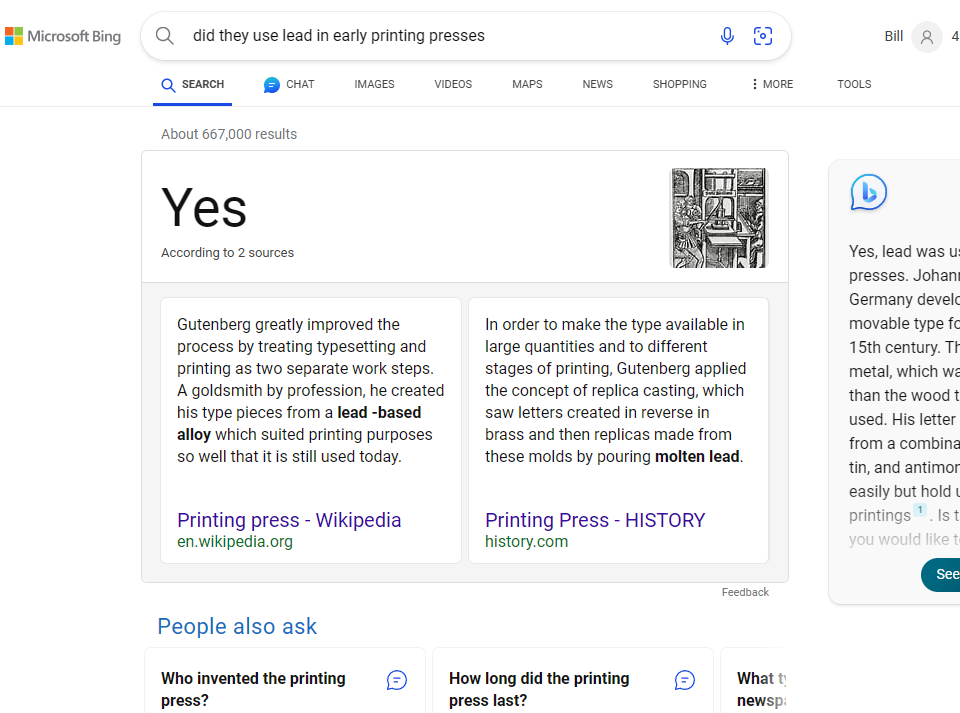
It’s nice when technology can be confident about the information it presents!
The history reports that Gutenberg was a goldsmith. I suspect that he if couldn’t use lead or an alloy of lead, he would be able to find other alloys that would meet his needs. He wouldn’t have been delayed much. (But obtaining an alternative might have been more expensive.)
Looking deeper, I can see that my understanding of lead’s history is pretty limited. There have been many other uses of the metal. Even modern plumbing has used lead as Flint, Michigan, discovered. I even forgot about an everyday modern technology, the lead-acid battery.
Answering the question what the world would be like would needs an in-depth study of history beyond an initial couple of ideas that first come to mind. It would be a fun thought experiment!
 W. Smith