To help staff celebrate Independence Day this week, the New Yorker is publishing a double issue, the July 8 & 15 2024 issue. I discovered this while I was updating my New Yorker fiction page. The page here is a growing index of the New Yorker short stories published each week. I try to extend the table one week forward and one week back every week. Right now, it goes from 2019-2024.
When I saw that it was a double issue, I was elated briefly, expecting that it would make it an easy two weeks to read all of the stories. Then I looked at the issue’s landing page and found that there are four stories for the issue–the first quadruple story issue in my index.
One of the stories is an unpublished story by E. L. Doctorow. His biographer said that the story “The Drummer Boy on Independence Day” was written in the 1950s but never published. The other three stories are “Kaho” written by Haruki Murakami, “Opening Theory” by Sally Rooney and “The Hadal Zone” by Annie Proulx.
The Hadal Zone is introduced with the blurb “Arwen’s last thought before sleep is that he is in a twisting cyclonic fall down through the ocean trench to become a compressed speck of matter. It feels good.” That’s a curious topic because, coincidentally, Randall Munroe published a video this month “What if you drained the oceans?” answering the question of what would happen if you would put a drain at the bottom of Challenger Deep. Munroe is known for the nerdy xkcd.com and has published several books including a series themed “What If?: Serious Scientific Answers to Absurd Hypothetical Questions” that was the inspiration for the video)

My “What if” question today is what if I would get a trap and capture the rabbit terrorizing my garden. I’ve got several tomato cages surrounded by fencing devoted to protecting the pepper plants. I planted some zinnia flowers and the rabbit really likes those too. I put a fence around some of them in the hope that a few will recover enough to produce flowers.
It is a pretty bold rabbit. Yesterday I was weeding in the evening, and it came out and watched me. …presumably waiting to find something to eat. I’m more vulnerable to him this year because I have more plants that are rabbit friendly. Peppers are definitely rabbit food. I knew that from last year but was wishful that they would be spared this year. Zinnias are rabbit food and last year’s sunflowers were gone before they got started. I’m glad tomatoes, zucchini and other squash vines are all crossed off in the rabbit diet guide.
I’m glad that I don’t have groundhogs. A cousin who lives in Pennsylvania has a group of groundhogs that have decimated her garden. They have a broader palate than a rabbit. My sister’s garden nemesis is crows which like to play and pull out all of the seedlings. Not to eat them, just to be irritating.
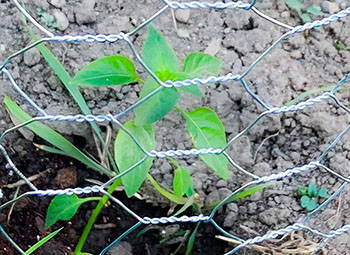
This is one of the plants from a couple weeks ago. I haven’t had any rabbit damage to the peppers now that they’ve got the fence around them. I was concerned that the rabbit might try to dig under the screen, but it’s not that motivated. There are a couple of plants that the rabbit didn’t see because they were hidden in the weeds. Now that they’re more visible, they’re more vulnerable to attack.
The New Yorker is a really solid magazine. I enjoy it every week. One of my projects last year was to make a book containing the comics organized by the artist’s name. It was fun making that. It could be a companion to the book the “New Yorker Encyclopedia of Cartoons”
Some artists are prolific contributors to the New Yorker, adding a comic every two or three issues. There are other artists who only publish one or two comics. It’s been a fun project to learn how to recognize the artists without needing to see the signature. Edward Koren, Roz Chast, William Haefeli, Sarah Akinterinwa, Liana Finck, P.C. Vey, Frank Cotham and Lars Kenseth all have unique styles. There are many other artists with their own characteristic styles that I haven’t listed.
I would like to be skilled enough as an artist to make a mashup of a couple of these artists’ styles (without the cheat of using an A.I. engine to help.)



 W. Smith