Drug: a definition

a. Something that has been purified.

b. Something that causes a characteristic change in an organism.

or c. Something that is chosen because it might cause a characteristic change.


Once a drug has been identified, there are some questions to ask:

  • What are its side effects?
  • How small of an amount can have an effect?
  • Does it interact with anything else?
  • Does chronic use of it cause problems? At what levels? What problems?
  • Does its usage affect other organisms?
  • What do you need to do to stop using it safely?
  • Can it cause acute harmful effects? At what levels? What effects?

A key point of this definition is that it does not specify that a drug must be a substance. Also a drug is defined by the change, not by its design.

I’ll come back to this definition once in a while to show how it can be a useful frame to think about important issues.

Silly Idea?

A red raspberry laying on a leafWhen the Bible talks about idols of gold and silver, does that have any application to us now?

Is our money a modern-day form of idol? I’ve heard people talk about the almighty dollar, so that makes me wonder.

We don’t make golden calves or set up altars to baal on the mountain tops, but it’s worth reviewing whether there are modern forms of idolatry just as sinful.

Original image: Untitled. By SeRg1o [Image license]

Censorship and the Courts

I was reading “Courts and Censorship” by Hans A. Linde[1].
A sculpture of blind justice holding a balance
He concludes: “When a constitutional prohibition is addressed to lawmakers, as the first amendment is, the role that it assigns to courts is the censorship of laws, not participation in government censorship of private expression. This, I suggest, is not an inappropriate relation between courts and censorship.”

What this means to me is that the courts can take an expression of law and cut out the offending part of the law, while it should not take an expression of ideas, speech or writing and cut out the offending part of the expression.

That’s just so poetic to me. Perhaps the first clause is a way to clarify the definition of judicial restraint.

Original image: Blind Justice 3. By Marc Treble [Image license]

[1] Linde, H. (1981). Courts and Censorship. Minnesota Law Review 66(1), 171-208.

New home

Hi

I’ve moved this blog to a new home. http://blog.sesquibits.com

Tomato tango

a photograph of grape tomatoes at varying shades of ripeness
Unripe grape tomatoes
Grape tomatoes among some vines

Know the “enemy”

It’s interesting to go to international English language newspapers.

With the Internet being borderless, you can learn things from different perspectives. Especially in war and conflict.

I’ve learned some of the enticements ISIS gives to get Taliban fighters to join it in Afghanistan. One is to “join the winning team.” Another is “the West hates Muslims.”

That Syrian media portrays Bashar al-Assad as hugely popular and well-loved.

When Russia was making bombing attacks in Syria, the Russian use of the Iranian airbase was controversial in the Iranian parliament. Iran has a constitutional provision that prohibits it from allowing foreign armies to deploy on Iranian soil.

Brazil is undergoing a political crisis far beyond the impeachment of the president. Due to corruption charges against many of its politicians.

The Palestinians are following proceedings in the International Criminal Court about crimes committed during the Gaza conflict by both sides. Israel rejects the court’s authority.

The local paper glossed over the players in a recent terrorist attack from Gaza. In Israel, a non-Hamas group claimed responsibility, but the paper said “Israel holds Hamas responsible….” so that the U.S. paper didn’t have to explain the messy details of the Gaza conflict where there are multiple actors.

The contrast between the Chinese culture and the U.S. culture was an interesting subtext of the Shanghai Daily. It seemed to me that even though China has over a billion people, the articles have a “small-town” feel to me. The local, small-town paper, The Star in DeKalb County Indiana has plenty of stories of conflict and disunity in the U.S.

Broken UPC

I’d never seen this before. On the package of soy milk on the right, the UPC was mis-printed and can’t be scanned. The black lines are all too wide.
two red cartons of soy milk with their bar codes

Things I’m grateful for

  • A beautiful sunrise
  • Unplanned renewals
  • Family heirlooms
  • Answers are provided
  • Community
  • A sturdy house
  • Toastmasters
  • DNA
  • Wisdom

Imagination Cuts Delusion

Jon Kabat-Zinn describes how people are trapped in a cycle of fear, hatred and delusion. If you look at front page news stories, you can usually find one or more of them very close to the surface.

clouds with a ladder leading to one of themIf these three are negative qualities, there must be counteracting positive qualities. There are obvious candidates like love to counteract hate, but I don’t think love has been very effective. Fear can feed hate and love has no power over that mixture.

In my past couple of blog posts, I’ve described the three qualities as elements of a game reminiscent of rock, paper, scissors. I claim that trust covers fear and curiosity smashes hatred. These pairs of spiritual qualities are mutually exclusive. They cannot exist together.

It is challenging to find the third element of a celestial elixir to replace the last element of delusion. One idea is understanding, another is knowledge. The one I like best is imagination, but none of these three are mutually exclusive to delusion.

A delusion is a fixed idea that stands up despite evidence to the contrary. The mind grabs onto a thought and runs with it. Paranoia which is supported by fear and prejudice that is fed by hatred are two of the strongest delusions. Since they’re both based on the other parts of the trio: fear and hate, it’s understandable that they have such power.

Consider whether imagination cuts delusion. A fixed idea is like the flowing of a river, it has deep banks and a straight path. Imagination looks around the landscape and can see that there are quiet pools and beautiful tributaries. A clump of dead leaves that follows the natural route will never find these bounties..

The application of spiritual principles takes work. If they were easy, people could accept and act on them continuously. Trust, Curiosity and Imagination are three qualities that are positive spiritual principles. They may not be spoken of in the church, synagogue or mosque, but they are still important.

Faith, hope, and love are necessary utensils for the spiritual kitchen. Trust, Curiosity and Imagination are like spices to keep in the cupboard. They can help everyone share spiritual feasts.

Original image: Access to Cloud / Ladder to Heaven. By FutUndBeidl [Image license]

Curiosity Smashes Hate

Just as Trust can cover Fear, in the spiritual game of rock paper scissors, Curiosity smashes Hate.

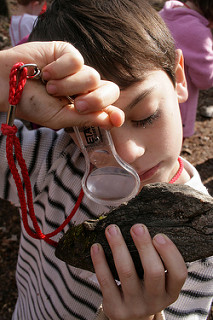
I was thinking about the cliche of love being the opposite of hate, and that seems silly. Why is there the expression of a love-hate relationship if they can destroy each other?A boy looking at a rock through a magnifying glass
If you hate someone, you want them to be out of your life. You don’t want to think about them, you don’t want to know how they’re feeling. It doesn’t bother you in the least that they had a bad day at work or a good game of golf.

If you are curious about someone, you want to know more. You may disagree, like I disagree with my friends that are pro 2nd amendment. But, if I’m curious I can ask to understand what that actually means to them. I can find the reason that it’s important. I can’t hate them for anything if I’m willing to ask them what the 2nd amendment means to them on a personal level.

Another way Curiosity smashes Hate is that it is respectful which builds trust. The triad that starts with Trust and Curiosity support each other.

Someone you hate, you’re likely to fear. Someone you are curious about, you can accept when they’re honest and it becomes a trust building exercise. With that trust, building curiosity is more successful.

Curiosity is different than inquisitiveness. Inquisitive wants to figure something out. It is limited and only has certain goals. Inquisitiveness can be mocking or insincere. If you’re curious, you truly want to learn something about the person.

I talked to a friend last night and learned a lot of interesting things. She shared with me some stuff and as our trust built, I shared some stuff that she was curious about and I was fearful of sharing with anyone for it being misused. But, as our trust built, the curiosity was rewarded and we talked about things I’d never shared before.

Hate is destructive and black. Curiosity is like shining a flashlight in cave: there’s always more to see. There’s always the next surprise to find. Children are curious, children don’t hate until they are corrupted by others.

Curiosity can become a game and lead to all sorts of joy… a sort of communion between two people so that they can see each other’s humanity and be refreshed by the life spirit within each of them.

Original image: rock hound. By woodleywonderworks [Image license]